By 2026, “WhatsApp + voice” is no longer a nice add-on. It is the default frontline for customers who expect to move from a missed call to a chat thread, from a WhatsApp inquiry to a live agent, and back again without repeating themselves. The centers that win are not the ones with the most channels. They are the ones where routing, data, and AI are designed so every contact feels like one continuous conversation, not a series of disconnected tickets.
1. Why WhatsApp + Voice Is the New Default Entry Point
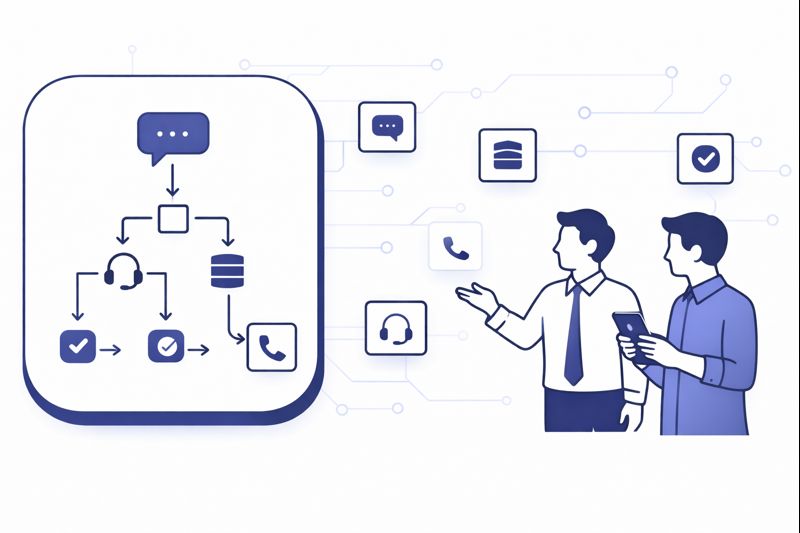
In many regions, especially LATAM, EMEA and GCC, WhatsApp has silently become the “front door” to your contact center. Customers start there because it feels low-friction: they can ask a question while commuting, share screenshots, or follow up on a previous issue without calling the IVR. Voice is still where high-stakes, emotional or complex issues land. The play is not to pick one over the other. It is to design your contact center platform so WhatsApp and voice share routing logic, context, and analytics.
Think about your current journeys. A missed inbound call that dies in voicemail is a wasted opportunity. A WhatsApp thread that gets stuck with a bot is a churn risk. In a 2026 stack, both events are simply triggers. Missed call → instant WhatsApp follow-up. WhatsApp escalation → voice queue with full history. When you join channels like this, you reduce abandonment, increase first contact resolution, and give agents the full story before they say “hello.”
2. Core Architecture: One Profile, Two Channels, Shared Brain
To make WhatsApp + voice feel like one surface, you need a single customer profile that sits above channels. That profile should store identifiers (phone, WhatsApp ID, account numbers), conversation history, consent flags, and preferences. Your cloud platform then attaches both calls and chats to this record, instead of treating them as unrelated tickets. This is where a modern, cloud-first downtime-resistant call center core becomes non-negotiable.
Technically, you want three layers to play nicely: telephony for voice, the WhatsApp BSP/API, and your CRM/helpdesk. CTI and messaging integrations glue them together so routing decisions can read from CRM data and conversation context. Teams that treat this as an “integration project” rather than an add-on channel consistently outperform; they map journeys, events, and triggers up front, often guided by frameworks like integration catalog blueprints instead of one-off webhooks.
| Trigger | Routing Logic | Destination | Primary Goal |
|---|---|---|---|
| Missed inbound call | If WhatsApp opt-in = yes | Automated WhatsApp message + queue callback | Save abandoned calls and capture intent |
| IVR overflow / long wait | Offer “switch to WhatsApp” option | WhatsApp queue with context | Reduce frustration and queue time |
| New WhatsApp inbound | Identify account → check priority | Bot triage → live chat or voice transfer | Deflect simple issues, route complex ones |
| WhatsApp “call me” request | Check best time / language | Outbound dialer with scheduled callback | Increase successful connects and CSAT |
| Post-call follow-up | Completed call + open action | Automated WhatsApp summary + link | Confirm next steps and reduce repeat calls |
| Order / ticket update | System status change | Proactive WhatsApp notification | Prevent “Where is my order?” calls |
| High-risk transaction | Risk score above threshold | Immediate voice call + WhatsApp confirmation | Secure verification and fraud prevention |
| Bot fails / low confidence | Confidence score below threshold | Escalate to voice agent with full transcript | Avoid loops and “sorry I didn’t get that” rage |
| VIP customer contact | Segment tag = VIP | Priority queue for voice and WhatsApp | Shorter wait and dedicated handling |
| Renewal reminder | Upcoming expiry date | WhatsApp sequence + optional outbound call | Increase retention with minimal agent effort |
| Abandoned cart / application | No completion within X hours | WhatsApp nudge + “talk to agent” button | Recover revenue with blended channels |
| SLA breach risk | Ticket aging + high sentiment risk | Voice outreach plus WhatsApp apology/update | Save at-risk customers before they churn |
| Peak volume event | Spikes detected by analytics | Dynamic rules favour WhatsApp triage | Protect voice queues during surges |
| Compliance disclosure needed | Specific product or region | Scripted voice + written WhatsApp confirmation | Create an auditable disclosure trail |
| Customer feedback request | Closed interaction | Short WhatsApp CSAT/NPS survey | Improve survey completion rates |
3. Inbound Patterns: Designing Flows That Respect Customer Intent
Inbound is where customers tell you how they want to talk. Your job is to steer them without fighting that preference. When WhatsApp is the first touch, use bots to collect structured data (order ID, account number, reason) and then decide whether to resolve in-channel or escalate. That escalation might be to another WhatsApp queue or straight to voice, depending on risk, value and complexity. This kind of logic depends on tight integration between channels and CRM, which is why checklists like the CRM–contact center integration blueprint are so valuable.
On the voice side, your IVR should treat WhatsApp as a peer, not a rival. Instead of making callers “hang up and message us,” offer direct channel-shift: “Press 1 to stay on the line, 2 to continue this conversation on WhatsApp.” When they choose 2, open the thread with a message that includes the same menu or queue selection they just made. This lowers abandonment and lets customers move to an asynchronous flow when they cannot wait on hold. Behind the scenes, both channels feed the same routing engine and reporting layer.
4. Outbound and Re-Engagement: Using WhatsApp to Protect Voice Capacity
Outbound teams often burn voice capacity on tasks that do not require a live call: reminders, low-risk verifications, simple upsells. WhatsApp is perfect for these, as long as you respect opt-in rules and template policies. A smart outbound design uses the dialer for high-value connects and WhatsApp for everything that benefits from asynchronous handling. When calls are needed, they are usually scheduled callbacks triggered from the chat, which increases answer rates and shortens handle time compared to cold dial attempts, similar to how high-performing dialer teams structure predictive outreach playbooks.
In revenue operations, think in terms of sequences: WhatsApp nudges with clear CTAs, followed by a call only if the customer engages but does not complete. In service, lean on WhatsApp for “we’re on it” updates, links to self-service, and quick approvals. This protects your voice queues for complex or emotional issues where live conversation adds real value. As your stack matures, AI can help decide which channel is best for each contact based on past behaviour and segment, using the same data discipline you’d apply in integration-first routing strategies.
5. Industry Playbooks: Banking, E-commerce, Healthcare, and GCC Markets
Different industries need different mixes of WhatsApp and voice. Banking and fintech care about security, audit trails and fraud prevention. Here, WhatsApp is ideal for one-time passwords, transaction alerts and low-risk inquiries, while voice handles KYC, disputes and complex advice. Many GCC institutions also want Arabic-first journeys with bilingual fallback, which is where stacks designed for Arabic language analytics and routing stand out.
E-commerce and retail live and die by volume and peaks. WISMO, returns and promo questions are perfect for WhatsApp-first flows, with bots handling common scenarios and agents stepping in when policy or empathy is required. For healthcare, regulations are stricter: WhatsApp can handle scheduling reminders, basic triage questions and paperwork nudges, while voice is reserved for clinical conversations or sensitive outcomes. Regardless of vertical, your feature roadmap should align with practical ROI evidence, not vanity features — shortlists like ROI-ranked feature reports are useful guardrails.
6. AI’s Role: Triage, Coaching, and 100% QA Across Channels
Once WhatsApp and voice share a spine, AI becomes the multiplier. At the front door, AI can classify intents and sentiment in both modalities, using the same models that power self-service and routing. In the middle of the conversation, agent assist tools surface answers, macros and next-best actions, which is especially powerful for multilingual markets where scripted answers and policy language matter. This is the same “second brain” pattern that underpins AI-led labour reduction playbooks, now applied across voice and WhatsApp together.
At the back, QA and analytics ingest transcripts and message logs from every channel. With the right scorecards and calibration, AI can score 100% of interactions for compliance, empathy, process adherence and outcome, not just random samples. Teams that modernise their quality programs around AI-first QA engines and updated QA templates are the ones that catch issues early: broken flows, agents misusing WhatsApp, or scripts that create friction when customers jump from chat to call.
7. Implementation Roadmap: 90 Days to a WhatsApp + Voice Pilot
Day 1–30: Map your current journeys, volumes and pain points. Where do customers already use WhatsApp informally. Where do calls spike. Which use cases are best candidates for hybrid flows. In parallel, confirm that your core platform can handle true omnichannel routing, not just disconnected add-ons. If needed, this is the time to consider moving to a more flexible contact center platform tier rather than bolting WhatsApp onto an ageing ACD.
Day 31–60: Wire integrations. Connect WhatsApp, telephony, CRM and ticketing with a clean data model. Define 5–10 routing patterns from the table above and implement them for one region or business line. Add basic AI where the risk is low: intent classification, FAQ bots, and summarisation. Keep humans firmly in the loop. Use pricing and ROI tools like contact center cost calculators so every pilot metric ties back to either cost or revenue.
Day 61–90: Expand the pilot to more intents and queues. Introduce real-time coaching on complex calls and tighten QA, using omnichannel analytics to see where journeys break. This is also when you harden compliance: review opt-in flows, consent scripts and retention rules based on guidance like modern pricing and packaging approaches and integration-focused buyer’s guides. By the end of day 90, you should have a repeatable playbook you can roll out country by country or brand by brand.