Most inbound call centers still brag about “ACD configuration” when customers judge them on one thing: whether the problem is actually solved on the first contact without friction. You can have perfect queues and IVRs and still bleed repeat calls, churn, and low CSAT because the stack was designed for load distribution, not outcome delivery. In 2026, winning inbound operations treat ACD as plumbing and optimize the layers above it: routing logic, knowledge, agent assist, QA, and feedback loops. This guide shows you how to design inbound call center software and processes around FCR and CSAT from day one, not as afterthoughts.
1. Why Traditional Inbound Centers Underperform on FCR and CSAT
Classic inbound design starts with “Where do we point the call?” rather than “What does the customer need to accomplish?” Teams obsess over IVR menus, skill groups and music on hold, then wonder why repeat contacts and low satisfaction persist. The ACD did its job – it distributed calls – but nothing above it was built to remove effort from the caller’s journey. Knowledge is scattered, policies are rigid, and agents have limited authority to resolve edge cases on the spot.
The second failure pattern is measuring volume instead of resolution. Dashboards show average speed of answer and handle time, while FCR and sentiment are either approximated or ignored. Without outcome-first analytics like the ones mapped in advanced call center metric frameworks, leadership optimizes for shorter calls instead of fewer calls. That’s how centers become efficient at making people call back twice.
2. Architecture for Outcome-First Inbound: Layers Above the ACD
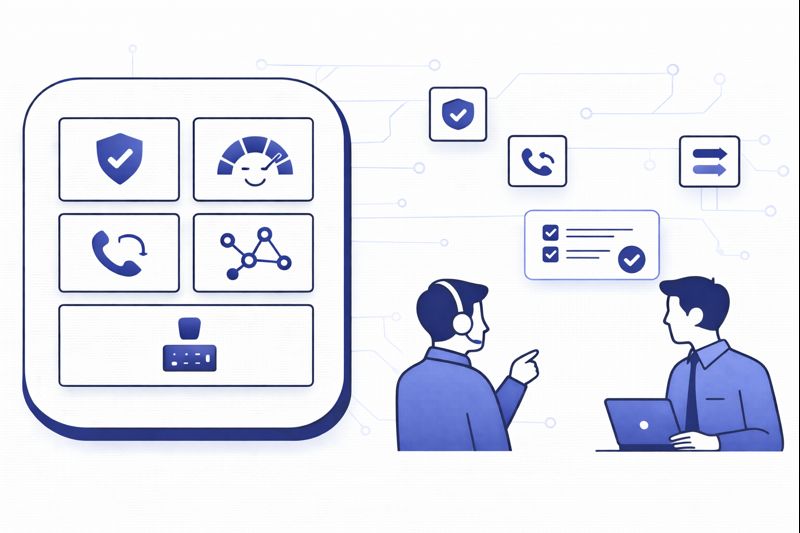
To design for FCR and CSAT, treat your inbound stack as five coordinated layers: access & entry (numbers, IVR, call-back), routing & capacity, agent desktop & knowledge, assist & automation, and analytics & QA. ACD sits inside the routing layer; everything else must be orchestrated around it. Start by standardizing on a cloud platform that can handle global routing, elastic channels and rich integrations, similar to the architectures described in modern contact center platform overviews.
Resist the temptation to custom-build every component. Use APIs and pre-built integrations where possible to keep your “plumbing” boring and robust, like the stacks outlined in integration-first call center blueprints. Your real differentiation comes from how you configure journeys, not how cleverly you reinvent call distribution.
| Layer | Decision | Impact on FCR | Owner |
|---|---|---|---|
| Entry | Offer call-back vs hold for key queues | Reduces abandonment and frustration | CX Lead |
| Entry | Group numbers by intent, not department | Cuts misroutes before they start | Product / Ops |
| IVR | Use 3–5 simple options, fewer “trees” | Shorter time to right queue | CX Design |
| Routing | Route by intent and value, not just skill | Puts complex calls with best agents | Workforce |
| Routing | Predictive routing using history | Increases resolution odds on first try | Data / AI |
| Desktop | Single view of customer + interactions | Stops agents from “flying blind” | IT / Systems |
| Desktop | Integrated knowledge + macros | Reduces transfers and hold time | Knowledge Lead |
| Policy | Empowerments (refunds, exceptions) | Prevents “I’ll escalate and call back” | CX / Legal |
| Assist | Real-time coaching + next best action | Improves outcomes per conversation | QA / Training |
| QA | Scoring tied to FCR and sentiment | Aligns behavior with outcomes | Quality Lead |
| Analytics | Track repeat contacts by reason | Reveals process and product defects | Analytics |
| Security | Recording + redaction policies | Keeps QA scalable and compliant | Compliance |
| Feedback | Close-loop on low CSAT cases | Turns “bad calls” into saves | CX Recovery |
| Change | Monthly IVR/routing reviews | Prevents design from going stale | Operations |
| People | Hiring profiles for complex inbound | Raises problem-solving baseline | HR / CX |
3. Routing Logic: From Queue Thinking to Resolution Thinking
Resolution-first routing starts with understanding why people call. Use historical data, transcripts and tags to cluster your top 20–30 inbound reasons, then group them into intent families: “I can’t use it,” “I can’t pay,” “I don’t understand my bill,” “I want to cancel,” and so on. Build IVR wordings, menu options and digital entry points around those intents, not internal teams. This is the same mindset behind predictive routing strategies that prioritize outcomes over raw speed.
Next, define explicit routing preferences for each intent: best team, best language, best seniority level. High-value, high-risk calls – like cancellations or VIP complaints – should jump queues or land with more experienced agents. Lower-stakes inquiries can route to standard queues or self-service flows. Over time, layer on routing models that account for customer history, sentiment trends and past resolutions, borrowing from the predictive approaches described in modern cloud telephony architectures that prioritize both resilience and intelligence.
4. Agent Desktop, Knowledge and AI Assist: Where FCR Really Lives
The moment the call connects, everything shifts to the agent desktop. If your agents are juggling three systems and manually searching for articles, FCR will always lag. Aim for a unified interface that brings customer profile, interaction history, open tickets, and account context into one view – similar to how robust stacks consolidate data in customer-loss prevention contact center designs. Reduce clicks, not just screens; agents should be able to resolve 80% of common issues without leaving the main workspace.
Layer AI directly into that desktop instead of forcing agents to alt-tab into separate tools. Real-time coaching platforms like those described in AI-assisted call center guides can suggest responses, summarize policies, and surface next-best actions based on the live conversation. For complex flows (refunds, upgrades, exceptions), use guided workflows that adapt based on customer inputs and system data. The goal is to move agents from “let me check with my supervisor” to “here’s what I can do for you right now” in as many scenarios as possible.
5. QA, Analytics and Feedback Loops Tied Directly to FCR & CSAT
Traditional QA listens to a tiny sample of calls and scores them on generic behaviors. That doesn’t scale, and it doesn’t reliably improve FCR. Instead, use AI-powered monitoring to review 100% of inbound conversations for key signals: repeat-contact indicators, unresolved intents, compliance gaps and emotional cues. Approaches like those in AI-first QA deployments let you spot systemic issues in days, not quarters, and tie them to precise call drivers.
From there, redesign your scorecards to reward resolution and clarity over speed and scripts. Templates like those in modern QA scorecard frameworks combine soft skills, policy adherence, and measurable outcomes (resolved vs unresolved, callbacks requested, sentiment shift). Connect these scores to coaching programs, not just performance management. Every low-performing pattern – by agent, queue, or intent – should trigger training or process fixes. Capture post-call CSAT in-channel and link it back to the exact call and agent so feedback is specific and actionable.
6. Leveraging AI and Automation Without Killing the Experience
AI in inbound call centers works best as an amplifier, not a gatekeeper. Start with tasks that clearly slow FCR: authentication, account lookups, status checks and documentation. Use speech recognition and natural language understanding to extract intent and surface the right workflow, but always provide a clear route to a human if the bot struggles. This balanced approach mirrors the AI deployment strategies used in cost-reduction AI toolkits where savings never come at the expense of core customer promises.
On the QA and coaching side, combine AI-generated insights with human judgment. Let algorithms flag risky or unresolved calls and propose coaching themes, while experienced supervisors refine those into specific actions. Full-coverage AI monitoring like that in 100% QA coverage models gives you scale; human coaches give you nuance. Together, they create a continuous improvement loop that steadily raises FCR and CSAT without burning out your team.
7. 90-Day Roadmap to Redesign Inbound Around FCR & CSAT
Days 1–30: Diagnose and reframe the problem. Pull three months of inbound data and identify top contact reasons, repeat-contact rates, and FCR by queue. Use frameworks similar to ROI-ranked feature audits to inventory which capabilities you actually use today. Listen to a curated set of calls where customers had to call back and map exactly where the first interaction failed – misroute, policy, system, knowledge or behavior.
Days 31–60: Redesign routing, desktop and policies. Rebuild IVR options around intent families and simplify menu trees. Introduce or refine skills and routing rules so high-value or complex calls land with your best-equipped agents, drawing on lessons from modern telephony evolution guides. In parallel, streamline the agent desktop and ensure key systems (CRM, billing, logistics) are integrated, similar to setups in integration-focused inbound stacks. Update empowerment policies for your top 10 call drivers so frontline teams can resolve more on the spot.
Days 61–90: Deploy AI, revamp QA and hard-wire feedback. Roll out real-time coaching on your most critical queues using patterns from AI-first quality programs. Launch 100% interaction monitoring for FCR indicators, and rebuild scorecards to weight resolution and sentiment over handle time. Implement CSAT surveys that trigger automatically after calls and link results to transcripts and agents. Finally, establish weekly FCR/CSAT reviews where product, operations and CX jointly own actions, not just the call center.
8. FAQ: Building FCR-First Inbound Call Center Software in 2026
Is FCR always more important than handling time?
How do I measure FCR accurately across channels?
Can small teams realistically use AI for inbound without huge budgets?
What’s the role of call recording and compliance in FCR-focused design?
Where should I start if my current inbound stack is mostly legacy ACD?
Inbound call center software in 2026 isn’t “better ACD.” It’s a stack where routing, desktops, policies, AI and QA all pull in the same direction: solve the problem once, clearly, and with as little friction as possible. When you design every layer around FCR and CSAT – and let the ACD quietly do its job in the background – you build the kind of operation customers remember for the right reasons.