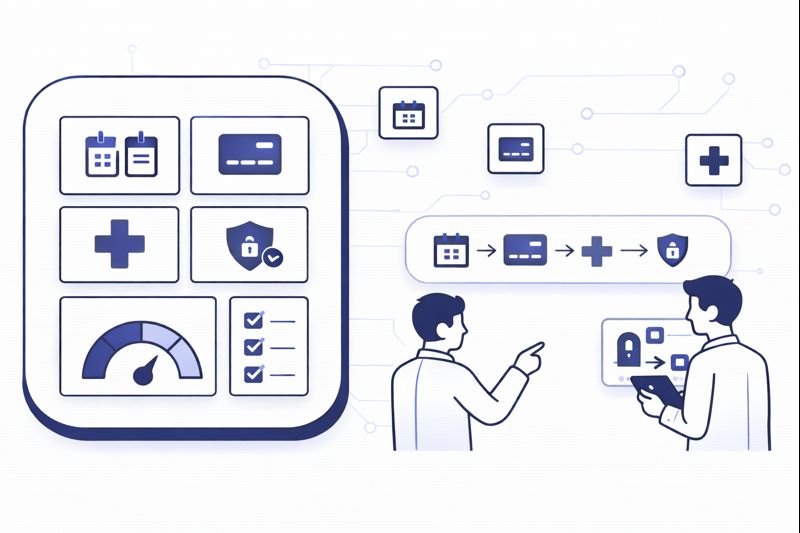
Healthcare contact centers are no longer “reception with headsets.” They sit in the middle of referrals, appointments, prescriptions, billing, insurance, and telehealth. Every call or message carries PHI, emotion, and revenue risk. The tech stack you choose in 2026 has to protect patient data, coordinate scheduling across channels, and move money without friction or compliance anxiety. This guide breaks down how to design that stack so it feels modern for patients and safe for compliance and finance teams.
1. Why Healthcare Contact Centers Need a Different Stack
Generic call center software is built around speed and efficiency. Healthcare contact centers add a few constraints that change the entire design: PHI in every interaction, multiple systems of record, strict consent rules, and high stakes outcomes if something slips. The stack has to route calls and messages like any other contact center, but it also has to respect HIPAA, insurance rules, and internal governance patterns. That is why many organizations start from a resilient cloud foundation similar to modern cloud contact center architectures and then layer healthcare specific workflows on top.
Another difference is channel mix. Voice still dominates for complex issues, yet chat, portals, WhatsApp and SMS are now built into care journeys. Patients expect confirmation links, reminders, and payment prompts to land in the channels they already use. The most effective healthcare contact centers mirror omnichannel designs used in other industries, like those described in cross vertical contact center use case playbooks, while keeping the clinical record as the single source of truth.
2. HIPAA First Architecture and Data Handling
HIPAA compliance is not a feature you toggle on after go live. It shapes which platforms you can use, where data can live, and how you handle recordings, transcripts and analytics. At minimum, your contact center platform must support encryption, access controls, audit logs, and a Business Associate Agreement. Many teams now align their policies with frameworks like call recording compliance guides for HIPAA and global standards so voice and screen content is handled correctly at each step.
Architecturally, PHI should flow through as few systems as possible. Call controls can live in the contact center user interface while clinical details load from the EMR or practice management system on demand. That is why healthcare operations lean heavily on carefully designed integrations, taking cues from references such as call center integration buyer guides and checklists. The goal is simple: agents see what they need, while PHI stays inside systems that are already governed and audited.
| Step | Patient Scenario | Systems Involved | Key Contact Center KPI |
|---|---|---|---|
| 1. Intake | New patient calls to register | Contact center, CRM, EMR | Handle time, first contact resolution |
| 2. Triage | Nurse triage or symptom routing | ACD, clinical triage app | Queue time, safety escalations |
| 3. Eligibility | Insurance verification | Billing system, payer portal | First pass eligibility rate |
| 4. Appointment Booking | Book in person or telehealth slot | Scheduling app, EMR calendar | First contact booking rate |
| 5. Pre Visit Reminders | SMS or voice reminders | Outbound dialer, SMS platform | No show reduction |
| 6. Digital Check In | Update demographics, forms | Portal, EMR, payment gateway | Self service completion rate |
| 7. On Day Support | Directions, reschedule, tech help | Contact center, maps, telehealth app | Abandon rate, satisfaction |
| 8. Post Visit Follow Up | Lab, imaging, care plan calls | Dialer, EMR tasks | Completion of follow up attempts |
| 9. Payment Reminder | Outstanding balance notification | Billing, IVR payments | Self service payment rate |
| 10. Refund or Dispute | Patient questions bill | Billing CRM, knowledge base | Time to resolution |
| 11. Pharmacy Coordination | Questions about prescriptions | EMR, pharmacy portal | Transfer accuracy, call backs |
| 12. Referral Management | Specialist or external provider | Referral system, EMR | Referral closure rate |
| 13. Outreach Campaigns | Screenings, vaccines, recalls | Campaign dialer, CRM | Reach and conversion rate |
| 14. Complaints and Grievances | Formal complaint intake | Case management, QA | Closure time, repeat complaints |
| 15. Retention and Experience | NPS and patient experience calls | Survey tools, analytics | Response rate, satisfaction score |
3. Scheduling and Capacity: The Heart of Patient Experience
Scheduling is where patients feel how modern your contact center really is. If agents have to bounce between screens, call back for insurance verification, or manually coordinate referrals, trust drops quickly. Leading organizations treat scheduling as a shared workflow between the contact center, EMR, and any digital front door tools. They often lean on integration patterns used in structured CRM and contact center integration checklists so caller context, eligibility and provider calendars are visible inside one guided script.
Modern dialers and outbound tools can also support scheduling. For example, proactive outreach campaigns that invite high risk patients to screenings can be orchestrated through the same engines that drive revenue campaigns in other sectors, adapted from designs like predictive dialing strategy libraries. The difference is intent: instead of closing a sale, you are closing care gaps with the same discipline around pacing, retries and consent.
4. Payment and Revenue Cycle Flows Inside the Contact Center
Billing experiences often shape how patients remember their care. If your contact center can explain charges clearly, offer flexible payment options, and accept payments securely without long transfers, both cash flow and satisfaction improve. That requires tight integration between your contact center platform, payment gateways and billing systems, similar in structure to the integration patterns used in telephony plus CRM integration benchmarks, but tuned for financial data.
Many organizations now push more of the payment journey into self service IVR and digital links. Patients who call about a balance can receive secure payment links via SMS, or pay inside an IVR without speaking card details to an agent. The contact center still plays a role for disputes and complex scenarios, yet the bulk of routine payments can flow through automation. When combined with the kind of cloud telephony resilience described in zero downtime telephony architectures, payment experiences become reliable instead of fragile.
5. AI, QA and Analytics Without Losing the Human Element
AI in healthcare contact centers must support people, not replace clinical judgment. The quickest wins come from summarisation, intent detection, and next best action prompts. Agents and nurses can focus on the conversation while the system proposes ICD or CPT codes, referral workflows, or follow up tasks. This is similar to how AI tools reduce labour in other contact center contexts, as documented in AI cost reduction case studies, but tuned for care rather than commerce.
Quality programs are changing as well. Instead of reviewing a small slice of calls each month, healthcare operations increasingly adopt AI assisted QA that scores every interaction on compliance, empathy and process adherence. Analysts then focus on coaching rather than hunting for issues. Playbooks like QA scorecard templates and AI usage guides show how to design rubrics and combine manual and automated review safely. The result is better visibility into clinical conversations without drowning staff in admin work.
6. Implementation Blueprint: From Legacy Phones to Modern Healthcare Contact Center
Moving from legacy PBX and ad hoc call handling to a fully integrated healthcare contact center can feel risky. The risk can be managed if you treat it as a structured migration rather than a single cutover. Many organizations follow staged patterns similar to cloud versus on prem TCO roadmaps and CIO focused migration guides. Start by stabilising telephony and routing in one cloud layer, then integrate EMR, scheduling and billing step by step.
A typical journey starts with one line of business, for example centralised scheduling. You migrate that team to cloud telephony, add EMR integration, and refine scripts and flows. Once metrics look better than the old setup, you expand to nurse triage or billing, then add outbound campaigns. Throughout this journey, the contact center team should collaborate closely with compliance and clinical leaders. That partnership is what keeps the design safe, reduces rework, and positions the contact center as an enabler of broader digital health goals rather than a standalone project.
7. FAQ: Healthcare Contact Center Software in 2026
What makes healthcare contact center software different from generic solutions?
How should we handle call recording and transcripts under HIPAA?
Where does AI add the most value in healthcare contact centers?
How do we design scheduling workflows that respect clinical priorities?
How can we measure success after modernising our healthcare contact center?
Healthcare contact center software in 2026 sits at the intersection of clinical care, patient experience and revenue protection. When you design it around HIPAA first architecture, integrated scheduling, clear payment flows and AI supported QA, the contact center stops being a cost center and starts acting like a digital front door that patients trust and leaders rely on.