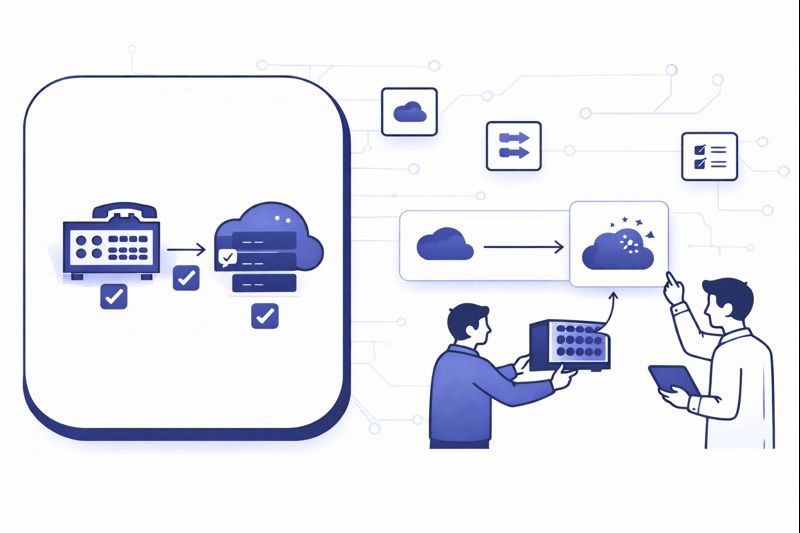
Every enterprise contact center that still runs on a legacy ACD feels the same pressure from three directions at once: customers expect instant, omnichannel support, regulators expect crystal clear recording and data control, and finance expects lower cost per contact. Old ACDs were built for stable volumes, fixed locations, and voice-only queues. 2026 stacks are built for unpredictable demand, remote agents, and AI on every interaction. This guide gives you a practical modernization blueprint that takes you from hardware-bound ACD to a cloud and AI powered contact center without burning your teams or your customers.
1. Why Legacy ACDs Are Now a Structural Liability
Legacy ACD platforms were designed for a world where calls enter through a handful of toll free numbers, route through fixed trunks, and land on agents sitting in the same building. In that world, static skills, manual IVR changes and overnight batch reports were acceptable. Today, the same architecture blocks you from remote hiring, omnichannel routing, rapid experimentation and AI. It also makes resilience harder, as explored in modern zero downtime contact center designs that assume outages will happen and design around them.
You also inherit hidden cost from every year you postpone modernization. Hardware support contracts, proprietary licenses and specialist engineers quietly consume budget that could fund your migration. When you compare fully loaded costs across three years, cloud models often win once you factor in maintenance and outage risk, as detailed in cloud versus on prem TCO breakdowns. The question is no longer “if” you move your ACD to cloud and AI, but “how you do it without destabilizing operations.”
2. Baseline Assessment: Inventory, Constraints and Non Negotiables
Modernization starts with a brutally honest inventory. List every entry point, queue, IVR tree, trunk, recording system, wallboard, WFM tool and integration that touches the current ACD. Map which business units own which flows and where you rely on custom code or vendor specific scripting. This is where many enterprises discover undocumented logic that nobody wants to touch. That discovery is valuable, because it tells you which flows should be simplified or retired instead of migrated.
Next, write down your non negotiables. For many enterprises, this includes uptime, compliance and specific routing behaviors for high value segments. Use structured frameworks like feature versus ROI analyses for cloud contact centers to decide which capabilities must exist on day one in the new stack and which can wait. This prevents you from chasing every shiny feature while missing the core items that actually keep your operation safe.
| Legacy Element | Common Pain | Cloud + AI Target | Modernization Tactic |
|---|---|---|---|
| On premise ACD chassis | Hardware failures, long upgrade cycles | Multi tenant cloud routing fabric | Lift flows into a cloud platform before decommissioning racks |
| Siloed IVR scripts | Hard coded menus, no experimentation | Visual IVR and conversational IVR | Rebuild journeys using low code editors |
| TDM trunks and PRI lines | Inflexible capacity, location bound | SIP and cloud carrier network | Introduce SIP alongside legacy per SIP evolution patterns |
| On premise PBX | Desk phone dependency, limited remote work | Cloud PBX and softphone clients | Follow phased changeover from PBX migration blueprints |
| Custom CTI connectors | Fragile integrations to CRM | Native CTI and call center integrations | Move toward standardized models from integration buyer guides |
| Batch reporting | Yesterday’s data, limited drill down | Real time analytics with AI insights | Adopt architectures similar to AI analytics rollouts |
| Manual QA sampling | Tiny fraction of calls reviewed | AI augmented, full coverage QA | Move towards methods from AI first QA programs |
| Fixed seat contact centers | Inflexible staffing, no surge capacity | Hybrid and remote ready model | Adopt multi location models similar to distributed VoIP deployments |
| Hard coded routing rules | Difficult changes, no personalisation | Dynamic and predictive routing | Incorporate routing tactics described in predictive routing playbooks |
| Local storage of recordings | Capacity limits, compliance risk | Cloud recording with policy engines | Align with regional regulations from recording compliance frameworks |
3. Target State Architecture: Cloud ACD with AI as a Fabric
A modern contact center platform is not just “ACD in the cloud.” It is a routing fabric that spans voice, chat, messaging, email and social, with AI and analytics stitched through every layer. Calls and messages land in an omnichannel queue with profiles enriched from your CRM, then AI helps classify intent, suggest next best actions and capture structured outcomes. This pattern is explored across future focused telephony pieces like cloud based ACD replacements that remove outage risk and cloud telephony evolution guides.
In that target state, your ACD logic becomes configuration instead of code. Business teams can change IVR prompts, routing rules and hours without opening tickets with telecom engineers. AI augments agents with real time hints and post call summaries rather than acting as a black box that replaces them. Integrations move from brittle one offs to standardized connectors that resemble the patterns in integration catalogs for contact centers. The architectural win is less about a specific vendor name and more about decoupling your experience layer from physical infrastructure.
4. Migration Strategy: Hybrid, Not Big Bang
The riskiest move in contact center modernization is a single cutover weekend where thousands of calls suddenly move to a new ACD. Instead, treat modernization as a hybrid period where both legacy and cloud stacks coexist. Start with low risk flows: internal helpdesk, a regional queue, or a specific product line. Move numbers or SIP routing for that slice into the new platform, then observe stability, agent experience and metrics for several weeks before scaling further.
This is exactly how successful PBX and ACD migrations play out in practice, as documented in survival guides for legacy phone system migration and blueprints that minimise downtime during PBX changeovers. You sequence moves so that you always have a fall back path. For high risk lines, you might keep carrier routing pointed at the legacy ACD while running dual delivery into cloud for monitoring and QA, then only flip traffic fully once the new flow has proven itself.
5. Data, Integrations and AI: Turning Conversations into Intelligence
A modern ACD is only as valuable as the data it produces and consumes. That starts with clean, reliable logging of every contact into your CRM, helpdesk or data warehouse. Each call should carry metadata for channel, queue, outcome and customer attributes. Integration checklists like CRM and call center integration guides are useful here because they force you to define field mappings and failure handling rather than trusting default settings.
Once the plumbing is stable, AI becomes a multiplier. Real time transcription, sentiment detection and summarization can feed QA and coaching programs, similar to the models in AI quality monitoring blueprints. Analytics engines can classify reasons for contact, detect emerging issues and flag broken processes long before they surface as complaints. In multilingual regions such as GCC markets, you can also follow patterns from Arabic focused analytics deployments to ensure transcriptions and models respect local languages and dialects.
6. Workforce, QA and AI Coaching in the New Stack
New routing and IVR alone do not deliver modernization. You also have to modernize how you manage people. Start by revisiting your workforce management and shrinkage assumptions. Cloud first operations tend to support more flexible staffing patterns, including remote talent, which changes how you think about adherence. Metrics libraries like call center efficiency benchmarks can help you recalibrate targets when your agents no longer sit in a single building.
On the quality side, move away from purely manual sampling. Blended programs that combine AI scoring with human calibration, such as those described in AI ready QA scorecard frameworks, give you a path to full coverage without exploding analyst headcount. Real time coaching becomes practical when your platform supports whisper modes and AI hints, similar to the designs in real time coaching platforms. These capabilities are where cloud and AI move from infrastructure savings into visible experience gains.
7. Governance, Compliance and Vendor Risk Management
Replacing a legacy ACD changes your risk posture. You move from a world where most voice traffic and recordings live in your own racks to one where vendors handle large parts of the stack. That is not inherently riskier, but it demands formal governance. Start by mapping regulatory requirements for each region and industry you serve. Align your retention, masking and redaction policies with frameworks such as call recording and data compliance guides so legal and security teams sign off early.
Vendor selection should then look beyond feature sheets. Examine uptime history, data residency, encryption practices and exit paths. Migration and resale experiences documented in regulated market contact center case studies and GDPR aligned cloud center designs are useful patterns here. You want clear answers to questions like “how do we get our recordings and logs out” and “what happens if this vendor is acquired or sunsets a region.” Governance that starts at RFP rather than during an incident is one of the strongest protections you can give your brand.
8. Twelve Month Modernization Roadmap: From Assessment to Scale
Quarter 1: Assessment and target architecture. Complete your inventory, non negotiables and gap analysis. Decide your target cloud architecture and shortlist vendors. Build a reference design that aligns telephony, channels, AI, QA and integrations, borrowing elements from cloud contact center reference architectures. Secure executive sponsorship by showing cost and risk comparisons, not just feature lists.
Quarter 2: Pilot flows and hybrid foundation. Stand up your new cloud ACD in parallel with the legacy stack. Migrate one or two flows and integrate them with CRM and analytics. Follow the hybrid techniques captured in downtime aware cloud migration guides so that no customer line is exposed to long outages. Validate uptime, quality, reporting, QA coverage and agent experience before expanding.
Quarter 3: Regional or line of business rollout. Extend successful pilots to additional regions or business units. Introduce AI transcription, summaries and basic analytics. Connect more integrations from your roadmap, guided by catalogs like integration rankings by use case and ROI. Run structured change management for supervisors and WFM teams, not just agents, so new capabilities actually show up in schedules and coaching.
Quarter 4: Decommission legacy ACD and optimise. Once most high volume flows sit on the cloud stack and meet or exceed legacy SLAs, plan decommissioning windows for your old ACD. Use patterns from PBX and VoIP cost reduction case studies to capture savings and redirect budget into further AI and analytics investments. By the end of the year, your contact center should feel like a flexible, AI aware platform rather than a fixed telephony system with workarounds.
9. FAQ: Enterprise Contact Center Modernization
How do we decide whether to keep any part of our legacy ACD?
What is the biggest technical risk when replacing a legacy ACD?
How does AI actually change the business case for modernization?
How should we manage vendors when we already have long term telephony contracts?
What should the first 90 days of a modernization project focus on?
Modernizing an enterprise contact center is not just a technology refresh. It is a shift from voice hardware to a cloud and AI fabric that supports customers, agents and analysts with the same intensity. If you inventory honestly, design for hybrid, treat data as a first class asset and use AI for leverage instead of theatre, replacing your legacy ACD becomes a controlled transformation rather than a risky leap.