Call recording has shifted from “nice to have” to “core evidence” for almost every contact center. At the same time, regulators have tightened expectations around consent, cross-border routing, card security, health data, and data subject rights. In 2026, you’re not just deciding whether to record; you’re deciding where recordings live, how they’re redacted, which AI tools can touch them, and how quickly you can prove all of that to an auditor. This guide walks you through a pragmatic, multi-region call recording compliance strategy that works across GDPR, PCI, HIPAA, and GCC rules — without killing agent productivity or CX.
1. Why call recording compliance is harder in 2026 than it looks
The main problem today is not “are we allowed to record?” but “under which conditions, in which locations, and with which safeguards?” Modern contact centers route traffic across countries, outsource to BPOs, use AI transcription, and stream recordings into analytics and QA. Every extra hop increases your exposure if consent or retention rules are unclear. Teams that once relied on generic “this call may be recorded…” messages now need documented policies, routing logic, and storage design similar to the governance used in data-compliant cloud deployments.
There’s also a disconnect between legal teams and operations. Legal cares about lawful basis, minimization, and data subject rights. Operations cares about dispute resolution, coaching, and QA coverage. Your goal is to design one recording strategy that serves both: enough coverage to improve CX and protect revenue, with clear rules about when to pause, redact, or avoid recording entirely, the way mature architectures do in zero-downtime contact center designs.
2. Global call recording rules at a glance (GDPR, PCI, HIPAA, GCC)
Laws differ by region, but the patterns are consistent: transparency, purpose limitation, true choice where required, and extra safeguards for financial and health data. Use the table below as a starting map for conversations with your legal team and providers — not as a substitute for jurisdiction-specific advice.
Call Recording Compliance Map – 2026 Snapshot (High-Level Only)
| Region / Framework |
Primary Scope |
Recording Allowed? |
Consent & Transparency |
Sensitive Data Expectations |
| EU – GDPR |
Personal data for EU residents |
Yes, if lawful basis is clear (e.g. legitimate interest or consent). |
Clear notice at or before recording; often preference for opt-in in sensitive scenarios. |
Minimize; avoid unnecessary recording of special-category data; strong access controls and deletion workflows. |
| UK – UK GDPR |
Personal data for UK residents |
Similar to EU; recording allowed with lawful basis. |
Notice and purpose explanation, aligned with privacy policy. |
Tight controls on financial/health data; data subject access rights apply to recordings. |
| PCI DSS |
Cardholder data (PAN, CVV, etc.) |
Yes, but PAN/CVV should not be stored in recordings or transcripts. |
Scripted disclosures for recurring payments; focus is more on data handling than consent. |
Pause/mask during card entry; encrypt recordings; restricted access to storage systems. |
| HIPAA (US) |
Protected health information (PHI) |
Allowed under BAAs and “minimum necessary” rules. |
Notice in patient communications; internal policies must define when recording is appropriate. |
Secure, access-controlled storage; audit logs; clear retention/deletion timeframes. |
| US – One-party consent states |
Call recording for residents |
Generally allowed if one party to call consents (e.g. the company). |
Best practice is still to provide an IVR or agent disclosure. |
Overlap with PCI/HIPAA when collecting payments or PHI; follow sector rules. |
| US – All-party consent states |
Call recording for residents |
Requires consent from all parties. |
Clear announcement and continued participation considered consent; handle “no” paths. |
Strong need for routing logic that respects state-level rules. |
| Canada |
Personal data under PIPEDA and provincial laws |
Permitted with meaningful consent and purpose explanation. |
Pre-call notice plus options (e.g. alternate channels) where appropriate. |
Retention tied to purpose; similar thinking to Canadian compliance architectures. |
| GCC – UAE |
Local data protection & sector rules |
Recording often allowed for service quality and security with notice. |
Disclosures in Arabic/English; alignment with telco and sector regulations. |
Data residency and controlled cross-border transfers; mirrored in UAE call center compliance guides. |
| GCC – KSA / Qatar / Bahrain |
National privacy & telecom rules |
Typically allowed for defined purposes with notice. |
Transparent IVR messages, language localization, and sector-specific expectations. |
Often strong stance on data residency and government access requirements. |
| India |
Emerging personal data & telecom rules |
Common in BPOs with clear disclosures. |
IVR/agent notice; contracts often specify recording terms. |
Extra care for offshore data transfers and financial calls, similar to India dialer deployments. |
| Philippines |
BPO-heavy data protection framework |
Widely used for QA and disputes. |
Client contracts plus local privacy rules dictate disclosures. |
Alignment with client-region laws (e.g. US/EU) for offshore programs. |
| Australia |
Privacy Act and state/territory rules |
Allowed with clear notice and purpose. |
Consent via continued participation once informed. |
Retention proportional to purpose; pairs well with multi-office VoIP architectures. |
| Global BPO contracts |
Client-specific requirements |
Defined in MSA/SOW; can be stricter than local law. |
Contractual scripts and playbooks required. |
Often prescriptive about storage region, retention, and access. |
Always validate local rules and client contracts. Use this map to frame conversations with legal, not as legal advice.
3. Designing consent flows that survive audits
Compliance starts at “hello.” Your IVR and agent scripts must make it obvious that recording is happening, why you’re doing it (quality, training, security, regulatory), and what options exist if the caller doesn’t want to be recorded. For inbound, this usually means a pre-announcement at queue entry plus reinforcement if the call is transferred. For outbound, it means an early disclosure, especially in all-party consent jurisdictions, similar to how TCPA-safe programs handle introductions in compliance-focused dialer setups.
Design “no recording” paths instead of treating them as edge cases. For example, you might offer a non-recorded line for highly sensitive conversations or steer customers to secure chat or email. From an audit perspective, it’s not enough to say “we inform people.” You need evidence: sample recordings with correct scripts, CRM logs showing consent flags, and configuration screenshots that prove when recording starts and stops, just like you would document routes and failover in modern telephony futures.
4. Masking, pausing, and redacting payments and PHI
PCI and HIPAA are where many recording strategies break down. Card and health data are often spoken aloud, typed into IVR flows, or surfaced on screen and read out. Your goal is to design paths where agents can still help customers, but sensitive data never lands in recordings or transcripts. That usually means a combination of pause/resume logic, DTMF masking, and redaction. Mature stacks wire this into their contact center platform or PBX in the same way they design safe routing in global PBX and VoIP architectures.
Standard patterns include agent-triggered pause buttons, automatic pause when a “payment” script node is reached, and post-call AI redaction that scrubs card numbers or identifiers from stored files. Whatever pattern you choose, it must be consistent and testable. QA teams should be able to pull a sample of payment calls and show that recordings either skip card entry or contain only masked tones, mirroring the discipline used in AI-driven cost and risk reduction programs.
Compliance Design Insights: Patterns That Actually Work
1. Separate “recording policies” by use case. QA, disputes, and training may need different retention and access rules. Use routing and tags to distinguish them, similar to how advanced stacks tag high-risk calls in
metric-driven scorecards.
2. Route sensitive calls to hardened queues. For healthcare or financial conversations, use dedicated queues with stricter recording, encryption, and retention rules instead of generic settings.
3. Keep AI models close to the data. Where possible, run QA and analytics inside your telephony or regional cloud, as shown in
regional AI analytics deployments, instead of exporting recordings to multiple external vendors.
4. Design for “right to be forgotten.” Make sure you can find and delete recordings associated with a contact quickly using IDs, not just date ranges.
5. QA and compliance are separate, but related. Compliance QA should verify scripts, consent language, and masking work — this layer complements performance-focused AI QA such as
100%-coverage scoring engines.
6. Don’t hard-code everything into one vendor. Keep consent, recording, and routing rules documented so you can migrate across platforms, similar to
CIO migration survival patterns.
7. Use integrations sparingly but deliberately. Each extra system that touches recordings must be justified, as in curated “must-have” integration lists like
high-ROI integration catalogs.
8. Train agents on the “why,” not just the script. Agents who understand risk will be more consistent when customers ask to opt out or change channels.
Revisit this list any time a regulator, client, or internal audit surfaces a recording issue. The root cause usually traces back to one of these design choices.
5. Multi-region routing and data residency
Once you operate across borders, routing and storage become as important as scripts. You need to know where media streams terminate, where files are saved, and which jurisdictions apply to each call. Many teams adopt a “regional hub” model: EU traffic terminates and is stored in EU data centers, GCC traffic in GCC, North America in NA. That pattern mirrors how modern cloud contact centers design GDPR-proof and GCC-ready deployments, like those in UK compliance-focused architectures.
Practically, this means separate tenants or instances per region, or at least strict data residency settings in your CCaaS platform. For BPOs, it may also mean physically segregated queues, teams, and S3 buckets per client or geography. When you plan new sites — for example, opening a GCC hub using patterns from Dubai call center setup playbooks — data residency should be on the first page of the design doc, not an afterthought.
6. AI, transcripts, and 100% QA coverage without violating privacy
AI is transforming QA, dispute handling, and coaching, but it also multiplies your risk if models are fed raw audio and transcripts without controls. You need to define exactly which AI workloads you want: post-call summaries, auto-scoring, red-flag alerts, real-time prompts, or all of the above. Then check whether each workload can run inside your compliant recording environment, similar to how AI QA engines operate inside the recording stack in AI-first QA deployments.
Key principles: minimize data (don’t feed full lifetime histories unless necessary), localize (keep EU and GCC data in-region when possible), and log every model’s access. You should be able to show which calls were processed by which AI tools and why, just like you can demonstrate agent access. Used well, AI lets you move from 1–3% manual sampling to near-100% coverage, as described in full-coverage QA frameworks, but only if privacy and retention rules are baked into the workflows.
7. Implementation blueprint: 90 days to a defensible recording posture
Days 1–30 – Map risk and current state. Inventory every place recording happens today: inbound, outbound, callbacks, WhatsApp voice notes, video, screen capture. Document where files are stored, who can access them, and how long they live. Map this against regulatory and contractual obligations, using reference architectures like PBX and call center migration blueprints. Identify “red zones” where sensitive data is being recorded without masking or clear consent.
Days 31–60 – Redesign flows, scripts, and storage. Update IVR and agent scripts with consistent, jurisdiction-aware disclosures. Implement pause/mask logic for payments and PHI-heavy flows. Reconfigure your CCaaS or PBX so EU, UK, GCC, and NA recordings live in appropriate regions, mirroring the patterns in regional PBX and IVR setups. Start wiring in AI QA for low-risk queues first, with anonymization where feasible.
Days 61–90 – Prove it and extend AI safely. Run internal “mini-audits”: pull random calls per region and per use case and check for correct scripts, masking, and retention behavior. Codify QA checklists so supervisors and compliance teams look for the same signals, borrowing structure from metric-based operations guides. Once the basics are stable, expand AI coverage to higher-risk queues, always pairing technical rollouts with policy updates and agent training.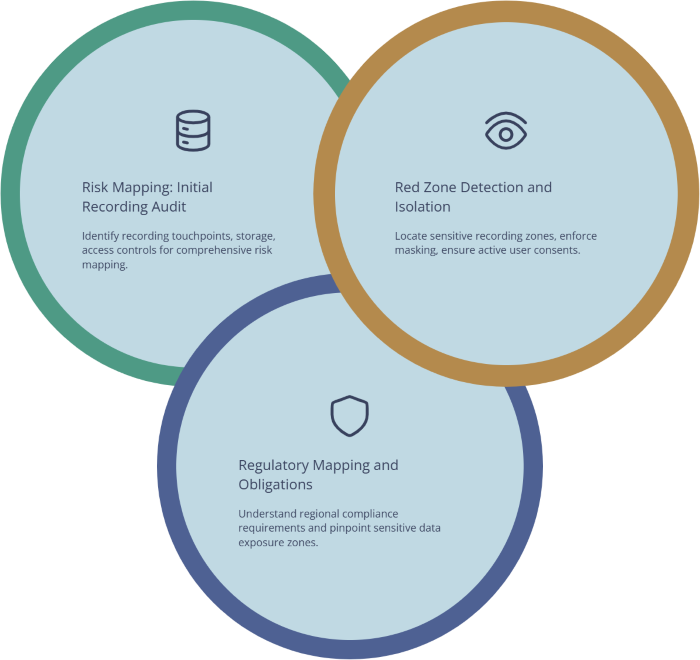
8. FAQs: Call recording compliance in 2026
Do we really need consent on every single recorded call?
In many regions, yes — but “consent” doesn’t always mean a customer clicking a button. In practice, clear pre-call announcements plus continued participation often count as consent, especially in one-party consent jurisdictions. Under GDPR-style regimes, you may lean on legitimate interest for certain recordings while still being transparent and offering alternatives. The safest pattern is to treat disclosures as non-negotiable and embed them into IVR and scripts the same way you’d standardize routing and failover in
GDPR-oriented deployments.
How long should we keep recordings before deleting them?
There’s no universal “correct” retention period. The right answer depends on dispute windows, sector rules, contractual obligations, and your risk appetite. Many teams adopt tiered retention: short windows (30–90 days) for general calls, longer for regulated lines or high-value sales, and extended retention where contracts demand it. Whatever you choose, document it, configure it in your platforms, and test it the way you’d test any infrastructure change, using the same discipline applied in
latency and uptime projects.
Can we still use AI for QA and coaching without breaching privacy laws?
Yes, if you design the workflows carefully. Start by keeping AI workloads inside your compliant environment wherever possible and limit access to only the fields and segments the model needs. Use anonymization or pseudonymization for long-term analytics where full identities aren’t required. Treat AI tools like internal users: give them roles, audit their access, and log what they process, as in structured AI QA deployments like
AI-first auditing frameworks. When in doubt, involve legal before exporting recordings to third-party tools.
How should BPOs handle recordings when each client has different rules?
The safest pattern is to treat each client like its own mini-environment. Give them dedicated queues, recording profiles, storage locations, and retention rules. Map every requirement from the MSA or SOW into concrete settings in your CCaaS or PBX, similar to the structured approach used in
multi-tenant contact center designs. Document exactly which calls are covered by which policy and make it easy to export or delete client-specific recordings if the contract or law requires.
What’s the best way to handle remote agents and home-based teams?
Focus on where audio terminates, not where the agent sits. If calls are processed in your cloud contact center, you can enforce the same recording, encryption, and retention rules regardless of location. The extra work is in securing endpoints (headsets, devices), hardening access, and training agents on privacy and screen-sharing etiquette. Many organizations pair cloud-native voice stacks like those in
downtime-resistant call center platforms with strict VPN, SSO, and device policies to keep remote work compliant.