
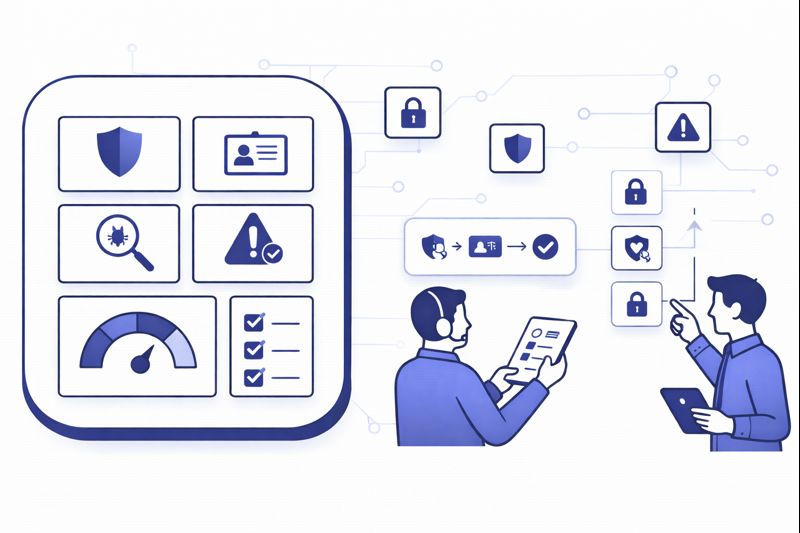
Banks and fintechs don’t run “contact centers” – they run live risk engines. Every call can contain card data, account access, identity proof, fraud alerts, loan decisions, or regulatory disclosures. Generic call center tools are built to handle volumes; financial operations need to handle volumes and survive audits, chargebacks, and fraud attempts. This guide breaks down how to design banking-grade contact center software for 2026 so KYC, fraud, and high-risk workflows are embedded into your routing, recordings, analytics, and AI – not left in spreadsheets and agent memory.
1. Why Banking & Fintech Contact Centers Need a Different Architecture
Financial contact centers carry three burdens at once: customer experience, regulated data handling, and real-time risk decisions. A missed call can mean lost lifetime value; the wrong disclosure or verification step can mean regulatory exposure. Your platform has to do everything a standard omnichannel contact center stack does – queues, IVR, routing, recordings – and then add granular controls over who sees what, which flows are allowed for which products, and how KYC outcomes feed downstream systems.
On top of that, fraud teams and compliance officers need traceability. They want to see what was said, which scripts were followed, what the agent saw on screen, and how that aligns with policies. That’s why banking operations lean on data-safe architectures similar to regulated-market cloud deployments: encrypted media, strict access roles, multi-region failover, and audit trails for every interaction. Only once that foundation is solid does it make sense to add AI, outbound engines, or complex cross-channel journeys.
2. KYC and Onboarding: Design the Workflows, Not Just the Script
KYC is where many fintechs leak money and time. If agents bounce between CRM, core banking, ticketing, and manual checklists, you end up with inconsistent outcomes, long handle times, and weak audit trails. A modern KYC experience starts with a single, guided flow that pulls identity data, risk scores, and document status into one screen, much like the best practices documented in integration-first contact center checklists. The agent doesn’t decide the steps; the workflow engine does, based on product, geography, and risk tier.
That same engine should drive which verification questions are asked, when to trigger one-time passwords, and how to capture consent. For low-risk cases, the contact center should be able to fast track onboarding; for high-risk signals, the call should be automatically tagged and routed to enhanced due diligence. Every outcome – approved, pending, declined – must sync cleanly with your core systems so future calls don’t repeat KYC from zero.
| Use Case | Key Data Pulled | Routing Logic | Primary Owner |
|---|---|---|---|
| New Account KYC | ID docs, address, sanctions, device | Risk score → low / medium / high queue | Onboarding & Compliance |
| Credit Card Application | Credit file, income, existing limits | Pre-approval → underwriter → manual review | Lending Ops |
| Loan Pre-Screen | Score, collateral, affordability | Eligibility rules → script branching | Credit Policy |
| Balance & Transactions | Real-time ledger, recent activity | IVR self-service → agent if complex | Customer Service |
| Card Activation | Card status, device, geo | Automated IVR → agent for exceptions | Card Ops |
| KYC Refresh | Document expiry, risk triggers | Outbound campaign → verified queue | Financial Crime |
| High-Value Transfer | Amount, counterparties, pattern score | Fraud flag → specialist team | Fraud Ops |
| Dispute & Chargeback | Transaction, merchant, evidence | Reason code → refund / investigation | Disputes Team |
| Account Takeover Suspect | Login events, device, IP, spend | Risk engine → emergency queue | Fraud & Security |
| AML Alert Follow-Up | Alert record, counterparties, SAR | Case management → investigator | AML Investigations |
| Digital Wallet Issues | Token status, device, network | Self-service path → agent assist | Digital Banking |
| Payment Failure | Decline code, route, merchant | Routing → tech or card support | Payments Ops |
| Business KYC | Company docs, UBO, sector risk | Tiering → enhanced due diligence | Corporate Onboarding |
| Collections Call | Arrears, history, promises | Treatment strategy → dialer list | Collections |
| VIP Wealth Management | Portfolio, profiling, preferences | High-priority queue → specialist | Wealth Desk |
3. Fraud and High-Risk Workflows: Build for Interrupts and Escalations
Fraud and high-risk calls rarely behave like normal customer service. They arrive during spikes, involve stressed customers, and require fast decisions under policy pressure. Your contact center needs queues, skills, and escalation paths that treat these contacts as critical incidents. That means dedicated fraud and disputes skill groups, emergency queues, and routing strategies similar in sophistication to predictive routing models for high-value interactions, tuned for risk rather than sales.
On the desktop, agents handling these calls should see a different toolkit: risk scores, device fingerprints, recent access anomalies, open cases, and options for temporary locks or step-up authentication. When they trigger an action – freeze card, block payment, escalate AML suspicion – the contact center should hand off to case management automatically. This is where deep integrations matter: designs that mirror the complexity described in large-scale integration catalogs, but applied to fraud engines, core banking and AML platforms.
4. Telephony, Channels and Routing for Regulated Environments
Banking clients expect never to hear “our phones are down.” Uptime, call quality, and resilient routing are table stakes. Modern operations run on distributed cloud telephony similar to zero downtime call architectures, with multiple carriers, regional failover and real-time health monitoring. For multi-country fintechs, that design extends across jurisdictions with local numbers, compliant recording rules, and regional storage policies.
Channel mix matters too. Voice, secure chat, in-app messaging, WhatsApp and email should all converge into the same contact center brain, with routing decisions based on risk and value. A password reset over chat is not the same as a seven-figure wire authorization over the phone. For outbound, dialers must respect consent, calling windows and regulations in each geography, using playbooks similar to TCPA-safe dialing strategies but adapted to your local regulatory stack.
5. Agent Desktop, Integrations and Supervision for Financial Use Cases
For banking and fintech, the agent desktop is a compliance surface, not just a productivity surface. Every field visible on screen, every button an agent can press, and every script they see should be intentional. That usually means building your contact center on a platform with deep integration capabilities, similar in spirit to native CTI and CRM integration blueprints, but pointed at your core ledger, card processor, fraud and AML tools.
Supervisors need a different cockpit from generic CX operations. They require wallboards that separate normal service queues from high-risk flows, alerts that trigger when fraud or dispute volumes spike, and instant visibility into which agents are handling sensitive transactions. Skill-based routing, dynamic scripting, and permission sets should work together so only certified staff can perform specific actions, while everyone else can still reassure the customer and route correctly.
6. AI, Analytics and QA for KYC, Fraud and High-Risk Work
AI in financial contact centers should act like a second set of ears and eyes for compliance, not an unsupervised decision maker. On calls and chats, it can detect risky language, missing disclosures, and inconsistent identity checks, then flag interactions for review. It can also summarise conversations into structured fields – reason for contact, risk indicators, promised actions – similar to how specialised analytics engines extract signals from multilingual interactions.
On the QA side, AI can score 100% of interactions for policy adherence, empathy and process, while human analysts deep dive the most critical ones. This is the evolution described in AI-first QA operating models: machines handle the boring consistency checks; people handle edge cases, coaching and rule refinement. Over time, those QA outputs should feed back into KYC scripts, fraud rules, training content and product changes.