In 2026, “AI call center software” is not a nice-to-have widget on top of your PBX. It is the operating system for how every conversation is handled, coached and audited. The strongest operations do not buy a separate bot here and a QA tool there. They design a single stack where voicebots, real-time agent assist and AI QA share the same data model, the same transcripts and the same routing logic. That is how they cut labour costs, boost CSAT and finally get a clean, reliable view of what customers are actually saying across millions of calls.
1. What “AI Call Center Software” Actually Means in 2026
Most teams still evaluate AI in isolation: a voicebot vendor demo here, a QA dashboard there, a separate “AI coach” in pilot. The problem is not that any of these tools are bad. The problem is that they sit on different transcripts, different tags and different routing triggers. In 2026, the top-performing centers treat AI as a shared infrastructure layer that powers labour optimisation, coaching and governance in one place, similar to how advanced teams built AI-led labour cost reduction playbooks instead of one-off experiments.
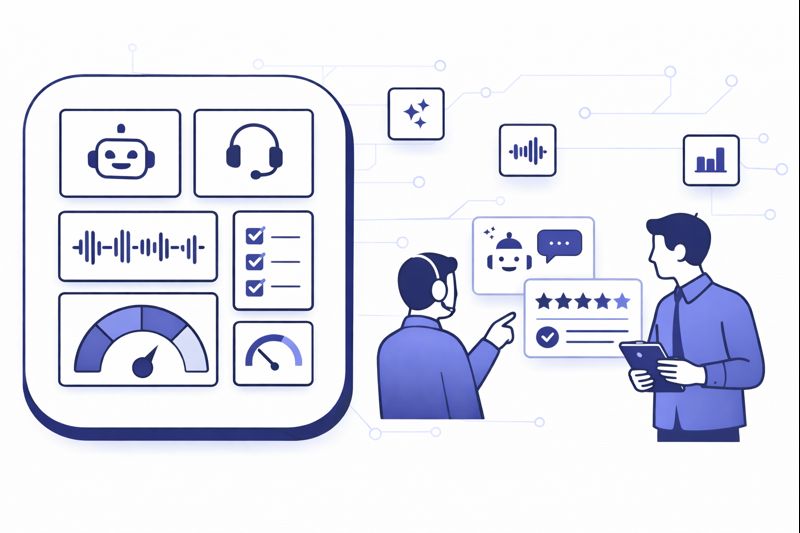
At a minimum, your AI stack should be able to do four things on the same call record: control parts of the conversation with voicebots, support the human with real-time guidance, summarise and tag the outcome, and feed 100% of calls into QA and analytics. If you cannot trace a straight line between “what the customer said,” “how the system and agent responded” and “what business outcome we got,” you have an AI point-solution mess, not a platform.
2. The Three Pillars: Voicebots, Agent Assist and AI QA on One Spine
Think of modern AI call center platforms as a spine with three main limbs. Voicebots handle repetitive, rules-driven tasks and triage. Agent assist turns live conversations into guided workflows for humans. AI QA and analytics convert raw interactions into stable signals leadership can act on. The mistake is implementing each limb from a different vendor without a shared brain. Leading stacks take the opposite approach and design the core around shared transcripts, consistent tagging and standard integration patterns, similar to how mature teams approach integration-first buyer’s guides.
When you evaluate platforms, ask questions that cut through marketing slides. Does the voicebot and the agent assist read from the same intent model. Does QA see the same entities and tags the router uses. Can you change a policy once and have it affect bot flows, agent prompts and scoring rules at the same time. That is what “one stack” actually looks like in practice.
| Capability | Primary User | Core Inputs | Business Impact | Common Failure Mode |
|---|---|---|---|---|
| Inbound voicebot | Customer | Intent model, knowledge base | Deflects simple calls, 24/7 handling | Overpromising “human-like” but failing edge cases |
| Outbound voicebot | Operations | Dialer, consent flags, scripts | Automates reminders and low-touch outreach | Non-compliant flows, poor detection of confusion |
| Real-time agent prompts | Agent | Transcript, CRM context | Higher FCR, consistent answers | Noisy prompts that distract more than help |
| Next-best-action guidance | Agent | Policies, intent, risk flags | Better saves, cross-sell, lower risk | Outdated rules that conflict with training |
| Auto-summarisation | Agent / Back office | Full transcript | Cuts wrap time, cleaner notes | Hallucinated details, missing key commitments |
| Disposition suggestion | Agent | Outcome, tags | More accurate reporting | Over-simplified reason codes |
| 100% QA auto-scoring | QA team | Policies, scorecards, transcripts | Full coverage, targeted coaching | Misaligned scoring, agent distrust |
| Regulatory checks | Compliance | Scripts, forbidden phrases | Reduced legal risk and fines | Not tuned to real conversation language |
| Sentiment and emotion tracking | CX leadership | Voice and text signals | Spot trends in frustration and delight | Over-reliance on sentiment as single KPI |
| AI routing assistance | WFM / Routing | Intent, value, agent skills | Better match between contacts and skills | Opaque models that are hard to tune |
| Anomaly detection | Ops leadership | Volume, topics, outcomes | Faster detection of outages and broken journeys | Alert fatigue from poorly tuned thresholds |
| Knowledge surfacing | Agents | KB articles, policies | Quicker access to trusted answers | Outdated or conflicting KB content |
| Dialer AI | Sales / Collections | Lead lists, consent, playbooks | Higher connect and conversion rates | Compliance breaches and over-dialing |
| Coaching insights | Team leads | Patterns across calls | Targeted 1:1 and team sessions | Generic “talk time” advice with no context |
| Executive analytics | C-suite | Aggregated KPIs and trends | Links CX insights to revenue and churn | Static dashboards that nobody acts on |
3. Voicebots That Actually Handle Calls Instead of Annoying People
The biggest mistake with voicebots is copying FAQ chatbots and pushing them to the phone. Phone calls are higher-stakes and more emotional, especially in regulated industries or high-value purchases. Good AI voice designs start with a ruthless map of which intents can be automated safely, which must be triaged and which can never be fully delegated. That mapping should follow the same discipline you would apply when evaluating CTI integration architectures: clear boundaries, clear fallbacks, clear ownership.
In practice, that means limiting full automation to tasks where policies are clear, data is available and user expectations are predictable: balance checks, simple WISMO, PIN resets, appointment confirmations. For complex issues, the voicebot’s job is to authenticate, collect key details and route to the right human with context. The handoff is the moment of truth. If the agent has to ask for the same information again, you have not built an AI stack, you have built an extra IVR step. Platforms that already connect unified transcripts to routing, like those used in low-latency voice architectures, are far better positioned to get this right.
4. Real-Time Agent Assist: Turning Average Agents Into Consistent Performers
Real-time agent assist is where AI stops being a demo and starts changing economics. When done well, it feels like a second brain sitting next to every agent: surfacing policies, suggesting phrasing, flagging risk language and nudging toward next-best action. The impact compounds in complex environments like financial services or healthcare where rules and products change frequently and you cannot rely on memory alone, which is why so many teams focus entire deployments on live AI coaching engines.
The design trap is bombarding agents with too many prompts. Instead, define 5–7 “moments that matter” in a typical call where assist is allowed to speak: greeting and verification, problem discovery, offer presentation, objection handling, compliance language and closing. Tune prompts around those moments, not every sentence. Measure success not just in AHT, but in reduced error rates, fewer escalations and faster ramp for new hires. And always give agents a fast way to rate suggestions as useful or not so the models improve instead of calcifying.
5. AI QA and Analytics: 100% Coverage Without Destroying Trust
The biggest shift AI brings to QA is coverage. You can go from reviewing 1–2% of calls to scoring nearly all of them against structured criteria, as long as you pair robust models with well-designed scorecards. That is why so many centers are rewriting their QA frameworks around AI-first monitoring patterns and updated scorecard templates rather than trying to bolt “AI scoring” onto legacy spreadsheets.
The failure mode is predictable. If scoring logic is opaque, misaligned with training or used purely punitively, agents will fight it, game it or ignore it. To avoid that, involve QA leads and top agents in designing the categories and thresholds. Use AI to pre-score and group calls into themes, but keep human reviewers on complex or borderline cases. Share examples of where AI caught issues that random sampling would have missed: systematic mis-selling, repeated broken processes, risky phrases in certain markets. When agents see it surfacing real issues, not nitpicking phrasing, trust goes up instead of down.
At leadership level, the value is in analytics: aggregating topics, sentiment, outcomes and root causes across regions and segments. Here, specialised deployments, such as Arabic-language analytics stacks, show how much nuance is lost when you only track high-level metrics. The best teams use these insights to fix broken journeys, not just coach individuals.
6. Architecture and Integration: One Stack, Many Channels
Under the hood, AI call center software in 2026 looks more like a data platform than a traditional ACD. You still need resilient telephony, but the core constraints are transcripts, events and integrations, not just trunks and queues. This is why so many teams start their design by mapping integrations using frameworks like integration ROI rankings rather than comparing features in isolation.
The minimum viable architecture includes: a cloud telephony layer or CCaaS that can expose events and media streams; a transcription and understanding layer (ASR plus NLU) that feeds both bots and analytics; a routing engine that can take AI signals into account; and a data plane that synchronises with CRM, ticketing, billing and knowledge. You are essentially building a live CTI and AI fabric similar in spirit to what is described in Salesforce CTI blueprints, but extended across every channel.
From there, the question is whether you assemble the stack yourself or buy it mostly integrated. Enterprises with strong internal engineering sometimes stitch together best-of-breed components. Many others pick a platform that already handles voice, AI and integrations in one offering, then use configuration and targeted customisation to close gaps. Whichever path you choose, treat integration work as a first-class project, not an afterthought.
7. Implementation Blueprint: From Pilot to Production Without Chaos
The typical failed AI rollout follows the same script: an enthusiastic pilot in one team, a few nice anecdotes, and then a slow fade as other priorities take over. To avoid that, you need a staged blueprint that ties each phase to measurable business outcomes. That is the logic behind serious cost and ROI calculators: you commit to targets before you commit to licenses.
Phase one: discovery and baselining. Capture a few weeks of calls, transcribe them and cluster intents. Use that to pick 5–10 automation and assist opportunities, and to design realistic scorecards. Phase two: limited rollout to one line of business, with clear staffing, QA and compliance oversight. Measure deflection, handle time, CSAT and policy adherence before and after. Phase three: expand to more queues and channels, refine models and integrate outputs into workforce management, training and product feedback loops.
Throughout, keep compliance close. Align recording, redaction and retention rules with regulations in your markets, drawing on practices from AI-first QA deployments where legal and QA sat at the same table. And remember that training is not a one-time event. Agents and supervisors need to be taught how to work with co-pilots and new scorecards, not left to “figure it out.”