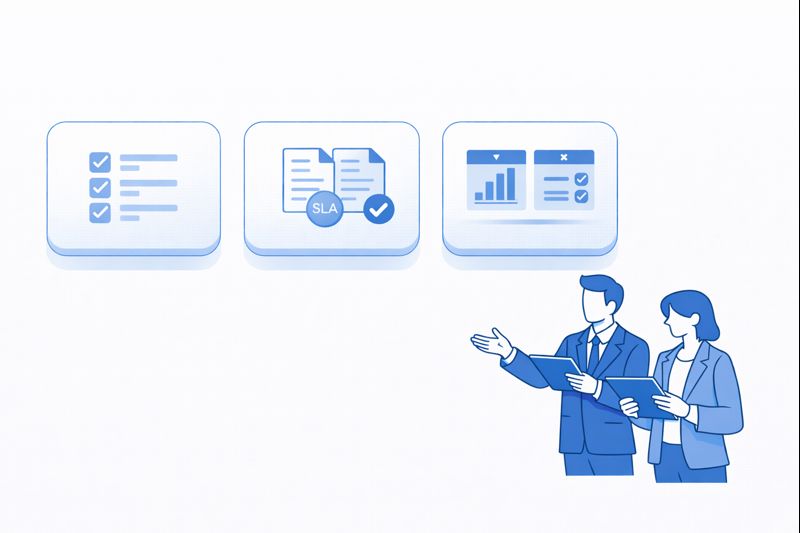
Copy, adapt and paste this into your own document. The questions are designed to
expose weak vendors on uptime, SLAs, integrations, AI, compliance and roadmap realism.
Tip: Ask vendors to answer each question in the same order. This makes side-by-side comparison much easier.
1. Company & Strategic Fit
- Describe your company’s primary focus (UCaaS, CCaaS, PBX, AI, BPO tooling, etc.). Where does our use case fit best in your ideal customer profile?
- Which regions and industries make up most of your current customer base? Provide examples similar to our size and complexity.
- Share your product roadmap highlights for 2026–2028. Which roadmap items are contractually committed vs. aspirational?
- What percentage of your revenue comes from contact center products vs. unrelated lines of business?
- Have you ever sunset or forced-migrated a core product in the past five years? If yes, describe impact and migration path.
2. Architecture, Hosting & Data Residency
- Describe your architecture (multi-tenant vs single-tenant, regional clusters, microservices, data-plane vs control-plane separation).
- Which cloud providers and regions do you use today (e.g., AWS, GCP, Azure, private DCs)? Specify where media, metadata and recordings are stored.
- Can we enforce data residency by region (e.g., EU, UK, GCC) for call recordings, logs and analytics?
- How is encryption handled for signaling, media and storage (TLS versions, SRTP, KMS, key rotation policies)?
- Provide your latest security certifications and reports (SOC 2, ISO 27001, PCI scope, penetration test summaries).
3. Core Contact Center Capabilities
- List supported channels (voice, email, chat, SMS, WhatsApp, social messaging). Which are native vs. through partners?
- Describe your ACD and routing engine (skills-based, priority, value-based, intent-based, predictive routing).
- How do you handle overflow routing, business continuity and global follow-the-sun models?
- Explain how you configure IVR trees and conversational IVR. Who can change flows (admins vs. vendor only)?
- Describe your native call recording features (pause/resume, PCI masking, retention policies, legal holds).
4. AI, Automation & Analytics
- Which AI capabilities are native vs third-party (ASR, NLP, voicebots, summarisation, sentiment, topic detection)?
- What languages and dialects do you support for transcription and intent detection (e.g., Arabic Gulf, Hindi, Urdu, Tagalog)?
- Describe your real-time agent assist and AI QA features. What percentage of calls can you score automatically?
- Explain how AI models are trained, updated and governed. Can we opt out of using our data for global model training?
- Provide example dashboards for operations, WFM and CX leaders. Can dashboards be exported or pushed to our BI tools?
5. Integrations & CTI (CRM, Ticketing, UC)
- List your certified CTI integrations for Salesforce, HubSpot, Zendesk, ServiceNow, Dynamics and others.
- Describe your screen-pop behaviour. What can we show in the first three seconds of a call (records, intents, previous contacts)?
- How do you support click-to-dial, auto-logging, disposition codes and wrap-up workflows inside CRM or helpdesk?
- Do you provide an open REST / GraphQL API and/or event streams (webhooks, web sockets) for custom integrations?
- Share examples where you replaced legacy CTI with modern integrations similar to those in our stack.
6. Compliance: TCPA, GDPR, HIPAA, PCI, Local Regulations
- Describe how your platform helps enforce TCPA / local dialing rules (consent flags, dialer modes, time-of-day rules, audit logs).
- How do you support GDPR / local data rights (export, rectify, delete) for call recordings, transcripts and analytics data?
- Are you able to operate in regulated environments (HIPAA, PCI DSS). Describe your shared-responsibility model with customers.
- Explain how you manage consent for call recording and AI processing across regions (announcements, IVR prompts, opt-out flows).
- Provide sample regulatory and compliance documentation you share with enterprise customers.
7. Reliability, Uptime & Disaster Recovery
- Share your last 12–24 months of actual uptime and incident logs for core services (signaling, media, APIs).
- What is your standard SLA for uptime (e.g., 99.9% / 99.95% / 99.99%) and how is it measured (monthly, quarterly)?
- Describe your failover architecture (carrier redundancy, region failover, database replication, automatic vs. manual).
- How quickly can we move traffic if a region or carrier fails? Provide an example of a real incident and resolution timeline.
- What credits or penalties do you offer for SLA breaches? How often have you paid those in the last 24 months?
8. Implementation, Migration & Change Management
- Describe your standard implementation phases for a 50-, 200- and 500-seat deployment (timelines, roles, dependencies).
- How do you handle number porting, IVR recreation, call-flow migration and historical data migration from legacy ACD / PBX?
- Do you provide dedicated project / technical resources or rely solely on partners for rollout?
- Explain your approach to training admins, supervisors and agents. Include documentation, LMS and certification options.
- Share two examples where you migrated from a legacy system (e.g., on-prem PBX, Five9, NICE, Avaya) with minimal downtime.
9. Support, Escalations & Account Management
- Detail your support tiers (hours, channels, response times) for standard vs. premium support.
- Explain your escalation ladder from frontline support to engineering and leadership. Provide example SLAs for P1 incidents.
- Will we have a named Customer Success Manager and/or Technical Account Manager? What are their responsibilities?
- How do you collect and act on customer feedback and feature requests?
- Describe your update / release cadence and how we are informed about changes that affect routing, UI or APIs.
10. Pricing, Commercials & Contract Terms
- Describe your pricing model: per-seat, per-minute, per-channel, per-feature (AI, analytics, storage), or hybrid.
- List all mandatory and optional fees: minimum commitments, setup / onboarding, overage rates, storage, compliance add-ons.
- How do you handle seasonal ramp-up / ramp-down (e.g., retail peak season) without long-term penalties?
- What is your standard contract length and renewal model? Are price increases capped and/or indexed?
- Under what conditions can we exit early (persistent SLA failures, roadmap changes, acquisition, regulatory changes)?
11. References, Case Studies & Proof of Value
- Provide 3–5 reference customers similar in size, region and industry. Include contact details where possible.
- Share case studies with quantified outcomes (CSAT, FCR, AHT, cost-per-contact, revenue uplift, AI impact).
- Can you support a limited-scope pilot or POC? Describe typical scope, duration and success criteria.
- How do you measure success during the first 90 days post-go-live?
- What are the top three reasons customers choose you over competitors – and the top three reasons they leave?
12. Vendor Declaration
Please confirm the following:
- All answers in this RFP are accurate to the best of your knowledge as of the response date.
- You will notify us of any material changes (ownership, product deprecation, data residency shifts) during contract term.
- You agree that statements made in this RFP may be reflected in contractual commitments and SLAs where applicable.
Signature, name, title, company, date
Most call center RFPs look impressive on paper but collapse in negotiations because they don’t ask the right questions. Vendors answer in buzzwords, promises and “roadmaps,” and buyers end up with vague SLAs, hidden fees and integrations that never quite work. A 2026-ready RFP has one goal: expose weak vendors fast by forcing them to show proof on uptime, AI, integrations, compliance and real-world delivery. This template gives you the structure, questions and scoring lenses to do exactly that, so you can shortlist partners that actually match your volumes, risk profile and growth plans.
1. What a 2026 Call Center RFP Really Needs to Do
A modern RFP is not a shopping list of features. It is a stress test of how a vendor designs, delivers and supports a contact center that fits your reality: hybrid teams, AI expectations, heavy integrations and strict regulation. Start by stating business outcomes clearly — lower abandonment, better FCR, higher CSAT, more revenue-per-call, stronger fraud control — and tie every RFP section back to them. Use your outcomes to filter generic platforms from focused call center software approaches that already solve problems similar to yours.
Next, define your non-negotiables: geography, languages, regulated workloads, expected AI usage, integration depth, and internal security requirements. An honest constraints section forces vendors to respond with architecture, not marketing. It also helps you compare stacks fairly — a solution designed for small e-commerce teams will not handle banking-grade KYC or multi-country routing. The rest of this template turns these outcomes and constraints into targeted questions that either prove maturity or reveal gaps.
2. Core Sections Your RFP Must Include
Instead of one massive questionnaire, structure your RFP into sections that mirror the real stack. At a minimum, you need categories for telephony and routing, omnichannel capabilities, AI and automation, QA and recording, integrations, security and compliance, reporting and analytics, SLAs and support, implementation and migration, and commercial terms. Each section should contain a mix of open questions, specific metrics, and yes/no items that vendors cannot dodge. This is also where you declare your current CRM, ticketing and WFM tools so vendors can explain how they will connect, not just claim they “support integrations.”
For integrations, assume this will be one of the hardest parts of the project and interrogate it accordingly. Ask vendors to map how they would connect to your CRM, helpdesk and data warehouse, and how they handle high-volume call data, dispositions and transcripts. Compare their answers with best-practice guidance from deep-dive resources like call center software integration buyer guides and large-scale integration lists. The goal is to differentiate between shallow “app store” connectors and real, bi-directional workflows that power routing, QA, CX and finance.
3. Questions That Expose Weak Vendors (And Their SLAs)
The wrong questions invite marketing copy; the right ones force vendors to reveal architecture, trade-offs and operational discipline. The table below gives you RFP questions that reliably separate robust platforms from fragile ones, plus what good and bad answers look like. Use this as the backbone of your RFP questionnaire and adapt the wording to your industry and risk profile.
| Area | RFP Question | What Strong Vendors Show | Red Flags |
|---|---|---|---|
| Uptime & SLA | Provide 24-month historical uptime by region and product, plus list of P1 incidents. | Time-series uptime, incident summaries, root cause and corrective actions. | Only marketing SLA, no hard numbers or past incident detail. |
| SLA Penalties | Describe financial credits and automatic triggers when SLAs are breached. | Clear credit tables, auto-apply rules, customer-friendly caps. | “We’ll discuss on contract,” vague or discretionary remedies only. |
| Architecture | Share a high-level architecture diagram for a customer like us. | Topology, regions, failover, data flows, 3rd-party dependencies. | Generic diagrams that don’t reference your use case or geography. |
| Disaster Recovery | Explain RPO/RTO targets and last full DR test results. | Documented tests, timelines, learnings, remediation status. | “We have multiple data centers” with no tested DR evidence. |
| Routing & IVR | Show how you’d design routing and IVR for our top 5 journeys. | Journey-specific flows, skills, queues, failover logic. | Generic “intelligent routing” promises without concrete flows. |
| AI & Automation | Provide 3 customer examples where AI reduced handle time or improved CSAT. | Baseline vs result, metrics, use case detail. | Future roadmap talk, no real-world impact numbers. |
| QA & Transcripts | How do you support 100% AI-led QA coverage and calibration? | Scorecard model, sampling options, calibration process. | Only manual QA or AI as vague add-on with no process. |
| Recording & Storage | Explain how recordings, transcripts and metadata are stored and accessed. | Retention tiers, API access, encryption, regional controls. | Unclear retention, export friction, no regional separation. |
| Compliance | Describe how your platform supports GDPR, PCI, HIPAA and regional rules relevant to us. | Regulation-specific features, masks, routing and audit detail. | “We are compliant” with no control-level explanation. |
| Integrations – CRM | Show how calls, dispositions and recordings sync with our CRM in real time. | Sequence diagrams, object models, field mapping, error handling. | Links to marketplace listing and “out-of-the-box” claims only. |
| Integrations – Data | Explain how we’d get raw events into our data warehouse daily. | Event streams, batch exports, schemas, volume benchmarks. | Reports-only access, no mention of raw data feeds. |
| Reporting & Analytics | Provide sample COO dashboards for customers like us. | Screenshots, metric definitions, drill-down paths. | Single “wallboard” views with vanity metrics only. |
| Security | List certifications, pen-test cadence and security incident processes. | Certs, third-party tests, clear escalation and communication plan. | High-level “we take security seriously” language only. |
| Implementation | Share a typical implementation plan and timeline for our size and complexity. | Phase breakdown, responsibilities, risk mitigation. | One generic Gantt chart with no customer responsibilities. |
| References | Provide 3 references in our industry/region with similar scale and complexity. | Named references, case studies, contact details. | Only anonymous logos or “under NDA.” |
| Commercials | Explain all variable and fixed fees, including AI, storage and support tiers. | Transparent fee table, volume breaks, escalation paths. | Add-ons buried in fine print, vague AI or overage pricing. |
| Roadmap Fit | Show how your roadmap aligns with our next 3 years of growth. | Concrete features, timing, co-design opportunities. | Generic “AI-first future” with no specifics or dates. |
4. SLAs, Uptime and Penalties That Actually Protect You
Most SLAs exist to market “five nines,” not to protect your customers when something fails. Your RFP needs to force vendors to talk in specifics: region-based uptime, maintenance windows, degraded modes and what happens commercially when they miss. Ask for historical uptime per region and platform tier, aligned to how modern cloud architectures handle failover and zero-downtime deployments like those described in resilient cloud call center designs. Then, demand clarity on what they count as downtime — not just “complete unavailability,” but severe degradation.
Penalties should be automatic, tiered and real. Request a table that shows credit levels at different SLA breaches, how they apply (invoice credit, service extension, dedicated engineering), and maximum caps. Also ask how they handle chronic underperformance across several months, not just single incidents. Finally, clarify data-access SLAs: how quickly you can pull recordings, logs and transcripts during an incident, and how long they’re retained. This directly impacts legal exposure, compliance investigations and your ability to reconstruct what happened when regulators or customers ask.
5. AI, QA and Compliance: RFP Questions Vendors Don’t Like
AI is where marketing language is currently loudest and weakest. Your RFP should cut through the noise by asking for concrete use cases, baselines and results. Require vendors to outline how their platform supports voicebots, real-time assist and AI QA in one stack, similar to the patterns seen in dedicated AI call center software roadmaps. Make them show which models they use, how they handle hallucinations, and how supervisors override or tune AI suggestions.
For QA, ask how they deliver 100% coverage, what a typical scorecard looks like, and how they calibrate between human and AI reviewers. Compare their answers with best-practice guidance from QA scorecard templates and AI-first calibration frameworks. On compliance, interrogate call recording, masking, retention and regional data residency. Use specific references to GDPR, PCI, HIPAA and GCC rules and benchmark their responses against the kinds of safeguards laid out in modern call recording compliance guides. Any answer that stays at “we are compliant” level should be scored low.
6. Tailoring the Template by Industry and Scale
The core of this RFP template works across sectors, but you should tune the emphasis. Banking and fintech buyers must go deeper on AML, fraud flows, KYC journeys and regulator expectations, similar to the patterns discussed in high-risk contact center designs. Healthcare teams need more detail on PHI handling, appointment scheduling, clinical escalation and secure payments. E-commerce and retail leaders care about peak volume handling, WISMO flows, returns and seasonal spikes.
Scale matters just as much. A 30-seat remote team and a 500-seat BPO should not issue the same RFP. Smaller teams can simplify questions about multi-region deployment and choose vendors optimised for lean operations and remote work, while still insisting on integration depth and clean analytics. Larger organisations will need more detail on multi-tenant models, partitioning, admin delegation and hybrid deployments, sometimes mixing global PBX components such as those described in global cloud PBX architectures. The structure stays the same; the weight and depth of questions change.
7. Scoring Vendors and Running a Fair Process
A strong RFP is useless without a disciplined scoring framework. Before you send anything out, define 5–7 scoring dimensions such as platform fit, integration depth, AI and analytics capabilities, compliance posture, implementation track record, commercial value and cultural fit. Give each a weight that reflects your goals. For example, if you are replacing a legacy system that constantly fails, uptime and SLAs might get heavier weighting than AI ambition. If you are in a mature market with complex journeys, integration and analytics may dominate.
Then, translate critical questions from this template into scored items. Not every question needs a numeric score; some are simply gatekeepers. For example, a vendor that cannot provide references in your region may be auto-eliminated regardless of a high feature score. Use insights from contact center shortlists by use case to sanity-check your weighting: if your scoring gives top marks to a vendor that consistently underperforms in similar public comparisons, revisit your criteria. Throughout the process, keep written notes explaining why you scored the way you did; these become invaluable when you negotiate and when leadership asks “why this vendor.”
8. 90-Day Timeline: From RFP Draft to Vendor Selection
To avoid RFPs dragging on for a year, treat the process like a project with clear phases. In Weeks 1–3, align internal stakeholders on goals, constraints and must-have sections using this template as a baseline. Capture input from operations, CX, IT, security, legal and finance so there are no surprises later. In Weeks 4–6, issue the RFP, host vendor Q&A sessions and clarify ambiguous answers with written addenda. Expect stronger vendors to ask detailed questions back — that’s a good sign.
Weeks 7–9 should focus on scoring and narrowing to a shortlist of two or three candidates. Combine written responses with demos, architecture deep-dives and reference calls. Use dashboards and SLA questions from this template to drive demo scripts instead of letting vendors run generic tours, similar to how COO-focused analytics buyers structure their evaluations in reporting and analytics buying guides. Weeks 10–12 should be reserved for commercial negotiation, security reviews and, where possible, a small pilot. By the end of the quarter, you should have a signed contract and a clear implementation plan.