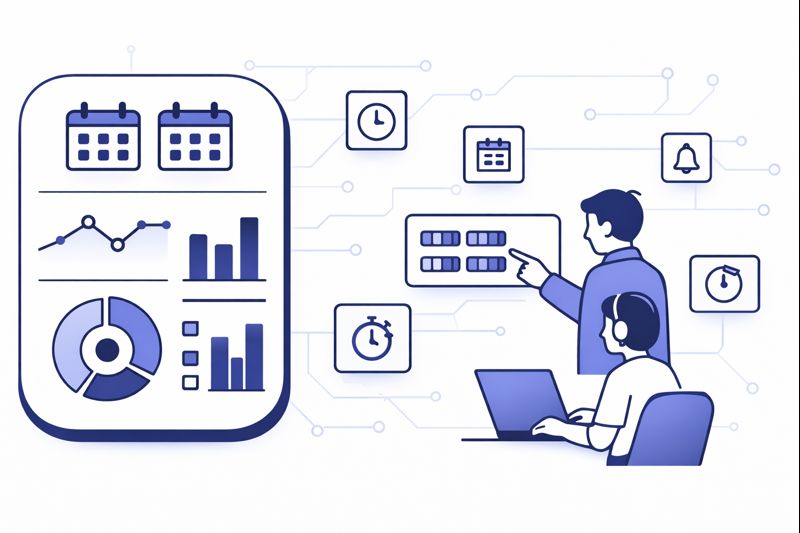
Most cloud contact centers think they have a routing or “AI” problem when they actually have a workforce management problem. You can buy the best dialer, voice platform and CRM on the market and still miss SLAs, burn agents out and leak revenue if you mis-forecast demand, schedule the wrong mix of skills, or ignore shrinkage. In 2026, WFM is not “back office.” It is the control tower that decides whether your cloud stack feels like magic or chaos.
1. Why Workforce Management Is Your Real Profit Engine
Cloud telephony and omnichannel platforms made it easy to add queues, channels and locations. What they did not solve is how many people you actually need online at 10:15 AM in each skill group. Workforce management sits exactly at that intersection: it converts demand patterns into the right headcount and skill mix so you can protect SLAs without paying for idle capacity. That is why the best-performing teams pair their WFM discipline with feature sets that already emphasise efficiency and reliability, similar to what you see in ROI-ranked cloud call center feature lists.
If you ignore WFM, every problem gets misdiagnosed as a “tool” issue. AHT looks high, so you buy more AI. Abandonment spikes, so you add more phone numbers. In reality, you are flying without a forecast, scheduling to gut feel, and treating shrinkage as an afterthought. Tight workforce management puts math around all three and gives your COO one levered question: are we trading the right amount of cost for the level of service and revenue we want.
2. Forecasting: From Raw Volume to Intent-Level Demand
Forecasting is not about guessing tomorrow’s call count from yesterday’s total. It is about predicting contacts by intent, channel and handle time band. Cloud centers that still forecast with a single volume curve per queue are stuck in 2015. In 2026, you need at least three layers: historical patterns, planned events (campaigns, releases, policy changes) and external signals like seasonality or pay cycles. This is the same thinking used in advanced volume modelling for modern efficiency metric frameworks.
Start by tagging every interaction with intent, even if it is rough (billing, login issues, fraud, WISMO, cancellations). Then forecast each intent separately for voice, chat, email and WhatsApp. This matters because some intents are highly deflectable to self-service or bots, while others will always require a human. When you layer average handle time and wrap on top of this, you get a much more realistic workload profile that can actually drive staffing.
| Lever | What It Really Means | Primary Owner | Main Impact |
|---|---|---|---|
| Forecast horizon | How far ahead you predict demand (intraday, weekly, seasonal). | WFM Lead | Determines how early you can adjust hiring and training. |
| Granularity | Level of detail (15-min intervals, per-queue, per-intent). | WFM + Ops | Better granularity reduces both overstaffing and SLA misses. |
| Arrival pattern | How volume actually arrives across the day, not just totals. | WFM | Critical for matching shifts to real peak windows. |
| AHT and wrap | Average talk and after-call work per intent and channel. | Ops + QA | Direct driver of staffing requirements and cost per contact. |
| Service goals | Target SLA, abandonment, speed of answer per segment. | COO + CX | Sets the trade-off between cost and perceived quality. |
| Skills and routing | Which agents can take which contacts and in what order. | Ops + IT | Impacts occupancy, wait time and first contact resolution. |
| Shrinkage assumptions | Planned and unplanned time agents are not on contacts. | WFM + HR | Missed here is the main reason teams miss SLA with “enough” heads. |
| Scheduling rules | Shift lengths, start times, breaks and part-time mixes. | WFM | Determines how tightly you can match staffing to demand curves. |
| Overtime strategy | When and how you use OT instead of hiring or vendor capacity. | COO + WFM | Safety valve for spikes; overuse drives burnout and cost creep. |
| Vendor mix | Onshore, nearshore, offshore and BPO capacity ratios. | COO + Procurement | Adds flexibility but complicates SLA and quality control. |
| Automation and AI | Deflection, self-service and assistant tools used at scale. | Product + Ops | Changes the shape of demand and required skills over time. |
| Channel priorities | Who waits when voice, chat and messaging are all busy. | CX + COO | Prevents silent queues from starving while calls dominate. |
| Remote vs on-site mix | Proportion of agents working from home versus centers. | Ops + HR | Affects shrinkage patterns, flexibility and supervision style. |
| Training and nesting | Time before new hires reach target productivity. | L&D + WFM | Decides how early you must hire to hit future SLAs. |
| Change calendar | Single view of launches, campaigns and policy changes. | COO + Product | Keeps forecasting aligned with reality, not just history. |
3. Scheduling in the Cloud: Skills, Flexibility and Real-Time Changes
Once workload is modelled correctly, scheduling becomes an optimisation exercise: fit the right skills into the right intervals with the least waste. Cloud contact centers have more options than ever: remote agents in multiple time zones, split shifts, part-time pools and BPO overflow. The risk is treating this flexibility as a toy instead of a discipline. Teams that thrive follow the same “design then automate” mindset they apply when choosing global cloud PBX and VoIP architectures.
Build your scheduling rules so they protect both SLAs and people. That means defining maximum consecutive time in high-strain queues, protecting coaching blocks, and giving WFM authority to rebalance work across voice, chat and messaging when forecasts are wrong. The platform should support rapid intraday changes without re-building entire schedules, and routing should reflect skill matrices that WFM actually maintains, not a static setup from three years ago.
4. Shrinkage: The Silent Killer You Can Actually Control
Shrinkage is the gap between “paid hours” and “time available for contacts.” It includes breaks, training, meetings, absence, system issues and pure unplanned time. Many leaders treat shrinkage like weather: something to complain about, not something to model. In reality, it is one of the few levers you can shape through better planning, policy and tooling. If you under-estimate shrinkage by 10 points, your beautifully calculated staffing plan is wrong before the day starts.
Separate shrinkage into planned and unplanned components. Planned shrinkage includes vacations, training and scheduled meetings. Unplanned includes sick time, emergencies, over-long breaks and system outages. Each has different owners and remedies. Planned shrinkage belongs on your forecasting inputs. Unplanned shrinkage belongs in your operational dashboards and in the same risk-conversation as platform reliability, such as the zero-downtime practices highlighted in modern cloud architecture breakdowns.
5. WFM + Routing + AI: One Design Problem, Not Three
In legacy setups, WFM, routing and dialers were separate worlds. In cloud contact centers, they are parts of the same system. Forecasts inform routing strategies. Routing decisions change handle times. AI changes both by deflecting or shortening contacts. If these teams do not design together, you get beautiful schedules feeding into chaotic queues. The opposite is visible in high-performing environments that treat predictive routing and WFM as two sides of the same coin.
Concretely, WFM should provide routing teams with demand projections by intent and segment. Routing should respond with expected handling flows: which subset will be handled by bots, agents or blended. AI and automation owners should publish expected deflection and AHT reductions by use case, using logic similar to what you see in AI cost and labour impact guides. This shared picture becomes the baseline forecast. As reality deviates, all three teams adjust together instead of trading blame.
6. Labour Cost, Remote Work and BPO: Designing the Mix
You cannot talk about workforce management without talking about labour cost. Cloud infrastructure made it easy to span countries. The temptation is to simply chase cheaper locations. What works better long-term is designing a balanced portfolio of internal teams, remote cohorts and BPO partners, each with clear roles. That is how teams building multi-office and multi-region setups keep both flexibility and resilience.
Use WFM to simulate the cost and SLA impact of different mixes. How does your staffing requirement and occupancy change if a certain percent of volume moves to an offshore BPO. What if you replace part of that with automation. At the same time, model risk: which queues must stay in-house for compliance or expertise reasons, similar to constraints you see in regulated sectors covered in vertical-specific call center use cases. The outcome is not “cheapest possible seats” but “best risk-adjusted cost per resolved contact.”
7. WFM Tooling and Data: Integrations, CTI and Source of Truth
Good WFM is impossible with bad data. If your call platform, chat system, CRM and WFM tool disagree on what a “contact” is, no forecast will save you. You need a single system of record for contact volumes and handle times, with WFM pulling from that source. That is why integration depth matters just as much as forecasting algorithms when selecting platforms, as shown in integration-focused call center software overviews.
In practice, this means using CTI and APIs to push consistent start and end times into the WFM layer for every interaction, across voice and digital. Dispositions, wrap and outcome codes must be standardised so intent-based forecasts are possible. On top of that, you need live adherence feeds: who is actually in what state versus what the schedule says. Without live adherence, intraday corrections turn into guesswork rather than targeted interventions.
8. 90-Day WFM Upgrade Roadmap for Cloud Contact Centers
Days 1–30: Baseline and data clean-up. Catalog existing forecasts, schedules and shrinkage assumptions. Compare them with observed reality over the last 8–12 weeks. Identify queues where you consistently miss SLA or run chronic overtime. In parallel, audit your data pipeline: can you see interval-level volume, AHT, occupancy and adherence without exporting half a dozen spreadsheets. Use criteria similar to those in modern call center platform selection guides to judge whether your stack is helping or hindering WFM.
Days 31–60: Redesign forecasting and scheduling. Move from a single-volume forecast per channel to intent-based models for your top 10–15 drivers of contact. Update shrinkage assumptions using real data, separated into planned and unplanned buckets. Introduce new scheduling rules that respect those assumptions. If you use vendors or remote teams, bring them into the same forecasting and adherence model. This is also the right window to bake in upcoming migrations described in cloud versus on-prem TCO playbooks, so long-term changes do not break your new WFM logic.
Days 61–90: Embed WFM into daily and weekly rituals. Make forecast-versus-actual reviews part of your morning stand-ups. Give operations and team leaders live adherence views and authority to trigger schedule tweaks, not just escalate. Align your reporting layer so WFM metrics appear alongside contact center KPIs, following patterns in cost and capacity calculators. By the end of this phase, WFM should not feel like a back-office function. It should feel like the operations cockpit everyone uses.