Most outbound teams are still burning money on “lists, lists, lists” – CSV uploads, linear sequences, half-compliant dialers – while buyers live in a world of signal, timing and consent. In 2026, the gap between static list dialing and predictive AI outbound is the gap between noise and pipeline. Modern outbound engines don’t just dial faster; they decide who to call, when, through which channel, and with what talk track based on data. This guide walks you through the architecture, metrics, and playbooks you need to move from basic outbound software to a predictive AI engine that respects law, reduces labor waste, and turns dead time into revenue.
1. Why Static-List Outbound Is Dead in 2026
Static lists assume your prospects are frozen in time. In reality, intent, budgets and compliance status change weekly. Teams that still upload CSVs, assign fixed sequences and “power through” calls see the same symptoms: low connect rates, burned domains, high spam flags and reps complaining that “these leads are dead.” That’s exactly the pattern documented in post-manual dialing outbound analyses, where the cost of wasted attempts dwarfs the software bill.
The second problem is compliance and trust. Manual or semi-automated dialing on old data is where TCPA violations, DNC complaints and carrier blocking begin. Without real-time consent checks, channel reputation monitoring and pacing aligned to laws, aggressive outbound becomes a liability instead of an asset, especially at scale. Frameworks like modern auto-dialer compliance guides exist because regulators and carriers have caught up with “spray and pray.” In 2026, your outbound engine must be smart enough to avoid trouble, not just fast enough to create it.
2. Architecture of a Predictive AI Outbound Engine
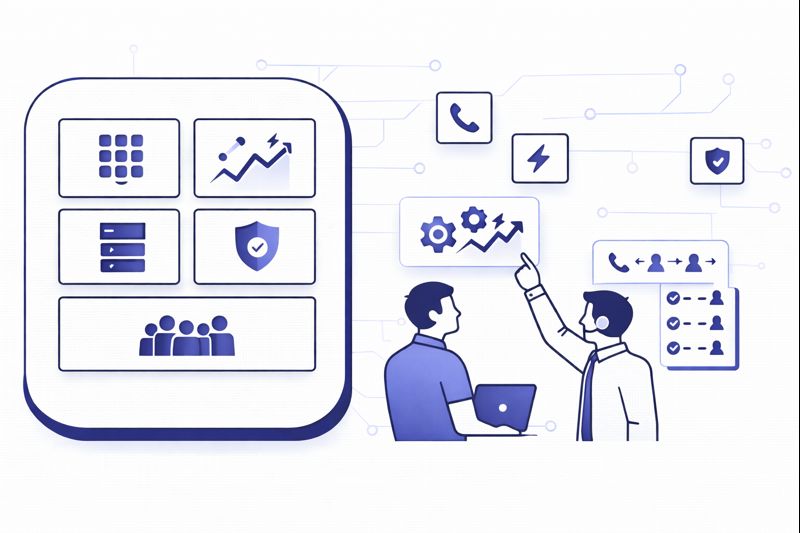
A real outbound engine is not “dialer + CRM.” It’s a coordinated system with distinct layers: data ingestion, enrichment and scoring, campaign orchestration, dialer modes, agent experience, analytics and compliance controls. The dialer is just one piece – and often the easiest to replace. The hard work is teaching your system how to pick the right next call, not just the next row in a spreadsheet. That is exactly why high-performing teams lean on architectures similar to those used in revenue-first auto-dialer setups, where routing, data and coaching all work together.
Think of this as moving from a “call list” to an “outbound graph.” Every lead, account and contact is a node with attributes: industry, deal stage, prior outcomes, engagement, risk flags, channel preferences. Your engine traverses that graph to find the next best conversation across thousands of possibilities. The software you choose needs APIs, integration depth and routing logic on par with the integration hubs described in large-scale call center integration catalogs, or you will always be stuck in list mode.
| Layer | Primary Purpose | Key Signals / Inputs | Typical Owner |
|---|---|---|---|
| Data ingestion | Pull leads/accounts into one model | CRM, MAP, product usage, lists | RevOps |
| Enrichment | Fill gaps, add firmographics | Industry, size, tech stack | Ops / Data |
| Scoring | Rank opportunities by win/response odds | Engagement, fit, timing | Data Science |
| Segmentation | Bucket into plays/cadences | Use case, region, product line | Sales / Marketing |
| Campaign engine | Define sequences and SLAs | Channel mix, touch spacing | Sales Leadership |
| Dialer modes | Choose predictive/progressive/power | Connect rate, agent capacity | Outbound Ops |
| Compliance guardrails | Enforce TCPA/DNC/opt-out rules | Consent flags, jurisdiction | Legal / Compliance |
| Routing & pacing | Assign right lead to right agent | Skill, language, capacity | Workforce |
| Agent desktop | Give full context + controls | History, notes, tasks | IT / CX |
| AI assist | Suggest messaging and next steps | Transcript, objections, outcomes | Sales Enablement |
| Analytics | Measure conversion and waste | Connects, pipeline, cost per opp | RevOps / Finance |
| QA & coaching | Improve talk tracks and behavior | Call scores, AI insights | QA / Managers |
| Telephony core | Deliver stable global connectivity | SIP trunks, carriers, QoS | Network / Telephony |
| Channel expansion | Mix SMS, WhatsApp, email | Opt-ins, template approvals | CX / Marketing |
| Feedback loop | Feed outcomes back into scoring | Wins, losses, no-shows | RevOps / Data |
3. Data, Scoring and Segmentation: Who to Call and When
The biggest performance unlock in outbound is not another dialer; it is deciding who should never be dialed, who should be called now, and who belongs in a low-touch nurture stream. Start with your closed-won and closed-lost data. Model patterns by industry, company size, tech stack, decision-maker role and cycle length. Then plug those patterns into your scoring layer so that the dialer always prioritizes segments with high win probability and enough intent. This is the same logic used when ranking predictive dialing strategies by impact: your engine must know what “good” looks like.
Next, segment by motion and risk. Outbound to cold accounts in highly regulated sectors should follow very different playbooks than callbacks on product-qualified leads. Use multi-channel behavior (opens, replies, site visits, trials) as recency and intensity signals. Feed them into your campaign engine so that an account browsing your pricing page this week is treated differently from a three-month-old list import. Integration-heavy setups like those described in deep call center integration guides make this practical by syncing CRM, product and marketing data onto the same timeline.
4. Dialer Modes, Compliance and Risk Management
In 2026, picking the wrong dialing mode is the easiest way to get blocked, fined, or both. Predictive dialers maximize agent talk time by dialing ahead of capacity; progressive dialers call only when an agent is free; power dialers call one contact per available rep. Each has a place, but only when configured around compliance and experience. Comparisons like dialer mode decision matrices show that “fastest” is not always “best” – especially in jurisdictions with strict abandoned call rules.
Your outbound software must embed TCPA, DNC and regional consent logic into the dialing engine, not leave it to reps. That means real-time scrubbing, pacing constraints, caller ID management and explicit workflows for opt-outs. Enforcement models like those in TCPA-proof scaling frameworks treat compliance as a routing and data problem, not a legal paragraph in the playbook. For US outreach, pick platforms and configurations similar to compliant predictive dialer setups that blend speed with guardrails instead of forcing a choice between them.
5. AI for Scripts, Coaching and Conversation Intelligence
AI’s real leverage in outbound is not writing generic cadences; it is compressing the feedback loop between call, learning and improvement. During live calls, agent assist tools like those outlined in real-time coaching platforms can suggest rebuttals, surface case studies and highlight next steps based on objections and intent detected in the conversation. Instead of following a static script, reps get adaptive guidance that changes by persona, stage and tone.
After the call, AI should automatically summarize, tag and score the interaction. That feeds your scoring layer, QA, and pipeline analytics. Full-coverage QA models like 100% AI monitoring frameworks allow you to review every outbound conversation for risk, opportunity and coachable moments instead of sampling a handful. Over a quarter, these insights become a library: which openings correlate with booked meetings, which talk tracks trigger objections, and which verticals respond best to certain offers. Feed that back into your scripts and cadences, and your outbound engine steadily gets smarter without eating more manager time.
6. Playbooks by Vertical: Outbound Engines That Actually Print Pipeline
Outbound engines look different when the outcome is a demo, a donation, a payment or a clinic visit. High-performing teams build vertical-specific plays instead of generic “5-step sequences.” In healthcare and financial services, for example, compliance and sensitivity dominate; voice may be used sparingly alongside secure email or portals, echoing the patterns in regulated-market call center use cases. Your engine needs knobs for pacing, consent and language that match each sector’s reality.
In high-velocity B2B or B2C sales (SaaS, solar, insurance, e-commerce upsell), the key is turning agent time into booked meetings and revenue. That’s where ranked playbooks like auto-dialer revenue use-case catalogs become blueprints. For each vertical, define: the trigger that moves a record into an outbound sequence (trial start, cart abandonment, renewal date); the maximum number of high-quality attempts; the ideal channel mix; and the objection patterns AI should flag. Your software must support this granularity without forcing every change through IT.
7. 90-Day Roadmap: From Static Lists to Predictive AI Outbound
Days 1–30: Audit, focus and stop the bleeding. Pull three to six months of outbound data. Measure connect rates, meeting creation, pipeline, win rates and complaints by list source, vertical and dialer mode. Identify “waste zones”: lists with near-zero outcomes, reps stuck in manual dialing, or teams over-dialing the same small pool of accounts. Use frameworks from metric-first call center scorecards to define a baseline. Pause obviously low-quality lists and non-compliant workflows before you scale anything.
Days 31–60: Implement scoring, segmentation and parallel AI coaching. Roll out basic fit + intent scoring and re-segment your universe into A/B/C tiers. A’s get high-touch outbound; C’s move to nurture. Update campaigns to reflect this change. In parallel, pilot AI transcription and coaching on one or two teams, using approaches similar to AI-first QA deployments. Don’t change scripts yet; simply observe what the data says about your current outbound reality.
Days 61–90: Upgrade dialer modes, embed compliance and industrialize feedback. Based on your data, redesign dialer configurations queue by queue using guidance from auto dialer capability comparisons. For high-risk territories, favor progressive or preview dialing with strict pacing; for opt-in-heavy segments, cautiously introduce predictive modes. Bake compliance rules directly into campaigns following patterns from TCPA-safe scaling playbooks. Finally, build a monthly outbound review where scoring, dialer data, AI insights and revenue all live in one meeting – and where sequence changes are shipped as a direct result.
8. FAQ: Designing Outbound Call Center Software Around AI and Compliance
Do we need predictive dialing to justify an AI outbound engine?
How do we balance compliance with aggressive outbound targets?
Where should we start if our team still relies on manual or “click-to-dial” outbound?
How does outbound AI integrate with our existing CRM and telephony stack?
What metrics should define success for a predictive outbound engine?
Outbound call center software in 2026 is not about who can dial the most numbers; it is about who can aim the most precise, compliant, well-timed conversations at the right people. When your stack evolves from static lists to a predictive AI engine – with data, routing, coaching and compliance wired together – outbound stops feeling like noise and starts behaving like a controlled, compounding revenue machine.