In 2025, nobody is asking whether you should use a dialer. The real question is which dialer logic you trust with your reps’ time, your connect rates, and your compliance risk. Predictive, progressive, and power dialers all promise “more talk time,” but they behave very differently under pressure. Choose wrong and you burn leads, miss SLAs, or trigger complaints. Choose well and you turn every rep into a focused, AI-assisted revenue engine. This guide breaks down how each dialer type actually works today, where it wins or fails, and how to design a stack that feels fast without feeling reckless.
1. The Three Dialer Modes: How They Actually Behave in 2026
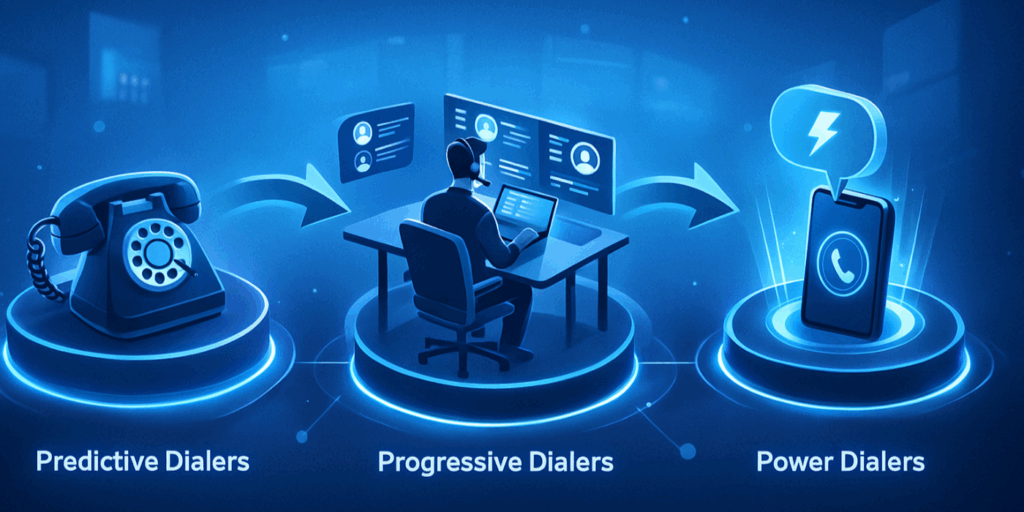
Think of predictive, progressive, and power dialers as three different answers to one question: “Who controls the pace of outbound — the machine, the rep, or a mix of both?” A power dialer keeps life simple: one rep, one record, one click-to-dial loop. It’s faster than pure manual but still rep-driven, much like early outbound setups before AI reshaped the floor, described in modern sales acceleration breakdowns.
A progressive dialer automates more of the workflow. It automatically dials the next record only when a rep is free, enforcing a one-call-per-agent model with better pacing and list hygiene. A predictive dialer goes further: it dials ahead of availability using algorithms to predict when reps will free up, pushing utilization close to the legal and practical limits. In 2025, the smartest predictive engines also bake in compliance, consent, and AI scoring, similar to how advanced stacks treat the dialer as part of a full contact center operating system.
2. Predictive Dialers: Where AI Pacing Wins (and Where It Backfires)
Predictive dialers are built to maximize talk time. They look at historical handle times, abandonment thresholds, and agent status, then dial multiple numbers in parallel so that whenever a rep wraps a call, a new conversation is already ringing. When tuned well, they can feel like the “auto-pilot” of high-volume outbound, especially in environments where teams run sophisticated predictive dialing strategies instead of random list blasts.
The risk is that bad predictive logic can easily cross lines. Over-dialing leads to abandoned calls, frustrated prospects, and regulatory trouble. That’s why modern predictive implementations pair AI pacing with strict legal guardrails, consent management, and DNC logic aligned with frameworks like 2025 outbound compliance guides. Predictive shines when you have big, healthy lists, consistent handle times, and clear playbooks. It struggles when data is messy, volumes are tiny, or your team is still learning the motion.
3. Progressive Dialers: Controlled Speed with More Context
Progressive dialers were built for leaders who didn’t trust full-blown predictive. Instead of dialing ahead, they wait until a rep is available, then automatically place the next call in the list. No parallel dialing, no abandoned calls; the dialer simply removes the “click-and-wait” cycle so agents can focus on live conversations. This is the mode many teams adopt when they’re modernizing from click-to-call setups to more structured outbound engines, inspired by revenue-first dialer designs.
Because progressive dialers keep one rep on one call at a time, they’re usually easier to govern, especially in regulated industries and high-trust markets. Supervisors can still monitor pacing, list quality, and outcomes in real time, but they don’t have to worry about large spikes in abandoned calls. Progressive becomes especially powerful when paired with real-time agent assist and CRM context, similar to how AI coaching layers on top of dialing in AI-assisted outbound teams.
4. Power Dialers: When “Simple and Fast” Is Still Enough
Power dialers are the spiritual successor to “accelerated manual dialing.” The dialer automatically moves to the next record as soon as a rep clicks or finishes a call, but there is no predictive math. One line per rep, one call at a time, with minimal automation beyond list progression. In early-stage teams and boutique B2B motions, that simplicity can be a feature, not a bug, especially if your reps are high-skill, low-volume closers rather than volume-driven SDRs.
The problem is that power dialers can easily become a ceiling. At some point, you hit a limit on how many calls a rep can realistically push while still taking good notes, updating CRM, and handling objections. That’s why more mature operations treat power mode as a stepping stone inside a broader modernization path, similar to the journeys laid out in legacy-to-cloud migration roadmaps. You don’t have to throw power dialing away; you just have to stop pretending it’s enough for scaled outbound.
5. How Dialer Choice Impacts Your Stack, Metrics, and CX
Dialer mode isn’t a cosmetic setting — it shapes how you design routing, reporting, and coaching. Predictive environments behave more like full contact centers. You need clear SLAs around abandonment, robust reporting, and a telephony core that can keep up, similar to the architectures described in zero-downtime cloud call systems. That also means investing in clean integrations into CRM and ticketing so every call outcome feeds the rest of your funnel.
Progressive and power-heavy stacks can feel lighter, but they still benefit from disciplined metrics and tooling. Track connect rates, conversion, and revenue per hour like the mature operations in modern KPI frameworks. The more your dialer is treated as part of an integrated CCaaS and VOIP platform rather than a standalone widget, the easier it becomes to evolve between modes as your business, regulation, or markets change.
6. Where Each Dialer Wins: Real Scenarios, Not Abstract Theory
Picture a 120-seat outbound BPO serving insurance, telco, and utilities. Lists are massive, contact rules are strict, and margins are thin. Here, a compliant predictive dialer paired with clear pacing rules, AI QA, and strong contact policies can be a superpower. It’s the kind of environment where playbooks similar to large-scale dialer comparisons actually come alive as you balance cost, speed, and regulation.
Now switch to a 20-seat B2B SaaS pod selling into mid-market accounts. Deal sizes are larger, lists are smaller, and every conversation demands research and nuance. In that world, progressive becomes your default, often blending with power dialing for strategic account sweeps. You still want integrations, VOIP resilience, and stack design similar to global-ready cloud PBX platforms, but your priority shifts from “more dials” to “smarter sequences and better conversations.”
Finally, imagine a founder-led enterprise motion with a handful of high-value prospects. Here, a power dialer is usually enough. Your main upgrade path isn’t more aggressive pacing; it’s adding AI summarization, call scoring, and long-term account memory. Over time, as that motion scales, those same teams often graduate into progressive or predictive modes, mirroring the staged modernization paths seen in IT cost optimization blueprints.
7. Implementation Roadmap: Moving From “Whatever the Dialer Has” to an Intentional Mix
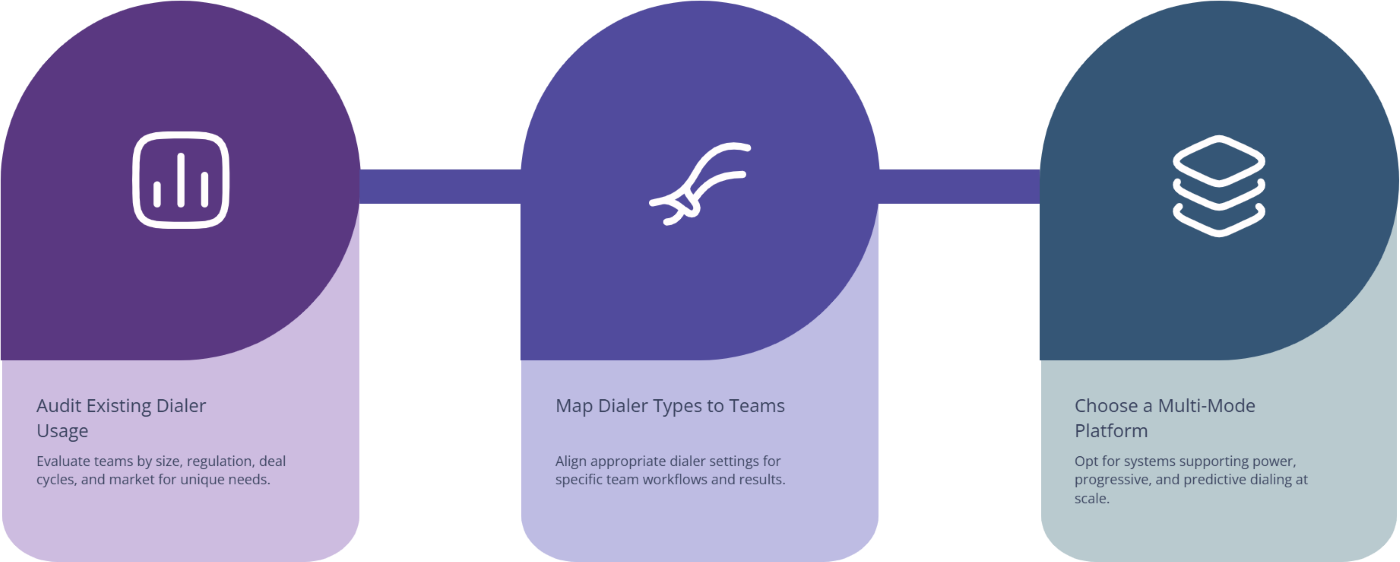
Step one is to stop treating dialer mode as a checkbox. Audit each team: list size, list source, deal cycle, regulation, and target markets. Map those against the strengths and weaknesses of each dialer type. You’ll likely find that your support upsell pod, cold SMB program, and enterprise account teams each deserve different defaults, just like different sites in a global network deserve tailored VOIP designs as seen in multi-country telephony case studies.
Next, pick a platform that supports multiple modes natively instead of forcing you into one pattern. That lets you start where you are (often power or progressive), then graduate into predictive once lists, consent, and processes are mature. Treat your rollout like any other critical migration: phased, measured, and reversible. Many organizations follow playbooks similar to downtime-free cloud call center cutovers, starting with non-critical campaigns before moving revenue-heavy motions onto new dialer logic.
Finally, design feedback loops. Weekly reviews for pacing, abandonment, conversion by mode, and rep sentiment prevent surprises. Layer AI QA and agent assist incrementally, not all at once, borrowing coaching patterns from real-time coaching engines. In a year, your dialer will feel less like a monolith and more like a flexible toolkit you can reshuffle as markets, regulations, and products evolve.
8. FAQ — Choosing Between Predictive, Progressive, and Power Dialers in 2025-2026
Predictive, progressive, and power dialers are not competing religions. They are tools that should flex with your markets, lists, and risk profile. In 2025, the strongest outbound and contact center teams don’t argue about which mode is “best.” They design stacks where each mode has a clear job, where AI assists rather than overwhelms, and where dialer strategy is tightly coupled to revenue strategy — not just to how many calls fit into an eight-hour day.