

Setting up a call center anywhere in the UAE isn’t just about finding cheap seats and buying headsets. It’s about proving to regulators, banks, fintechs, and global brands that you can handle voice, data, and recordings without creating legal risk. Done right, a UAE call center becomes a magnet for GCC and international clients who care about uptime, multilingual support, and clean governance. Done wrong, one audit or complaint can stall your contracts before the first invoice. This guide walks you through licensing, telecom, data protection, call recording, outbound rules, AI usage, and vendor selection so your operation looks enterprise-ready from day one.
1. Map Your UAE Call Center Model Before You Touch Licenses
“Call center in UAE” can mean a handful of agents in Ajman answering WhatsApp calls, or a multi-site operation with hundreds of seats supporting GCC banks. Before you speak to any free zone, sketch a one-page model: inbound support, outbound sales, collections, or blended? Are you building an internal CX hub for your own product, or a BPO that sells capacity to clients the way global outsourcers do in high-volume offshore markets? Your choices here drive everything from your trade license category to how strict your data and recording posture must be.
Next, decide your footprint. Many founders launch in Dubai or Abu Dhabi but serve clients across all seven emirates and beyond. Clarify whether agents will sit in a single office, multiple emirates, or fully remote using a cloud voice layer modeled on hardware-free VoIP deployments. That decision informs how you design your contracts, how you handle employment law across locations, and how you architect your network for latency and redundancy.
2. Licensing and Legal Structure: Mainland vs Free Zone
In the UAE, compliance starts with the piece of paper that defines what you are allowed to do. Your first decision is mainland versus free zone. Mainland licenses generally suit providers who want full access to onshore government and regulated clients, while free zones like Dubai Internet City, DMCC, or ADGM can be attractive for tech-heavy or export-oriented operations. Take time to map your target industries against your legal options instead of picking solely on cost, the way some legacy voice shops did before migrating to modern stacks described in PBX migration roadmaps.
Match your licensed activities to reality. If you sell outbound sales, service desk, and technical support, your trade license should reflect those functions explicitly. This matters when banks, insurers, or healthcare providers ask for documentation. When your activities are vague or misaligned, compliance reviews drag, and you look less credible than competitors whose documentation cleanly matches their pitch. Work with a corporate services provider who understands call center categories instead of accepting a generic “consultancy” label that doesn’t support your long-term growth.
3. Telephony, Numbering, and Recording Rules
Many UAE call centers still carry technical debt from older PBX setups, where every change required hardware tweaks. New operations have the advantage of starting cloud-first: they can run voice, IVR, and routing from a platform similar to the architectures described in zero-lag call center blueprints. When you select carriers and a hosted contact center, consider three things: the right to use VoIP for your business model, access to local and toll-free numbers, and the ability to route calls across regions without falling into grey areas of telecom rules.
Call recording is where compliance, operations, and sales collide. You need clear rules on when you record, how long you keep recordings, who can access them, and what you say to callers about it. For some sectors, customers expect explicit notification. For others, your clients may demand retention windows long enough to cover legal disputes. Choose a cloud platform that lets you vary retention and access by program, much like enterprise-grade call center software solutions do. Build workflows so that one compliance request can find, lock, and export all relevant recordings without manual searching.
4. Data Protection, Cross-Border Flows, and Sector Rules
Global clients increasingly ask “Where will our data sit, and who can see it?” before they ask about your price per minute. Even if your primary storage lives in regional data centers, you will usually rely on a mix of cloud platforms—voice, CRM, ticketing, analytics—that may store or process data in different jurisdictions. Map every system you use, the categories of data it handles, and its residency model, the way serious contact centres do when evaluating integration-heavy software stacks. Without this map, you can’t answer basic security questionnaires.
Sector-specific rules add another layer. Banks may require additional encryption and logging for calls that handle account information. Healthcare providers will care about how you store PHI-like details from patients. Government entities may require data residency within particular zones or prohibit certain cross-border transfers. Use your first few verticals to define opinionated templates: one for financial services, one for healthcare, one for public sector. Each template should specify which tools you can use, which features you must enable, and which data fields must be masked, similar in spirit to how outbound operations codify rules in resources like modern dialing compliance frameworks.
5. Outbound Campaigns, Auto Dialers, and Consent
Outbound calling can transform your revenue—or your risk—depending on how you structure it. Even if the UAE doesn’t mirror US-style TCPA rules exactly, your international clients will often expect similar standards. Treat informed consent, contact sources, and calling windows as design constraints for your dialer and list management tools. Study how mature outbound teams structure campaigns in resources like predictive dialing strategy catalogs and adapt those principles to your jurisdictions rather than reinventing.
Separate compliance logic from individual reps. Use your platform to cap call attempts, enforce quiet hours for each geography, log opt-outs centrally, and restrict what happens when numbers are flagged. When you design dialer logic with the same rigor described in compliance-focused auto dialer architectures, you reduce the chance that one overeager agent creates trouble for your entire operation. Document this logic so that when clients ask “How do you protect our brand?” you can show flows, not just promises.
6. Platform, Integrations, and AI With Governance
Your contact center platform is where compliance either becomes easy or impossible. Choose a cloud stack that supports granular roles, field-level security, and audit logs across voice, chat, and email. It should also integrate natively with CRMs, helpdesks, and workforce tools, the way advanced cloud deployments do in next-generation telephony guides. Avoid architectures where agents copy data between systems manually; that’s how errors and uncontrolled exports happen.
AI is no longer optional, but it must be fenced. Start with clearly bounded use cases: agent assist, after-call summarisation, intent tagging, or QA triage inspired by approaches in AI labor reduction playbooks. For each use case, answer three questions: what data feeds the model, where that data is processed, and who can override AI-generated outputs. When you add customer-facing bots or voice assistants, define escalation rules so sensitive scenarios move to humans quickly. Align this with your Salesforce or CRM strategy, using patterns described in native Salesforce call center integrations so agents never lose context when AI hands off.
7. Workforce, SOPs, and Everyday Compliance Habits
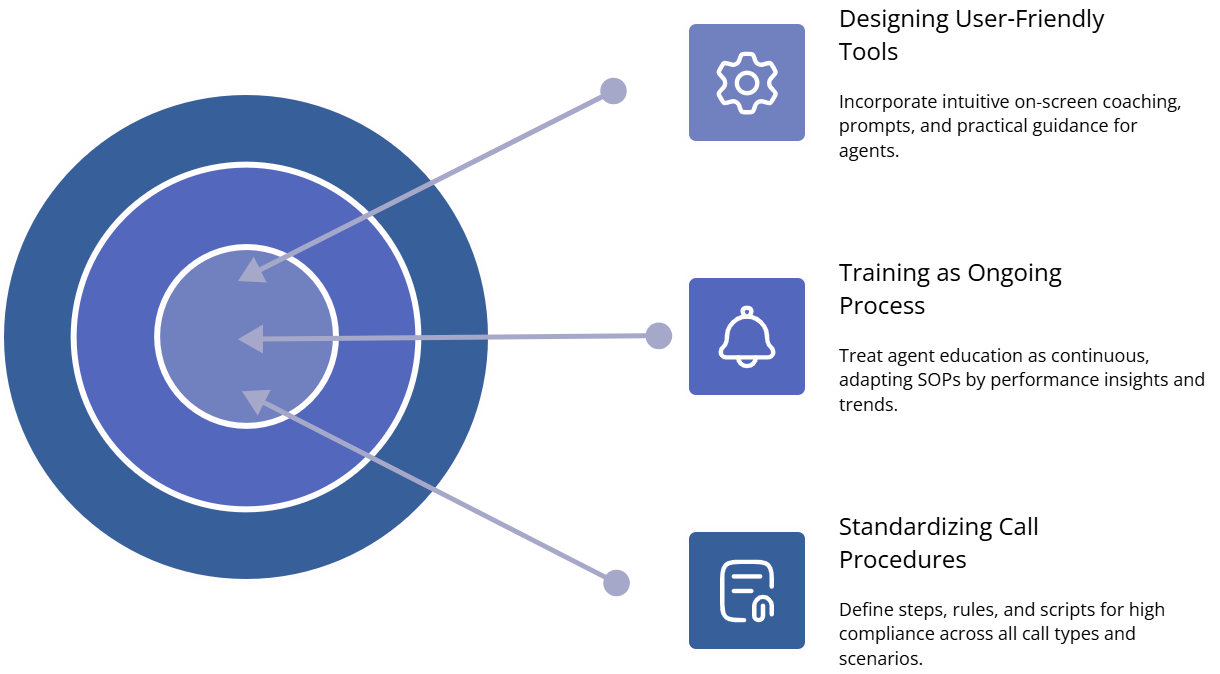
Technology can only carry compliance so far; your agents still decide what’s actually said and done. Treat SOPs and training as first-class assets rather than onboarding paperwork. For each major call type—verification, payment, complaint, escalation—define required steps and forbidden shortcuts. Build scripts, checklists, and decision trees that mirror the best practices you see in high-performing operations documented in ROI-ranked cloud feature studies. Then make it easy for agents to follow them in real time through on-screen guidance and prompts.
Build a cadence that keeps compliance alive. Daily, review basic health: abandon rates, SLA breaches, callback performance, and any unusual spikes in dispositions. Weekly, review QA outcomes, calibration sessions, and edge-case calls—particularly those involving vulnerable customers or complex disputes. Monthly, walk through your change logs: what was altered in routing, IVR, scripts, or permissions. This rhythm mirrors the boring-but-powerful discipline found in world-class operations highlighted in customer-loss prevention frameworks, and it ensures problems surface early instead of during client reviews.
8. 120-Day Roadmap: From Idea to Audit-Ready Operation
Day 1–30: lock your model, choose mainland or free zone, and start licensing. In parallel, shortlist contact center platforms that support multi-channel, strong recording controls, and GCC-friendly routing—an approach similar to how regional buyers evaluate UAE-ready call center stacks. Design your compliance matrix, assign owners, and draft your initial policies for data, recording, and outbound campaigns.
Day 31–60: sign with your voice and platform vendor; configure numbering, IVR, and core queues. Integrate your CRM and helpdesk, following the integrated patterns used in verticalised cloud call center architectures. Build your first SOPs and QA scorecards, set up access controls, and capture your configuration decisions in a lightweight configuration management log so you can always explain why a setting exists.
Day 61–90: hire and train your first cohort of agents and team leaders. Run a pilot with one internal line of business or one external client. Track compliance metrics alongside operational ones: consent adherence, correct disclosures, script usage, recording availability, and proper handling of opt-outs. Introduce light AI support (summaries, tagging) and align it with your documented AI governance model, inspired by best practices from AI-first QA rollouts.
Day 91–120: run a mock audit. Invite a trusted advisor or senior client stakeholder to walk through your licenses, contracts, platform configuration, SOPs, and reports. Stress-test your incident response by simulating an outage or data issue and rehearse your communication plan. Use what you learn to refine documentation, reduce manual steps, and strengthen weak links in the stack, benchmarking your evolution against modern downtime-resilient cloud call centers.
9. FAQs — UAE Call Center Compliance, Answered
When you treat compliance as the backbone of your UAE call center—not a hurdle to clear—you unlock better clients, smoother audits, and a business that scales without constant firefighting. The technology, licenses, and playbooks are all available; your advantage is putting them together with more discipline than the next operator.