
Five9 Alternatives (2026): What Replaces It When You Need Flexibility + Lower Cost

Five9 earned its place as a heavyweight in the contact center world: reliable telephony, proven routing, and enterprise-grade features. But by 2026, many teams
Multiple cloud contact center platforms connected through routing and analytics visuals.

Five9 earned its place as a heavyweight in the contact center world: reliable telephony, proven routing, and enterprise-grade features. But by 2026, many teams find themselves boxed in — locked into inflexible contracts, paying top-tier prices for features they barely use, or fighting to keep up with AI, new integrations, and regional compliance. If you’re asking, “What actually replaces Five9 when we need more flexibility and lower cost?” this guide walks through the real options, the trade-offs, and how to move without breaking your SLAs.

1. Why Teams Go Looking for Five9 Alternatives in 2026

Most organizations don’t leave Five9 because it “stops working.” They leave because their operating model changes faster than their contract. You add new regions, spin up AI initiatives, or bolt on digital channels, and suddenly small changes require large projects. Commercially, you may feel stuck in per-seat pricing that doesn’t match a hybrid world of bots, part-time agents, and seasonality — the exact cost patterns modern stacks expose through metric-driven capacity models.

Operationally, teams hit ceilings around routing sophistication, AI flexibility, or integration depth into CRM and internal systems. You start asking for more nuanced predictive routing, deeper CTI, or TCPA-safe dialers like those described in compliance-focused dialing guides, and realize your roadmap depends on a vendor’s release cycle, not your own. That’s when “Five9 alternatives” stops being theory and becomes an actual project.

2. Evaluation Framework: What “Better Than Five9” Really Means

“Alternative” is meaningless until you define the job your contact center has to do in the next 3 years. At a minimum, you should evaluate any Five9 replacement across six dimensions: telephony reliability, routing and dialer sophistication, AI coverage, compliance posture, integration maturity, and total cost of ownership. Tools that look similar on paper can diverge wildly once you run high-volume campaigns or complex workflows like predictive dialing strategies.

Start by mapping today’s pain: Are you overpaying for licenses that sit idle? Are you export-heavy because reporting doesn’t match how you manage performance? Do you maintain shadow systems for QA, analytics, or workforce management? Answers to those questions decide whether your best alternative is an AI-first CCaaS, a CRM-centric CTI layer, a GCC-optimized voice stack, or a hybrid telephony + AI architecture like those explored in modern cloud telephony futures.

3. Alternative Type 1: AI-First, Labor-Reducing Contact Centers

If your biggest line item is human time — not minutes or licenses — AI-first platforms are often the most compelling Five9 alternatives. These tools treat the call, transcript, and outcome as a continuous loop: real-time coaching, post-call summaries, and automated QA as standard, not add-ons. They mirror the architectures in AI-powered acceleration engines, where manual dialing, wrap-up, and random QA are replaced with automation.

In practice, this means supervisors can see risk phrases, sentiment, and objections across every conversation, while agents get next-best-action suggestions live. QA teams move from listening to a fraction of calls to governing scorecards, as shown in 100%-coverage QA designs. These platforms are a strong fit when you want to shrink handle time, reduce rework, and scale coaching without constantly hiring more team leaders.

4. Alternative Type 2: CRM-Centric CTI (Salesforce, HubSpot, Zendesk)

Many Five9 customers ultimately admit their real “home” isn’t the contact center UI, but Salesforce, HubSpot, or Zendesk. Sales and support live there every day; the phone system is just one channel. For those teams, the best alternative is often a deep CTI integration that makes CRM or helpdesk the true command center, following patterns documented in Salesforce CTI comparison guides and HubSpot integration playbooks.

With CRM-centric CTI, screen pops, click-to-call, call logging, dispositions, and follow-up tasks all live natively in CRM. Routing can use fields like lifecycle stage, MRR, or risk score. Reporting combines pipeline or NRR with call outcomes, like the VOIP + CRM pairings that cut handle time by 40%. This is ideal if “single source of truth” is more important than standalone CCaaS depth.

Five9 vs Key Alternative Types – Flexibility, AI, and Cost Snapshot (2026)
Dimension Five9 (Baseline) AI-First CCaaS CRM-Centric CTI GCC/Arabic-Optimized Stack Hybrid PBX → Cloud Architecture
Typical seat range 50–5,000 30–1,500 15–800 per CRM org 20–800 100–5,000
AI coaching & summaries Available, often add-on Native, real-time, similar to live coaching engines Varies; often app-based Focused on Arabic + English accuracy Added via cloud layer and APIs
QA coverage Sampling by default 100% scoring like AI QA frameworks Depends on QA add-ons QA tuned to language mix Often hybrid: legacy + cloud QA tools
Routing sophistication Strong skills-based routing Intent + value-based routing similar to predictive engines Routing driven by CRM fields Region, language, and time zone aware Routing split between PBX and cloud
Outbound dialer depth Predictive, progressive, power AI-paced dialer flows inspired by manual-dialing replacements Click-to-call + campaigns; less focus on predictive Dialers tuned for GCC regulations Predictive moved from PBX to cloud
Compliance posture Enterprise-ready, but centralized TCPA/GDPR-aware workflows like TCPA-proof designs Aligned with CRM data governance Explicit focus on GCC, DNC, local rules Mix of legacy controls + cloud policies
Arabic / GCC voice support Available, not primary focus Depends on vendor language stack Often Western-centric UI and flows Native Arabic IVR and routing like UAE cloud PBX designs Driven by chosen cloud layer
Integration approach Enterprise marketplace + APIs Focused on AI + automation partners Deep CTI into CRM like high-value integration catalogs Regional CRMs and payment systems Bridges legacy PBX tools with cloud apps
Ideal use case Mature enterprises with stable patterns Teams chasing labor savings & AI visibility Sales/support organizations living in CRM GCC call centers needing Arabic + local numbers Organizations mid-migration from on-prem
TCO over 3 years High, predictable Moderate; offset by labor reduction Moderate; tied to CRM licensing Moderate; savings from regional fit Moderate; savings from retiring hardware using PBX migration playbooks
Highlight the column that matches your next 36 months. Any vendor that can’t support that archetype reliably shouldn’t make your shortlist.

5. Alternative Type 3: GCC / Arabic-Optimized Voice Platforms

Five9 can support global operations, but if a big share of your volume is in UAE, KSA, Qatar, Kuwait, or Bahrain, a region-optimized stack can outperform generic CCaaS. These platforms ship with Arabic IVR, right-to-left prompts, local toll-free and DID options, and routing that reflects regional working weeks — similar to the designs in UAE call center setup guides.

Layer on AI tuned for Arabic speech and dialects, plus analytics tailored for GCC SLAs, and you get a stack that feels native to your customers and agents. When combined with cloud PBX architectures like global VoIP systems, these platforms make it easier to run hybrid offices — on-site teams in Riyadh or Dubai plus remote agents in nearby countries — without fighting latency or brittle call quality.

6. Alternative Type 4: Hybrid PBX → Cloud Telephony Architectures

Some Five9 customers are still carrying legacy PBX hardware for back office, branch locations, or voice recording. In those cases, the most realistic “alternative” isn’t jumping to an entirely new CCaaS overnight, but running a hybrid architecture while you migrate, as mapped in CIO survival guides for telephony. In this model, a cloud platform takes over contact center and external traffic, while PBX handles internal calling until it’s phased out.

The upside is risk reduction: you can move critical queues and outbound campaigns to the cloud with modern dialers, predictive routing, and AI while keeping existing internal extensions live. Over time, you retire PBX features and replace them with cloud capabilities like those in downtime-resistant call center setups. This path is ideal for large enterprises with infrastructure sunk costs and strict change-control processes.

Buying Insights: Why Teams Leave Five9 (and What They Wish They’d Done Earlier)
1. Contracts outlive strategy. Many teams lock into multi-year deals, then add AI, BPO partners, or new regions that don’t fit the original design. A more modular stack, like those in flexible cloud contact centers, would have adapted faster.
2. Voice becomes a data problem. It’s hard to control cost or quality without clean data across systems. That’s why integration catalogs like integration ROI rankings are so powerful.
3. Manual QA doesn’t scale. Large Five9 estates often rely on random sample listening. Teams that moved earlier to AI QA, as in 100% coverage models, now run leaner QA orgs.
4. Outbound risk creeps up quietly. Without a clear TCPA and consent framework, outbound programs accumulate risk. Designs like TCPA-proof dialing systems avoid painful retrofits later.
5. Reporting debt is real. When every big review requires exports and manual spreadsheets, you’re carrying “reporting debt.” Feature-ranked lists like ROI feature benchmarks help avoid that trap.
6. Regional needs get underestimated. GCC teams, especially, underestimate the cost of not having native Arabic IVR and local routing, then later pivot to stacks similar to UAE-focused software reviews.
7. Migration looks scarier than it is. Structured blueprints like PBX migration guides show that staged cutovers are manageable even for large orgs.
8. AI needs clean foundations. Teams that standardized dispositions, outcome codes, and QA forms early benefit most when layering AI on top.
If two or more of these resonate, treat “Five9 alternatives” as a structured roadmap project, not a last-minute vendor swap.

7. Migration Playbook: Moving Off Five9 Without Losing SLAs

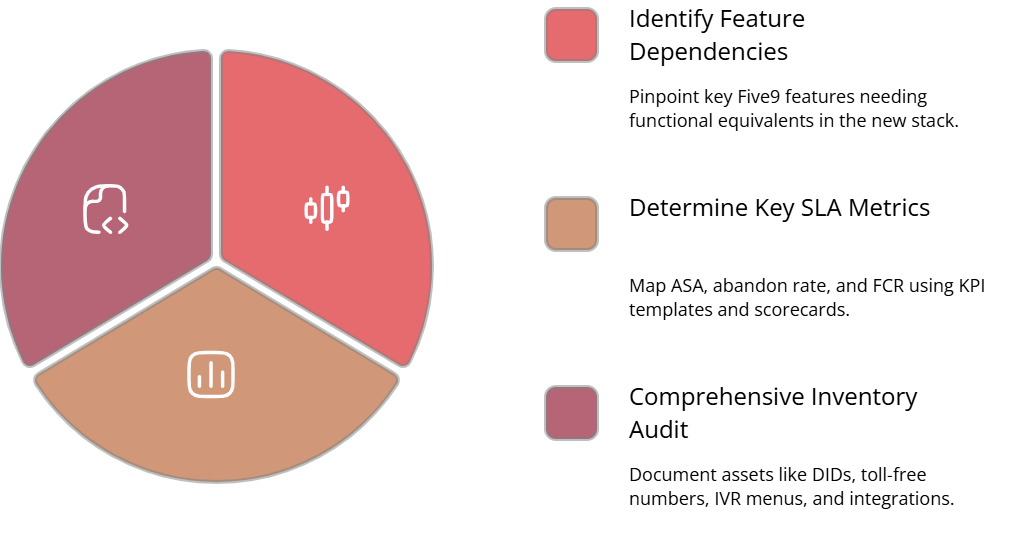
Switching platforms without disrupting customers requires more than a porting request. Borrow from proven telephony migration playbooks: start with discovery, then design, then cutover. Inventory all queues, campaigns, numbers, IVRs, and integrations. Map how each supports metrics like ASA, abandon rate, and FCR, using scorecards similar to those in call center KPI frameworks.

Next, design your target architecture. Decide what moves first: typically, one or two inbound queues plus a subset of outbound campaigns. Port only the numbers you need for that pilot into your new stack, configured with modern routing, dialers, and AI building blocks drawn from zero-downtime architectures. Run both systems in parallel for a few weeks, validate SLAs and call quality, then complete the broader migration in waves.pie chart related to Migration Playbook Moving Off Five9 Without Losing SLAs
8. FAQs: Choosing the Right Five9 Replacement in 2026

What’s the first sign that we’ve outgrown Five9?
The strongest signal is when incremental changes start feeling like projects. If adding a new region, channel, or integration means long timelines, custom work, or unexpected costs, you’ve likely outgrown the original design. Another signal is analytics debt: leadership keeps asking questions you can only answer with exports and spreadsheets, rather than dashboards similar to those in ROI-focused feature sets. Finally, if AI pilots live outside your main stack because integrating them is too painful, it’s usually time to evaluate alternatives.
Will a cheaper alternative always reduce our total cost?
Not automatically. License price is only one part of TCO. A “cheaper” platform can cost more in the long run if it forces manual QA, brittle routing, or poor integrations. The most impactful savings often come from labor and downtime — the same levers highlighted in downtime-focused designs and AI cost-reduction guides. The best Five9 alternative is the one that lets you serve the same or more volume with fewer manual hours and fewer outages, even if the headline license price is similar.
How risky is it to move outbound programs off Five9?
Outbound is where compliance and revenue risk are most concentrated, so you should treat it as a dedicated workstream. Start by documenting consent flows, DNC processes, and pacing rules, then choose alternatives that treat compliance like a first-class citizen, similar to auto-dialer compliance patterns and TCPA-proof system designs. Pilot with a single campaign, validate both connect rate and legal guardrails, and only then migrate the rest.
Do we need to replace everything at once, or can we phase migration?
Phasing is usually safer and more realistic, especially for enterprises. Telephony migrations described in migration mistake guides show that the best outcomes come from staged cutovers: move a subset of queues, keep old and new systems running in parallel, and only decommission legacy flows once metrics stabilize. You can also phase by region, line of business, or channel, rather than treating the entire Five9 footprint as a single “big bang” event.
How do we factor AI into our Five9 alternative decision?
Start with concrete use cases, not buzzwords. Are you trying to improve coaching, expand QA, shorten handle time, or add self-service? AI coaching and QA designs like live agent assist and automated scoring show the biggest gains when you already have clean dispositions, well-defined scorecards, and solid routing. Choose platforms where AI is tightly embedded into workflows you already understand, rather than bolt-on experiments that live outside your main stack.