
Keypad IVR was built for an era when customers were patient and call flows were simple. By 2026, your callers will expect something closer to a smart conversation: they’ll speak in Arabic, switch to English mid-sentence, mention a branch location, and expect your system to understand, route, and resolve without forcing “Press 1 for billing” repetition. For GCC and wider multilingual markets, conversational IVR is no longer a nice experiment — it’s the only way to keep up with expectations, rising labor costs, and complex queues. Done right, it reduces wait times, shrinks transfers, and quietly removes pressure from your agents and supervisors.
1. Why Legacy Keypad IVR Breaks in Arabic and Multilingual Markets
Traditional IVR menus only work when customers are willing to listen to long trees and remember option numbers. That breaks the moment someone calls from Dubai, Riyadh, Doha, or Karachi and expects to talk naturally in Arabic, English, or a mix of both. Keypad flows were never designed for code-switching, regional accents, or free-form questions like “Did my refund for last week’s order go through?” Modern call centers that still rely on rigid menus see high zero-outs, low self-service, and abandoned calls — exactly the customer-loss patterns described in advanced contact center retention playbooks.
By 2026, the gap between “press 1” IVR and conversational systems becomes visible in your P&L. Legacy IVR increases handle time because agents spend the first 60 seconds re-qualifying what the customer wanted. Conversational IVR, on the other hand, can greet in Arabic, recognize intent in real time, and reach the right queue with context attached. That’s not just better experience; it’s how you keep queues stable while volumes and expectations rise in parallel.
2. What “Arabic + Multilingual Conversational IVR” Really Means
Supporting Arabic isn’t just about adding one language pack. Gulf customers speak Emirati, Saudi, Egyptian, Levantine variations, often blended with English or South Asian languages. A future-ready IVR must cope with greetings like “Assalamu alaikum, I need to change my card limit today” without forcing callers back into rigid menus. It should also recognize place names, product nicknames, and brand-specific terminology across languages, the same way leading multilingual Dubai call center stacks align routing with local realities.
True multilingual handling also means switching language mid-journey. A caller might start in Arabic for authentication, switch to English to discuss a technical setting, and then receive SMS or WhatsApp follow-up in their preferred language. Conversational IVR in 2026 needs explicit rules, training data, and fallbacks for these scenarios, not just a checkbox labelled “Arabic available.” Without that depth, you risk sounding modern while still delivering the same old frustration.
3. Inside the 2026 Conversational IVR Architecture
A serious multilingual IVR stack has five core layers: telephony, speech recognition, natural language understanding, orchestration, and data. Telephony handles SIP trunks, carrier connectivity, and call control — often delivered via cloud platforms similar to global VoIP phone systems. Speech recognition turns audio into text across Arabic and other languages. NLU maps that text to intents, entities, and next steps. Orchestration engines decide whether to self-serve, escalate, or trigger outbound workflows. Data pipelines then feed analytics, AI training, and reporting.
By 2026, you’ll see more stacks where conversational IVR and agents share a common brain. That means one routing engine for voicebots and humans, one profile for the customer, and shared logic for SLAs. The same path that connects from SIP to AI in modern telephony designs — like those described in next-generation cloud telephony journeys — becomes the foundation for your IVR, not a side project running on a separate vendor.
4. Designing Conversational Journeys Instead of Menu Trees
In 2026, the best IVR experiences feel like short guided conversations, not mazes. That means designing flows where the system confirms intent (“You want to reschedule tomorrow’s appointment, right?”), checks key details, and either resolves fully or transfers with context. Skills-based routing becomes the underlying engine: once the IVR knows who the caller is and why they’re calling, it must find the right agent or bot queue instantly, the same way advanced predictive routing engines match customers to agents based on value and history.
Multilingual journeys add more branches: language preference, channel hand-off, and choice between self-service and assisted. The future of conversational IVR uses all three. A caller might authenticate with voice, resolve a simple query via bot, then receive a proactive SMS link to a help article or payment page. The aim is not to trap customers in automation but to move them through the lightest-touch path that still feels respectful and human.
5. Data, AI Training, and Integration with the Rest of Your Stack
Conversational IVR is only as smart as the data and examples it learns from. That’s why leading teams feed it transcripts, tags, and outcomes from past calls instead of artificial sample sentences. This requires a clean flow of interaction data from your contact center platform into CRM, helpdesk, and analytics, similar in spirit to high-value integrations detailed in integration-centric call center blueprints. Every resolved call, escalation, and callback becomes training material for better intent recognition.
Arabic + multilingual setups need extra care: you’ll want labelled examples for each dialect, common mixed-language phrases, and localized entity dictionaries (branch names, city spellings, brand variants). As your IVR improves, you can reuse the same models for live agents through real-time assist, like the approaches used in agent coaching engines. The result is a shared intelligence layer where bots and humans learn from the same conversations instead of competing for attention.
6. How to Measure Conversational IVR Success by 2026
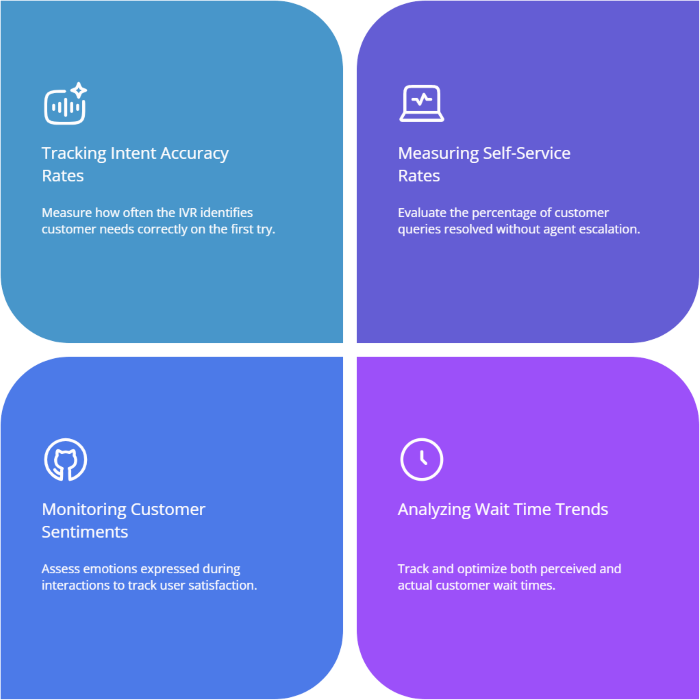
Keypad IVR was judged mostly on call containment and cost. Conversational IVR adds more nuanced metrics: intent recognition accuracy, successful self-service rate, sentiment during bot interactions, and agent feedback about transfer quality. You still track wait times, abandons, and SLA, but now you also watch how often the IVR reaches the right intent on the first attempt. Mature teams borrow KPI sets from modern efficiency scorecards and adapt them specifically for voicebot journeys.
ROI shows up in labor and revenue. If conversational IVR handles authentication, basic queries, and simple updates, agents can focus on high-value conversations. That’s how some operations justify investments in AI and routing by comparing pre- and post-automation cost per interaction, similar to how they evaluate ROI-focused feature upgrades. The future isn’t just fewer calls; it’s better use of the human time you still pay for.
7. Regional Roadmaps: Rolling Out Conversational IVR Across GCC and Asia
Many organizations won’t flip the switch globally in one go. Instead, they’ll start in one flagship market, prove the model, then expand. A typical pattern is to pilot in the UAE or KSA, then extend to Qatar, Bahrain, Kuwait, and beyond, leaning on the same telephony backbone and adapting language models and flows per country. That’s where planning frameworks from UAE call center compliance guides and similar regional playbooks become directly useful for IVR as well.
As you expand, keep two things stable: your core architecture and your governance. Routing engines, recording policies, and global analytics should stay consistent, even as prompts and intents localize. You can reuse lessons from broader call center setup journeys — like those documented for Saudi Arabia and India in GCC build-out plans and India contact center roadmaps — to align IVR evolution with staffing, training, and compliance, not fight it.
8. FAQ: Preparing Your Conversational IVR for 2026
Click to expand each question. Use this as a final checklist before you commit budget or pick a vendor.
Do we really need conversational IVR if agents already speak Arabic and English?
What’s the biggest risk when rolling out conversational IVR for Arabic callers?
How does conversational IVR impact our existing routing and ACD setup?
Where should we start if our IVR is still 100% keypad-based?
By 2026, the winners in Arabic + multilingual markets will be the brands whose IVR feels less like a machine and more like a smart, respectful front door. The technology is already here; the real work is designing journeys, data, and governance so that every spoken word becomes an opportunity to serve faster, smarter, and with fewer moving parts behind the scenes.