
Talkdesk, RingCentral, and 8×8 all pitch the same story: cloud-native, AI-ready, omnichannel, built for modern teams. But when you’re actually scaling from 10 reps to 100+ across regions, the shiny feature grids stop helping. What matters is: which stack keeps calls stable, which one your supervisors can actually control, and which one won’t punish you every time you need a new queue, routing rule, or integration. This guide breaks down Talkdesk vs RingCentral vs 8×8 from a scaling-ops point of view so you can match each platform to the reality of your team, not to a sales deck.
1. Start With Your Scaling Reality, Not the Feature List
Before comparing platforms, force yourself to describe “scaling” in hard numbers: seats today vs seats in 12–18 months, geographies, languages, and channels. A 30-seat hybrid team in one country is a completely different design problem than a 200-seat remote team across three time zones. Map your queue types, volume curves, and SLAs, then ask: which vendor actually makes it easy to build the routing, dashboards, and workflows you need? Use that to shortlist, alongside fundamentals like a strong cloud contact center core and proven telephony in your main markets.
Next, define your “non-negotiables.” For some teams it’s rock-solid inbound reliability; for others it’s dialing power plus strict TCPA discipline; for others, it’s AI that can coach and summarize calls without adding complexity. Write those out before demos. It keeps you from getting hypnotized by cool but low-ROI features and helps you see whether Talkdesk, RingCentral, or 8×8 are genuinely aligned with how your operation runs.
2. Telephony, Uptime & Network: Who Actually Keeps Calls Clean?
All three vendors run on cloud telephony, but their strengths show up when traffic spikes, routes cross borders, or your remote agents have less-than-perfect connectivity. For scaling teams, the question is less “Is voice in the cloud?” and more “How does this platform design for jitter, failover, and carrier diversity?” You’re looking for architectures similar to global cloud PBX and VoIP systems, where you can mix local numbers, toll-free, SIP trunks, and remote endpoints without endless custom work.
You should also understand how each platform handles latency and resiliency end to end. Does it offer built-in diagnostics? Can you segment issues by region, carrier, or ISP? Can you design for active-active or hot standby across data centers, like the patterns in zero-downtime call system architectures? If your team is growing fast, “we’ll raise a ticket with the vendor” is not a scalable incident response plan.
3. AI, Automation & Supervisor Control
At scale, AI is not a nice-to-have; it’s how you keep quality high without hiring a small army of QA analysts and trainers. When you evaluate Talkdesk, RingCentral, and 8×8, go beyond “Do you have AI?” and ask how AI is embedded into routing, QA, and coaching. The best experiences look a lot like AI-first QA operations, where every call can be auto-scored, not just a tiny sample.
Look for real-time prompts, suggested responses, and next-best actions that agents actually use, instead of clunky AI sidebars that get closed after week one. You want behavior similar to live AI coaching setups—fitting directly into the call UI, shortening ramp time for new agents, and giving supervisors live visibility into which calls need intervention right now.
4. Integrations, CRM, and the Workflows Agents Actually Use
Integrations are where most scaling projects live or die. Talkdesk, RingCentral, and 8×8 all have integration catalogs, but the question is: how deep do they go into your CRM, ticketing, and back-office tools, and how painful are they to change later? You’re aiming for a pattern like high-value integration playbooks, where every integration cuts swivel-chair work, not just copies data.
If Salesforce drives your world, insist on demos that show tight CTI screens, click-to-dial, screen pop, and data flowing both ways—ideally handled with the kind of native patterns discussed in Salesforce-specific call center guides. If you’re using HubSpot, Zendesk, or a vertical CRM, give the vendor real scenarios in advance (renewal calls, collections calls, VIP support) and ask them to show those flows live, end to end.
5. Pricing, Licensing & the Real Cost of Change
At 20 seats, pricing is simple. At 200 seats across markets, the wrong licensing model will quietly punish you for growing. Compare Talkdesk, RingCentral, and 8×8 not just on per-seat price, but on how they package AI, recording, analytics, and compliance. The goal is to map your likely usage to cost the way you’d map AI features to savings in a plan like AI labor-cost reduction frameworks.
Then factor in “cost of change.” How many people need admin rights to update routing, queues, and reporting? Does every serious tweak turn into a mini-project, or can your supervisors handle most changes themselves? When you’re scaling, the platform that lets you change quickly without breaking SLAs or opening a dozen tickets almost always wins, even if the sticker price isn’t the lowest.
6. Regional Fit, Use Cases & Future Telephony Strategy
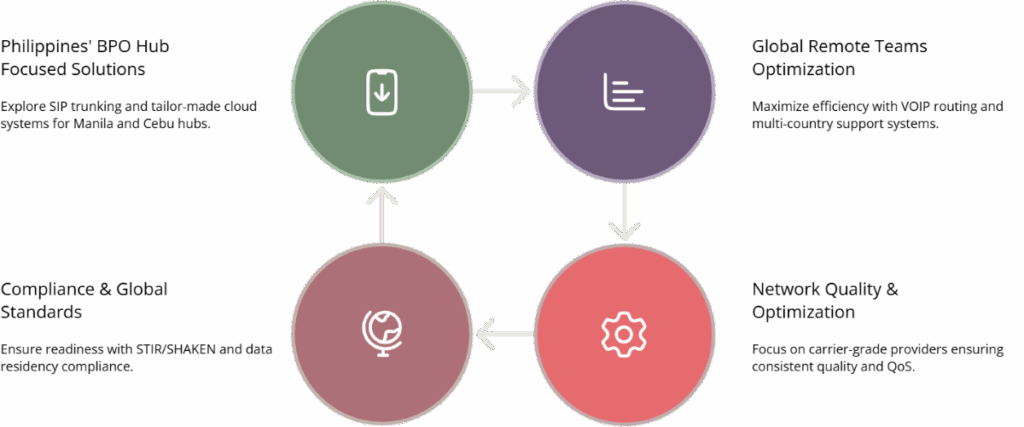
Where you’re growing matters as much as how fast. If you’re building BPO-style hubs in places like Manila or Cebu, you’ll care about the ultra-tight SLA, concurrency, and reporting demands you see in Philippines-optimized architectures. If you’re ramping multi-office remote teams across continents, look for routing, numbering, and QoS that match the multi-country design patterns used in global VoIP scale-outs.
Also check how each platform thinks about the next 3–5 years of telephony. Do their roadmaps line up with “SIP-to-AI” evolutions like those in future-of-telephony blueprints? Or are they still mostly layering AI onto old patterns? You don’t want to do another migration two years from now because your current stack ran out of headroom for the AI, compliance, or routing complexity you need.
7. Migration & Bake-Off: How to Choose Without Risking the Operation
Biggest mistake teams make: turning this into a theoretical debate. Instead, run a contained bake-off. Pick a country, business unit, or channel, and mirror the PBX-to-cloud migration approach in stepwise migration guides: port a subset of numbers, replicate your core queues, and run actual traffic through two contenders side by side for 60–90 days.
During the bake-off, obsess over fundamentals: call quality, reporting truth, agent adoption, and how fast your ops team can adjust routing and dashboards. Track the KPIs recommended in modern metric frameworks—AHT, FCR, transfer rate, occupancy, and QA coverage—on both stacks. The platform that makes weekly improvements easiest, while keeping these metrics stable or improving, is the one that will support you over the next decade.
8. FAQs: Choosing Between Talkdesk, RingCentral, and 8×8 for Scaling Teams
Which platform is best if we expect to double headcount in 18 months?
If your headcount is going to double, prioritize routing flexibility, supervisor control, and telephony resilience over “nice” extras. You want something that behaves like a purpose-built cloud contact center core such as the patterns in downtime-resistant CCaaS designs. In many cases, CCaaS-first platforms feel more comfortable here, but if your collaboration stack is fragmented, a unified UC + CC platform can still make sense—just insist on a live demo of how routing and analytics scale with seats.
How do we avoid overbuying AI features we don’t really use?
Start from concrete use cases: auto-summarization, AI QA, and real-time coaching usually deliver the fastest returns. Map those to features you can see in action, not just bullet points. Then borrow a page from ROI-focused feature rankings: force vendors to show where each AI feature moves AHT, FCR, or QA coverage. If the impact is unclear, treat it as optional for later phases, not as something you must license on day one.
What if we’re already locked into one vendor for phones and meetings?
If your phones and meetings are already with one of these vendors, it can be simpler to extend into their contact center product. Just don’t skip due diligence. Run a realistic pilot like you would when rolling out a new cloud contact center: real queues, real KPIs, real supervisors. If the CC experience feels like an afterthought compared to UC, keep your options open—there are times when a dedicated CCaaS platform paired with your existing UC still makes more sense.
How important is regional compliance (like GDPR or data residency) in this decision?
It’s critical if you operate in regulated regions or industries. Look for deployment options, data residency choices, and compliance documentation that resemble the rigor of compliance-focused cloud deployments. If a vendor can’t clearly explain where your recordings, transcripts, and analytics data live—and how they’re protected—treat that as a red flag, especially if you’re in finance, healthcare, or government contracts.
How do we know when it’s time to move beyond our current platform entirely?
Three signs usually show up together: your ops team spends more time fighting the platform than improving CX; every experiment feels like a mini-migration; and your reporting no longer matches the complexity of your queues and contracts. When those happen, you’re hitting the ceiling of your current stack. At that point, running a bake-off with a more modern, AI-aware architecture—similar to how teams rethink PBX in cost-cutting telephony redesigns—isn’t risky anymore. It’s how you protect your SLAs and margin over the next phase of growth.
If you treat this decision as a one-time “which brand is better?” debate, you’ll get stuck. If you treat it as “which architecture, licensing model, and AI approach matches how we actually scale?”, the right choice between Talkdesk, RingCentral, and 8×8 usually becomes obvious after a single, well-designed pilot.