Most teams do not rip out an on-prem PBX because of one outage. They kill it because every new project runs into the same wall: no APIs, no visibility, no support for remote work, and no way to turn calls into data for AI. In 2025, that is not just a telecom annoyance, it is a strategic ceiling on revenue and customer experience. This roadmap shows you how to move from legacy PBX to AI-ready cloud telephony in controlled steps, with dual running, phased cutovers, and hard guardrails so you keep calls flowing while you modernize.
1. Why Your On-Prem PBX Became a Strategic Risk
Legacy PBX systems were designed for a world where everyone sat in the same building, calls were only on copper or ISDN, and nobody asked for AI coaching or real time analytics. Today, those systems limit everything else you want to do: cloud contact centers, omnichannel routing, and geographically distributed teams. This is why many CIOs now treat PBX migration like other strategic programs, similar to the shift documented in modern PBX evolution playbooks instead of a basic “phone system upgrade.”
Risk is not only about outages. Old PBX platforms create hidden costs in manual QA, hand-built reports, and one-off integrations that break whenever vendors update their products. Sales, support, and finance all feel the drag. At the same time, competitors who already run on SIP and AI cloud telephony can stand up new regions, channels, and AI workflows while you are still negotiating maintenance windows. That is why you need a zero downtime roadmap, not just a list of new features.
2. Define Your Target AI Cloud Telephony Architecture
If you move to the cloud without a clear design, you simply swap one type of complexity for another. Start by sketching your target architecture in three layers: connectivity, control, and intelligence. Connectivity covers SIP trunks, carriers, and emergency calling. Control is your cloud PBX and routing logic, often delivered by a global VoIP and PBX platform. Intelligence is your contact center, analytics, and AI coaching stack. Every vendor and feature you choose should land in one of these layers.
Then map that architecture to business units and regions. A high volume sales or service operation may need a full cloud contact center solution similar in capability to enterprise-ready call center platforms. Back office teams may only need softphones plus basic routing. The goal is a voice fabric that lets you add offices, countries, and workloads with configuration, not new hardware projects.
3. Inventory and Dependency Mapping: No Hidden Lines Left Behind
The biggest threat to zero downtime is not the cloud platform. It is the extension, gateway, or integration nobody remembered until it went dark. That is why you need an exhaustive inventory of numbers, devices, call flows, and contact center routing before you lift a single trunk. Use the same discipline that underpins PBX cost reduction programs: audit, classify, and tag everything as mission critical, important, or safe to retire.
Do not stop at PBX boundaries. Map how voice connects to CRM, helpdesk, identity, and building systems. For each dependency, document how the new cloud stack will provide equivalent or better behavior. This kind of full-path view is what allowed teams in large multi country VoIP rollouts to keep remote staff reachable while consolidating platforms. When you later design pilots and cutovers, this map will tell you which teams must move together and which can wait.
4. Zero Downtime Cutover Strategy: Dual Running Done Properly
Zero downtime does not mean zero incidents. It means every incident has a limited blast radius and a clear recovery path. The core pattern is dual running. You operate legacy PBX and AI cloud telephony in parallel, then move specific numbers, queues, and sites in controlled slices. This is the same mindset that powers resilient cloud call architectures, where traffic shifts gradually instead of in one risky switch.
Start with low risk segments: internal help desks, back office extensions, or a single region. Port or redirect only part of the traffic, watch behavior in real time, and keep rollback plans ready. Use overprovisioned connectivity and redundant SIP trunks so you are never forced to choose between old and new platforms in an emergency. For contact centers, emulate your most important queues and IVRs in the new stack, then slow drip live traffic into them, learning and adjusting as you go.
Run each cutover as a mini program with a war room, live dashboards, and clear decision thresholds for rollback. Borrow the monitoring patterns used in downtime-free call center deployments: track answer rates, abandon rates, error codes, and MOS scores for both legacy and cloud flows during the overlap period. When numbers stay stable across a full business cycle, only then do you declare that slice complete.
5. Add AI and Automation Where It Actually Matters
AI cloud telephony is not just about putting “AI” on a slide. It is about removing manual work and decision fatigue from high volume conversations. Start with areas that already hurt: repetitive QA, slow agent onboarding, and unclear call outcomes. Modern stacks that mirror real time coaching tools can surface prompts, next steps, and relevant knowledge while the call is happening, not days later.
After that, target the work that nobody has time for today. AI QA can listen to every call, score behavior against your playbooks, and highlight the conversations that actually need human review, similar to the patterns in AI-first quality frameworks. Automated summaries and tagging feed clean data into CRM and reporting pipelines, which is the backbone of AI driven labor cost reduction. The key: treat each AI feature as a process improvement, not a novelty.
6. Monitoring, Metrics, and Post-Migration Optimization
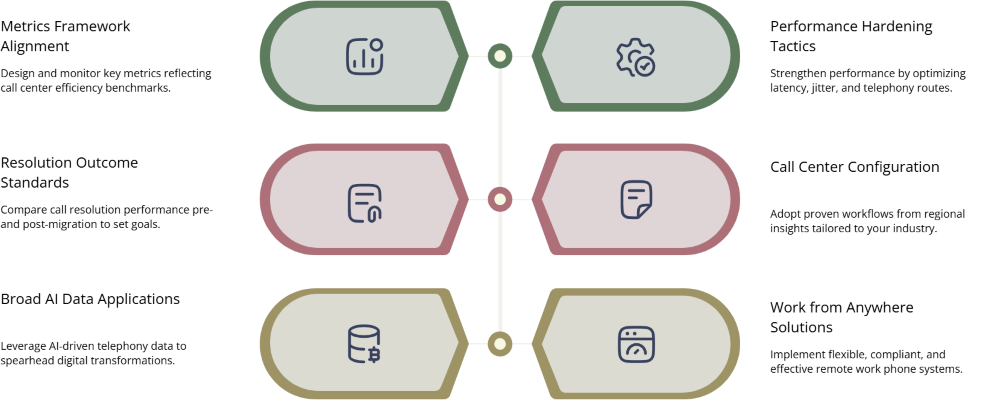
A zero downtime roadmap does not end at the last porting order. Once the PBX is gone, you still need to harden performance and extract value. Start by aligning your new platform’s metrics with a proven measurement framework like the one in call center efficiency benchmarks. Establish targets for answer time, handle time, transfer rates, and conversion or resolution outcomes, and compare them against your pre-migration baselines.
Then expand your view beyond the contact center. Use your AI telephony data to support transformation projects in regions and industries that look like your own. For example, if you run a service hub in India or the GCC, study the kind of setups described in regional call center build guides and adopt their best practices around routing, work from anywhere, and compliance. Your cloud voice fabric should support new lines of business without painful reconfiguration.
As you optimize, keep an eye on lag, jitter, and path quality. The architecture principles behind low latency telephony designs still apply. Test from the edge where agents and customers actually sit, not just from data centers. If certain routes or regions show persistent quality issues, work with your provider to adjust carriers, codecs, or PoPs before users feel the pain.
7. Governance and Roadmap: Treat Telephony Like Core Cloud Infrastructure
Voice is no longer an isolated telecom project. It is a core part of your customer and revenue infrastructure. That means you need the same governance, product thinking, and iteration you give to other cloud platforms. Define clear ownership: a product manager for voice and contact center, a platform team for integrations and reliability, and business owners who set success metrics aligned with the goals in customer retention focused contact center programs.
Build a roadmap beyond “PBX decommissioned.” Plan quarterly increments that add new AI capabilities, channels, and regions, similar to how global teams approached multi market scaling in integration heavy ecosystems. The technology is only the start. The competitive advantage comes from how quickly you can adapt routing, scripts, and workflows to new products, regulations, and customer expectations.
8. FAQ: Moving from On-Prem PBX to AI Cloud Telephony
Moving from on-prem PBX to AI cloud telephony is not a one night cutover. It is a structured program that touches infrastructure, data, people, and customers. If you treat it like any other strategic cloud move, with inventory, architecture, dual running, and continuous improvement, the migration itself becomes uneventful. What stands out instead is what you can do afterward: faster launches, smarter routing, and conversations that finally generate the kind of data your business has been asking for.