

Malaysia is full of founders who know exactly what they want: a business that throws off monthly cash flow, can serve clients in Australia, the UK, the Gulf, and still be run from Kuala Lumpur or Penang without eating their entire life. A call center fits that profile perfectly—recurring retainers, export-ready services, and a workforce that already speaks Malay, English, Mandarin, Tamil, and more. Where most people get stuck is not the idea; it’s turning “let’s start a call center” into a licensed, PDPA-aligned, multi-city operation that doesn’t collapse the first time a client asks about audit trails, uptime, or PCI. This guide walks you through how to design, license, staff, and wire a Malaysia call center that feels enterprise-grade from day one, without overspending or overcomplicating your stack.
1. Decide What “Call Center in Malaysia” Actually Means for You
“Call center in Malaysia” can mean very different things: a 12-seat outbound shop in Petaling Jaya selling B2B demos, a 60-seat CX hub in Cyberjaya supporting e-commerce brands, or a multi-site operation split between Penang and Johor Bahru doing multilingual support for banks. Before you touch licenses or telecom, write a one-page design: inbound service, outbound sales, collections, or blended? Are you running an internal support center for your own product, or a BPO selling seats to clients the way mature teams wrap services around a full cloud contact center stack? Your answer decides how strict your compliance posture must be and which metrics matter most.
Next, fix your geography, languages, and hours. A Malaysia call center that promises 24/7 coverage for Australian and UK clients needs shift design, weekend coverage, and redundancy that looks very different from a local Bahasa Malaysia / English 9-to-6 setup. Decide whether you’ll lean into Malaysia’s time zone to serve APAC, specialise in night-shift US work, or build a hybrid. Those choices drive salary expectations, talent pools (KL vs Penang vs secondary cities), and where you’ll rely on automation rather than headcount.
2. Market Positioning: Which Buyers Will Actually Pay Your Seats?
Malaysia is not the cheapest market in the region, so “we’re cheap” is a losing pitch. Practical buyers include regional e-commerce and SaaS brands, Australian companies that want near-shore support, and banks or insurers who want quality English plus regional language support. Choose one primary lane. If you’re courting regulated industries, your story leans on PDPA-aligned data design, call recording controls, and reliability similar to compliance-first cloud deployments. If you’re targeting global SaaS, you sell quick pilots, strong integration with their CRM and ticketing stack, and predictable SLAs more than raw price per seat.
Turn that positioning into clear offers instead of vague “contact us” pricing. For example: (1) a 10-seat starter pod for DTC brands, (2) a 30-seat dedicated team for fintech or insuretech, and (3) a multilingual shared model for startups. Each offer should define languages, channels, coverage hours, and an SLA promise. Price against value: first contact resolution, NPS, expansion revenue, or recovery rates—anchoring them in disciplined scorecards like those used in modern efficiency benchmarking, not just “calls per hour.”
3. Licensing, PDPA, and Regulatory Foundations in Malaysia
Malaysia rewards founders who respect process. Incorporation itself is straightforward; the nuance lies in choosing the right activity codes, understanding sectoral rules, and designing PDPA compliance properly. Work with a company secretary who has seen contact-center or BPO models before so your business description, contracts, and invoices all say the same thing—customer support, helpdesk, telesales, or back-office. That alignment helps during bank onboarding and when large clients run due diligence, especially those comparing you to providers operating in GDPR-aware markets.
PDPA should not sit in a PDF no one reads. Map your data flows: what personal data lands in your CRM, your call recordings, your analytics platform, and your WFM tools. Decide retention periods for recordings and transcripts per client type. Implement role-based access so only authorised roles can download or share recordings. This groundwork is the difference between “yes, we comply” and being able to show a real data inventory, retention table, and access policy when a bank or international brand asks.
4. Location, Telephony, and Network Design Across Malaysia
One of Malaysia’s superpowers is that you can blend big-city talent with lower-cost satellite locations. You might anchor leadership and training in Kuala Lumpur and spin up smaller pods in Penang or Johor Bahru. Choose based on language pools, salary bands, and client expectations. For example, Australian clients often like hearing agents who sound regionally neutral but confident in English, similar to what they’d expect from mature Australian multi-office voice setups. Decide early how much you want to lean on on-site vs hybrid vs fully-remote models.
On telephony, don’t glue together random PBXs. Start with a carrier-agnostic cloud platform that can host Malaysian and international numbers, handle SIP trunks, and maintain quality across routes. Think about latency and redundancy up front: you want failover between carriers or PoPs and active monitoring of dropped calls, jitter, and packet loss, mirroring the principles used in zero-downtime call architectures. Design IVRs in Malay and English at minimum, and set up queues based on language, skill, and client rather than one generic bucket for “support.”
5. Platform, Integrations, and AI: Building Your Operating Spine
A modern Malaysia call center is more of an integration problem than a telecom one. Your agents need one surface that brings together CRM data, order histories, tickets, and call controls. Start by listing your systems: Salesforce or HubSpot, helpdesk, billing, logistics, and your telephony layer. Choose a platform that supports deep integrations or APIs, the way advanced operators plug dozens of tools into high-value call center integration stacks. The goal is to get rid of “swivel chair” work where agents copy notes between systems after every call.
Once your spine is in place, layer AI on top of it—not instead of it. Begin with real-time agent assist, suggested replies, and knowledge surfacing for complex queries. Combine that with post-call summaries and automatic tagging that feeds consistent data into your reporting. For QA, use AI to triage and score calls so humans review the highest-risk or highest-value interactions, echoing patterns in AI-first quality programs. Document, for each AI feature, what data it touches, where it’s processed, and how long it’s retained so you can confidently answer client questions.
6. Workforce, Training, and Culture Across Malaysian Cities
Malaysia’s labour advantage isn’t only cost; it’s diversity. You can build Bahasa Malaysia and English-heavy teams for local work, Mandarin-speaking pods for Chinese customers, and Tamil or Hindi speakers for regional programs. Decide early how many languages you’ll truly support and which will be premium. Build hiring funnels city by city and design pay bands that reward multilingual expertise and subject-matter depth, similar to how multi-region operations staff customer-retention specialist teams differently from general support.
Training should be structured like a product, not an event. Combine foundational modules (systems, brand voice, PDPA basics) with vertical-specific playbooks—for example, healthcare, fintech, or retail. Use anonymised recordings and transcripts to create “golden calls” and “red flag calls” for each client. Layer in real-time coaching tools so supervisors can whisper-coach or barge when needed, supported by the same philosophy as live AI agent assist. Finally, build an operational cadence: daily stand-ups, weekly performance reviews, and monthly calibration sessions where QA and operations re-align expectations.
7. Money, Margins, and Pricing Models That Survive Reality
You can absolutely build a busy Malaysia call center that loses money on every seat if your pricing and utilisation assumptions are wrong. Start by mapping fixed costs—office (if you’re not fully remote), connectivity, platform fees, leadership salaries—then layer variable costs such as agent pay, benefits, and telecom usage. Model realistic occupancy (70–80%), shrinkage (10–15%), and attrition (monthly churn, not just yearly). Cross-check these assumptions against how mature operators cost out high-efficiency PBX and VoIP setups so you’re not guessing.
For pricing, combine predictability with performance. A base per-seat or per-hour rate should cover direct costs plus a healthy margin; on top of that, add performance fees tied to conversions, retention saves, or revenue per contact where appropriate. Avoid chasing the absolute lowest global price; instead, anchor your value on language coverage, time zone alignment, integration depth, and provable outcomes. When your forecasting, seat plans, and SLA commitments line up with your actual utilisation, you avoid the “busy but broke” trap.
8. 90-Day Execution Plan: From Idea to Live Calls in Malaysia
Days 1–30: Finalise your model, primary verticals, and geographies (KL-only vs multi-city). Incorporate the company and align activity codes with your real services. Draft your PDPA data map and retention policy. Shortlist contact-center platforms and run demos focused on routing flexibility, reporting depth, and integration options, similar to how buyers evaluate ROI-focused feature sets. Sketch your telephony architecture: which numbers you need, which carriers you’ll use, and how failover works.
Days 31–60: Sign with your chosen platform and telecom partners. Configure IVRs, queues, skills, and recording policies. Integrate CRM and helpdesk so agents can work from one surface, mirroring the discipline in global cloud PBX deployments. In parallel, hire your first team lead and a small cohort of agents. Run structured bootcamps that mix classroom learning with live system practice. Conduct internal test campaigns where staff call each other, stress-test reports, and rehearse outage and data-incident scenarios.
Days 61–90: Launch a controlled pilot with one client or one internal line of business. Track SLAs, AHT, FCR, abandonment, CSAT, and schedule adherence daily. Introduce bounded AI: summaries, tagging, and limited agent assist where you can easily measure impact, taking cues from AI cost-reduction playbooks. Run a structured review at day 90 covering PDPA compliance, security posture, platform configuration, and people performance. Use that to refine contracts, SLAs, and pricing before you scale seats or sign larger, more complex clients.
9. Risk Management and Common Failure Patterns in Malaysia Call Centers
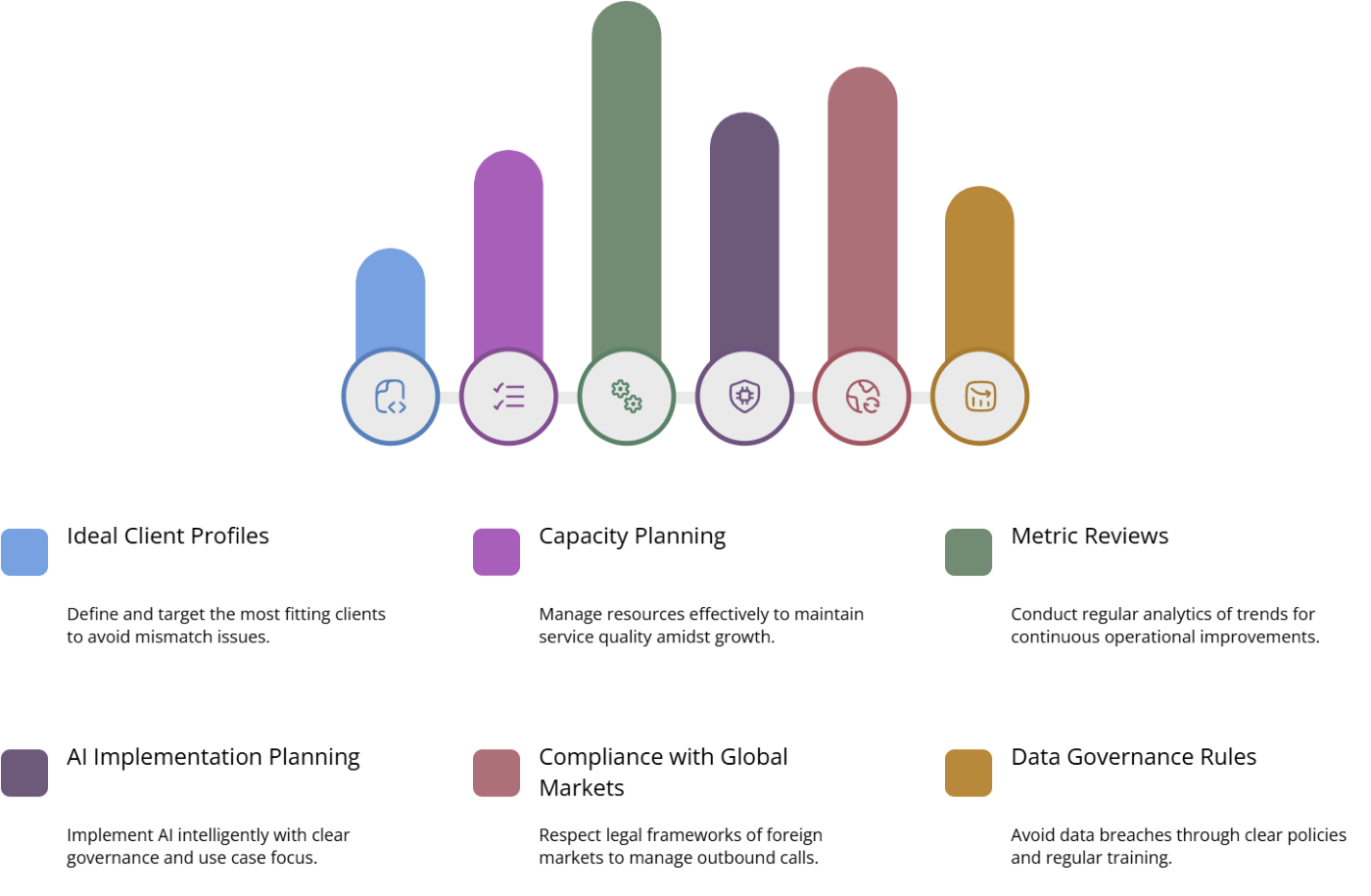
Most Malaysia call centers don’t fail because of missing features; they fail because they grow in the wrong direction. Typical patterns: signing any client who waves money, then trying to serve wildly different use cases from one generic queue; hiring too quickly before you’ve proven demand; or adding AI hastily without thinking about governance. You avoid these traps by defining your ideal customer profile, enforcing capacity discipline, and running weekly metric reviews that look at trends, not just snapshots—similar to how advanced teams monitor uptime and incident patterns to stay ahead of issues.
Regulatory and reputational risks also matter. If you’re doing outbound for foreign markets, you must respect their consent and dialing rules, not just local ones—using principles borrowed from modern dialer compliance frameworks. Data incidents, even small ones, can damage your brand if handled poorly. Maintain clear runbooks for outages, data breaches, and major client escalations, and rehearse them. The aim is not to eliminate all risk—that’s impossible—but to make sure that when something goes wrong, you respond in a way that makes clients trust you more, not less.
10. FAQs — Setting Up a Call Center in Malaysia
Built properly, a Malaysia call center is more than a room of phones; it’s an export-ready operating system for customer conversations. Get the model, PDPA foundations, telephony architecture, integrations, and people design right up front, and you give yourself permission to grow aggressively without losing control of risk, experience, or margins.