

Saudi Arabia is full of founders and operations leaders who know one thing: the customer expects to reach you instantly, in Arabic or English, from Riyadh to Jeddah to Dammam. But choosing the “best PBX phone system” isn’t about buying the flashiest cloud logo or overpaying for hardware you don’t need. It’s about designing a voice layer that can handle multi-branch growth, strict governance, Arabic IVR, and hybrid teams without constant firefighting. This guide walks you through how to choose, architect, and roll out PBX systems in KSA that feel enterprise-grade from day one, whether you’re upgrading a legacy box or building from scratch.
1. What “Best PBX Phone System” Means in Saudi Arabia in 2025-2026
In 2025, a “PBX” in KSA isn’t just a box in a server room. It’s a cloud-first voice platform that can host Saudi DIDs, international numbers, toll-free lines, and internal extensions in one place. The best setups behave like a modern software-defined phone system: one admin console, one routing brain, and unified reporting across branches, remote staff, and future call center teams.
For Saudi businesses, “best” usually means four things: Arabic-first IVR but easy English and regional languages; resiliency across multiple ISPs and trunks; compliance-ready recording and retention; and a clean upgrade path into full contact center and AI. If your PBX choice doesn’t make it easy to add queues, skills-based routing, or a cloud contact center layer later, you’re buying a dead end, not a platform.
2. Cloud vs On-Prem PBX for Saudi Businesses
Many Saudi companies still run on-prem PBX hardware bought years ago. It feels “safe” because it’s in your building, but you pay for that comfort in rigidity, maintenance, and downtime risk. Cloud PBX shifts the intelligence into managed data centers and turns features into configuration, not cabling. That’s the logic behind modern PBX migration projects worldwide: fewer moving parts on-site, more control from an admin dashboard.
On-prem can still make sense in very specific cases, but most growing KSA firms benefit more from cloud or hybrid: remote-friendly, carrier-agnostic, and ready for multi-region growth. To make the choice concrete, use a comparison matrix like this.
3. Architecture: Zero-Downtime Voice for KSA Branches and Remote Teams
Whatever PBX path you choose, the architecture must assume that voice is mission-critical. Think multiple SIP trunks, smart routing, and real-time monitoring, not just “phones that ring.” The patterns behind zero-downtime call systems are a good benchmark: multi-region failover, health checks on carriers, and alerting when latency or jitter spikes.
For Saudi companies with branches in Riyadh, Jeddah, Dammam, and beyond, the PBX should treat these locations as edges on one network, similar to how multi-office VoIP deployments work elsewhere. Agents in different cities log into the same PBX, share queues when needed, and enjoy consistent call quality. Remote and hybrid work become a configuration choice, not a special project.
Plan for monitoring and observability from day one. Dashboards should show per-number and per-queue performance, as well as trunk health. Without this visibility, you’ll blame ISPs for issues that are actually routing misconfigurations or codec problems—and spend weeks chasing ghosts.
4. Features That Actually Matter in Saudi PBX Evaluations
PBX demos are full of shiny features, but only a subset moves real KPIs. Before you talk to vendors, classify features into three buckets: must-haves, high-impact, and nice-to-haves. ROI-focused frameworks like feature impact rankings show that core capabilities—reliable routing, good reporting, and easy admin—beat niche functions almost every time.
For KSA markets, must-haves usually include: Arabic and English IVR; queue-based routing with overflow; recording and secure access controls; Salesforce/HubSpot or core CRM integration; Microsoft 365 and identity integration; WebRTC and softphone support; and clear support for future contact center requirements. High-impact options: call-back in queue, VIP routing, basic wallboards, and simple self-service flows for common requests.
AI, if used correctly, upgrades all of this instead of sitting on the side. Think real-time agent assist presenting suggestions during calls, and post-call analytics that auto-summarize and tag reasons. That’s the kind of capability seen in live coaching platforms and AI cost-cutting toolkits: it shortens ramp time for new agents and slashes manual documentation effort.
5. Multi-Site, Remote, and Regional Voice Expansion from Saudi Arabia
Most Saudi PBX projects don’t stop at one city. You might start with a Riyadh HQ and then add Jeddah, Khobar, or remote teams across the Kingdom. A modern PBX should make that easy: new sites become configuration items, not new hardware deployments. This is exactly how globally scaled VoIP environments are built: all sites under one virtual umbrella, with routing and analytics at the center.
If you plan to serve GCC or international customers from KSA, think ahead about international DIDs and routing models. Your PBX should be able to host Saudi numbers and, later, numbers from UAE, Qatar, or Europe—similar to global phone system designs. This avoids spinning up separate phone systems for each country and lets you keep one dashboard for everything: abandonment rates, AHT, SLAs, and usage by region.
Remote and work-from-home models matter too. Ensure the PBX performs well over typical Saudi home internet connections and supports secure WebRTC or softphone apps. Agents should get consistent call quality whether they’re in an office in Riyadh or at home in Taif, with the same controls and workflows.
6. Managing Costs and ROI for PBX in KSA
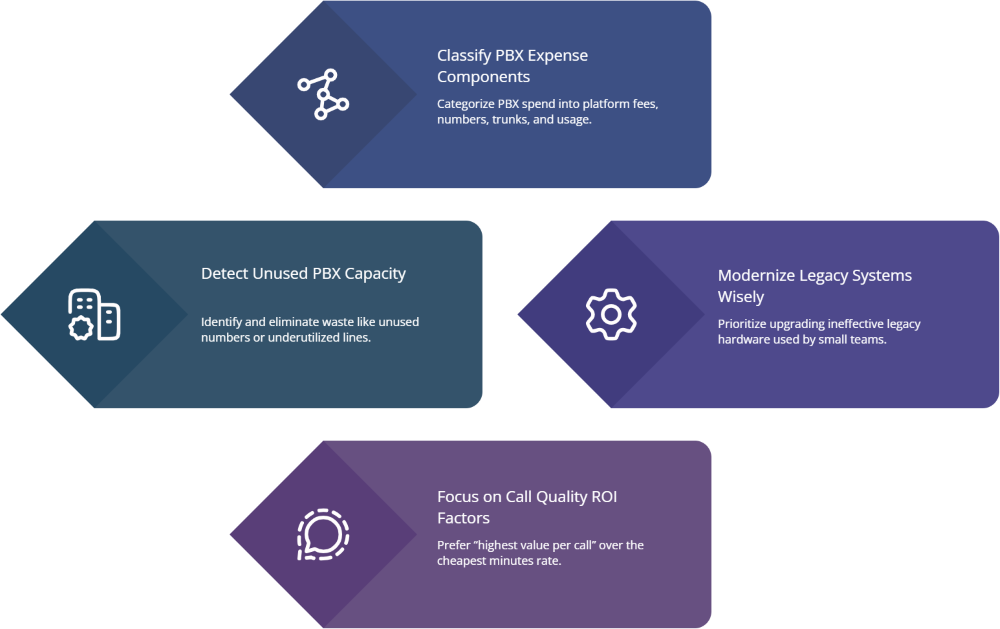
PBX upgrades are often justified as “modernization,” but finance teams care about real ROI. That’s where cost-optimization patterns from PBX cost-cutting studies become useful. Start by categorizing spend into three buckets: platform fees, numbers and trunks, and usage. Then find waste: unused numbers, underutilized lines, or locations still using legacy hardware for only a few seats.
The target is not necessarily “cheapest minutes,” but “highest value per call.” When PBX is tightly integrated with CRM and workflows, calls convert more sales, solve more issues on the first try, and take less handling time. Over time, the best indicator you chose the right PBX is not just a lower bill—it’s higher customer satisfaction, better agent productivity, and fewer outages disrupting revenue.
Finally, treat AI and advanced features as investments with expected returns, not toys. If you deploy AI QA or automation inspired by AI-first QA programs, define upfront how many hours of manual work you aim to remove or what metrics should improve. Otherwise it’s just extra licensing cost with no accountability.
7. Selecting PBX Vendors That Won’t Box You In
When you evaluate PBX vendors for Saudi operations, don’t start with “features.” Start with constraints: data residency, call recording requirements, integration needs, and your 2–3 year expansion plan. Then look for solutions that behave like a clean voice and routing foundation rather than an all-or-nothing monolith. Ask vendors to show you how they handle Arabic IVR, Saudi numbering, and integration with your existing CRM and helpdesk.
Request real architecture diagrams, not just marketing slides. Use technical benchmarks from future-ready telephony roadmaps and integration-heavy environments as reference points: Can they cope with multiple SIs and CRMs? Do they support open standards and flexible APIs? How easily can you switch carriers or connect to a different cloud contact center layer later?
Finally, insist on a production-like pilot. Port a small set of numbers, recreate key IVR flows, and run real traffic through them for 2–4 weeks. Test remote agents, branches, and failover scenarios. A vendor that resists realistic pilots is signaling what working with them will feel like when stakes are higher.
8. 90-Day Roadmap to Modern PBX in Saudi Arabia
Days 1–30: Discovery and target design. Map your existing numbers, flows, and pain points. Interview support, sales, and IT. Document what’s broken: outages, missed calls, confusing IVR, poor reporting. Use materials like the Saudi call center setup playbook as a lens to imagine where you want to be: resilient infrastructure, clean routing, AI-ready foundation.
Days 31–60: Vendor shortlist and pilot. Select 2–3 PBX vendors or cloud platforms and build small environments for each. Mirror a subset of your Saudi numbers, IVR flows, and queues. Let a pilot group of agents run real work in parallel with your legacy system. Track uptime, support responsiveness, admin ease, and integration depth using the same discipline seen in compliance-focused deployments and data-safe voice projects.
Days 61–90: Phased migration and optimization. Choose a winner and migrate in layers: internal lines, then low-risk customer numbers, then core inbound and outbound channels. Build playbooks for change control so IVR and routing are not edited randomly. Begin introducing basic AI (summaries, tagging, light QA) and refine analytics so you can see per-number and per-queue performance. At the end of 90 days, leadership should have a clear before/after story on outages, call outcomes, and cost predictability.
Best PBX Phone Systems in Saudi Arabia: FAQ
Do Saudi businesses still need physical PBX hardware in 2025?
In most cases, no. Physical PBX hardware is now more of a constraint than an advantage. Cloud PBX and hybrid models give you carrier diversity, easier remote work, and quicker configuration changes without racks of gear. The only strong case for on-prem is when regulations or contracts explicitly require it, and even then, many teams pair a small local system with a cloud platform, using patterns similar to resilient voice architectures. For greenfield projects or fast-growing brands, starting cloud-first is usually the smarter move.
How important is Arabic IVR in Saudi PBX design?
Arabic IVR is critical for customer trust and accessibility in Saudi Arabia. Even if many customers speak English, offering Arabic as the default or as an easy option signals respect and local alignment. You don’t need complex trees; short, clear prompts and shallow menus work best, mirroring the customer-focused logic seen in retention-oriented IVR setups. Analytics will tell you how traffic splits by language, and you can refine from there.
How do I compare PBX vendors without getting lost in feature lists?
Start with architecture, not features. Ask each vendor how they handle Saudi numbering, Arabic IVR, remote agents, and integrations. Then evaluate reliability and transparency, using the kind of benchmarks seen in PBX cost and stability studies. Only once these fundamentals check out should you compare features. If a system nails routing, reporting, and integrations, you can always layer on more functions later—while a feature-rich but brittle platform will slow you down.
Can I migrate from my legacy PBX gradually, or do I need a big-bang cutover?
Gradual migration is usually safer and more realistic. You can run legacy and cloud PBX side by side, moving numbers and teams in phases. This staged approach is the same pattern used in many modern PBX migrations: test internally, then move non-critical lines, then your main customer-facing numbers. Throughout, measure performance and user experience to catch issues early, instead of dealing with an all-at-once outage.
Where should call recordings be stored for Saudi operations?
That depends on your regulatory obligations and your customers’ expectations. Many cloud PBX and contact center vendors offer region-aware storage, encryption, and retention controls, similar to the transparency practiced in privacy-sensitive voice deployments. Define your requirements clearly: which teams need access, how long recordings must be kept, and what happens if a client requests deletion. Bake those answers into your vendor selection rather than treating recording as a simple toggle.
When is the right time to add AI to our PBX setup?
Introduce AI once your core flows are stable and your data is clean. Start with low-risk, high-value use cases: auto-summarizing calls, tagging reasons, and light QA automation, inspired by AI-driven QA approaches. Then, once agents and supervisors are comfortable, move into real-time guidance or predictive routing, following the principles in intelligent routing playbooks. The key is to measure results and expand gradually, not switch everything on at once.
Choosing the best PBX phone system in Saudi Arabia is less about which logo you pick and more about whether your voice layer is designed like a living system: resilient, observable, multi-lingual, and ready for AI. Get those fundamentals right, and the platform you choose will feel less like “telecom” and more like an adaptable part of your business stack.