

Amazon Connect looked perfect on the slide decks: pay-per-minute pricing, simple flows, deep AWS integration. But by 2025, a lot of CX leaders are quietly asking the same question: “If this is so simple, why does every change require a solutions architect, a Lambda function, and three weeks of testing?” This guide is for teams that feel boxed in by Connect’s limitations and want a clear-eyed view of what it does well, where it stalls, and which alternatives give you enterprise-grade routing, AI, and reporting without turning every tweak into an engineering project.
1. Where Amazon Connect Still Makes Sense in 2025-2026 (And Where It Doesn’t)
Amazon Connect is strongest when you already live inside AWS and have engineers who treat Lambda, S3, and DynamoDB as muscle memory. In those environments, Connect becomes a toolkit: you stitch together IVRs, queues, bots, and data pipelines to create something highly customized, similar in spirit to how teams design downtime-resistant cloud centers. If that’s you, Connect can be part of a powerful architecture.
Where it struggles is everywhere else: mid-market CX teams without dedicated AWS engineers, BPOs that need to onboard new clients in days, and revenue teams that want powerful outbound, QA automation, and coaching out of the box. Those teams don’t want a Lego kit; they want a finished machine with clear controls, similar to all-in-one cloud contact center platforms that ship with routing, analytics, and integrations already wired.
2. Amazon Connect Limitations at a Glance (And What Better Alternatives Look Like)
Before we dive deep, it helps to see Connect’s recurring pain points next to what a modern alternative should deliver.
3. Engineering Tax and Time-to-Value: The Biggest Hidden Cost
Every platform has a price. With Amazon Connect, you pay relatively little upfront for licenses, but you pay heavily in engineering time and cognitive overhead. Building IVRs becomes Flow + Lambda + Lex + CloudWatch. Reporting becomes Kinesis + Redshift + QuickSight. None of that is wrong — it’s just expensive in human hours. Compare that to platforms designed from day one as business-owned tools, informed by ROI-ranked feature sets, where supervisors can own flows and experiments without a ticket to the dev team.
The test is simple: when your CEO asks for a new call route or a different SLA policy, how long does it take? A good alternative should let you sketch a change in the morning and watch it live by the afternoon. If that’s not the case, you’re not just overpaying in engineering hours; you’re handing your competitors cycles where they can adapt faster with opinionated cloud call center stacks like those used in scalable US-based deployments.
4. AI, QA, and Coaching: Why “Building Blocks” Aren’t Enough
Connect gives you pieces for AI — transcription, sentiment, bots — but it doesn’t hand you a finished AI QA program or coaching engine. To get to the kind of 100% coverage described in AI-first QA approaches, you have to design the pipeline yourself. That’s fine if you have a data science team and months to experiment. It’s not fine if you just want to stop listening to 2% of calls and guessing the rest.
Alternatives increasingly ship with auto-scoring, phrase detection, and summary generation ready to test in days, plus real-time assist that nudges agents while the customer is still speaking, similar to the playbooks in real-time coaching setups. The magic is not just the AI; it’s how quickly you can plug that AI into your QA scorecards, coaching workflows, and team dashboards without stitching five AWS products together.
5. Telephony, Global Reach, and Reliability: Connect vs Dedicated Voice Platforms
Amazon Connect’s telephony is tightly bound to AWS regions and carriers. When it works, it works well. But when you start expanding into dozens of countries, running remote teams, or juggling complex number inventories, you often end up solving problems that dedicated voice platforms already cracked, like those described in global VoIP scaling case studies. You are effectively building your own carrier strategy on top of Connect’s primitives.
Alternatives that lead with telco expertise treat the voice path as the product, not an add-on. They offer battle-tested routing, SBCs, carrier redundancy, and failover patterns like you see in zero-downtime architectures. In practice, that means fewer weird regional issues, simpler number provisioning, and clearer accountability when something breaks. Connect can be a piece of that story, but it rarely wants to be your only voice strategy at scale.
6. Alternatives by Scenario: When to Move, When to Wrap, When to Stay
Scenario A: Mid-Market SaaS or E-Commerce CX Team
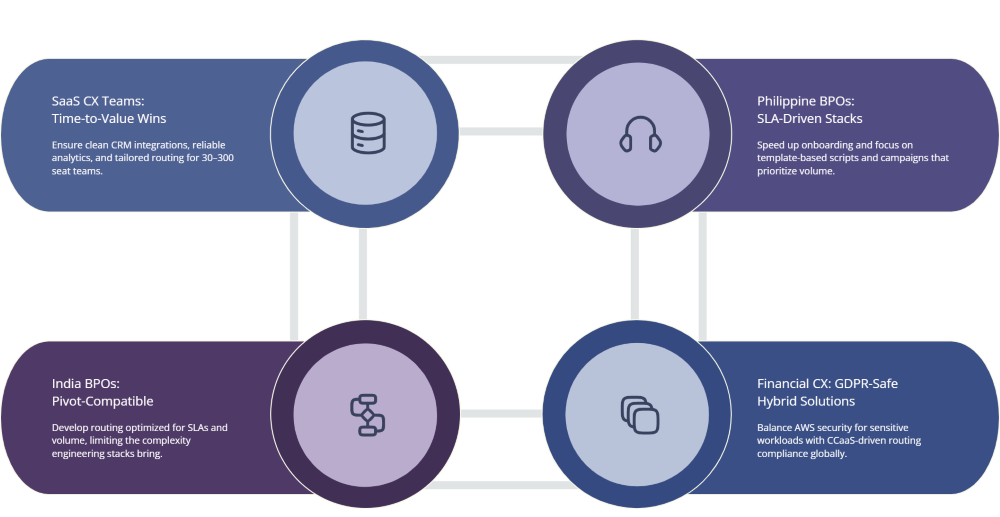
If you run a 30–300 seat CX team inside a SaaS or e-commerce business, your priorities usually revolve around time-to-value, clean integrations, and powerful analytics. You want something that plugs deeply into your CRM, supports predictable SLAs, and gives you routing and reporting out-of-the-box, similar to how vertical deployments are described in industry-specific cloud call center use cases. In this case, a CCaaS platform with strong native CRM integrations and pre-built AI often beats a custom Connect stack.
Scenario B: Global BPO in the Philippines or India
BPOs in Manila, Cebu, Bangalore, or Hyderabad live and die by speed: new client onboarding, script changes, campaign pivots. These teams usually don’t want to own Lambda code; they want configuration, templates, and battle-tested routing. Think of setups optimized for SLAs and volume like Philippines-ready BPO stacks or India-focused blueprints. Amazon Connect can play a role for specific clients, but as the backbone? Its engineering tax often outweighs its flexibility.
Scenario C: Highly Regulated Enterprises
Financial services, healthcare, and public sector operations do appreciate Connect’s ability to keep everything inside AWS. But many still shift part of the stack to platforms with more opinionated compliance patterns, like the designs in Canadian compliance-focused deployments or GDPR-sensitive UK setups in data-safe remote operations. For these teams, the right move might be hybrid: keep sensitive data or specific workloads in Connect, while offloading the rest to a CCaaS platform that simplifies global routing and AI.
Scenario D: High-Velocity Sales and Outbound Engines
Sales teams care about conversations per hour, not how pretty the AWS diagram looks. They want predictive dialers, local presence, branch logic, and revenue-driven workflows echoing the patterns in max revenue dialer designs and AI sales acceleration engines. Connect can handle outbound, but true sales dialer platforms, or CCaaS with native sales modes, often outperform it in both usability and raw pipeline impact.
7. Migration and Wrap Strategy: You Don’t Have to “Rip and Replace”
Leaving Connect doesn’t have to be a dramatic, all-or-nothing move. Many teams follow a staged approach similar to PBX migrations in legacy-to-cloud transition guides. They might:
Start by moving one business unit, geography, or channel to a new platform while keeping Connect running for the rest. Then, as confidence and data accumulate, they gradually port numbers and queues. In some cases, Connect remains in the background for very specific use cases while the new platform becomes the primary agent UI and orchestration layer, hooked into a global VoIP backbone like cloud PBX + VoIP systems that already handle the messy parts of telephony.
8. FAQs: Amazon Connect Limitations and Better Alternatives (Accordion)
Is Amazon Connect still worth considering in 2025?
Yes — if you are an AWS-first organization with strong in-house engineering and a clear need to deeply customize every part of your contact center. Connect shines as an AWS-native toolkit. It becomes less attractive when you want business-led configuration, fast rollout, or ready-made AI and QA. In those cases, CCaaS platforms modeled on best practices from scalable US deployments or region-specific stacks for Dubai, UAE, or the Philippines give you faster value with fewer moving parts.
What are the biggest operational limitations teams run into with Amazon Connect?
The short list: dependence on AWS engineers for every non-trivial change; fragmented reporting across multiple AWS services; relatively basic out-of-the-box QA automation; and more complex global telephony setups compared to dedicated voice platforms. These constraints usually show up as slow experiments, inconsistent KPIs, and high hidden labor costs — precisely the issues that modern AI-driven stacks, guided by metrics discipline and labor cost optimization frameworks, try to eliminate.
How do alternatives handle AI, QA, and coaching better than Connect?
Most alternatives aim to package AI as features, not building blocks. Instead of stitching transcription, sentiment, and analytics together yourself, you switch on modules for auto-scoring, red-flag detection, coaching recommendations, and real-time assist. These systems look much closer to the AI-first QA setups described in manual QA replacement guides and the real-time assist flows in live AI coaching articles. The result: faster rollout, higher adoption, and measurable improvements without hiring data scientists.
Can we keep Amazon Connect for some workloads and add another platform on top?
Absolutely. Many organizations run hybrid stacks for years. For example, they may keep Connect for a specific inbound queue that is tightly coupled to AWS workloads, while shifting outbound, sales, or certain regions to a CCaaS platform with a stronger global network, inspired by multi-country VoIP case studies. The key is to design clear boundaries — which platform owns which channels, numbers, and reporting — so agents and supervisors aren’t stuck in between two worlds.
What signals tell me it’s time to move off (or around) Amazon Connect?
Common warning signs: supervisors cannot change flows without raising tickets; dashboards don’t match between teams; QA is still sampling a tiny percentage of calls; your roadmap is full of “Connect work” instead of CX innovation; and adding new markets or clients feels risky rather than routine. When you recognize those patterns, it’s worth evaluating alternatives built on modern cloud telephony foundations like from-SIP-to-AI architectures that treat routing, AI, QA, and analytics as one coherent system instead of scattered parts.
You don’t have to hate Amazon Connect to admit you may have outgrown it. For many teams, the right move in 2025 is not to throw away everything they have built, but to be honest about where Connect is slowing them down — and to bring in a more opinionated, AI-ready, globally reliable stack to handle the parts of their contact center that should feel effortless, not experimental.