
Arabic-speaking markets are hitting a tipping point. UAE, Saudi Arabia, and Qatar now expect call centers to be more than “people with headsets” – they expect AI that understands dialect, sentiment, intent, and risk in real time. But most AI call analytics tools were trained on English-only patterns, Western call flows, and slang that means nothing in Riyadh or Doha. This guide shows you how to design and deploy AI call analytics stacks that actually work for Arabic, English, and hybrid conversations across GCC, so every minute of talk-time turns into usable data, coaching, and compliance protection.
1. Why AI Call Analytics in GCC Looks Nothing Like a US Playbook
In the US or UK, you can throw a generic “AI QA + transcription” layer on top of your dialer and get something usable. In Arabic-speaking markets, that approach falls apart fast. Calls jump between Gulf Arabic, Modern Standard Arabic, English, Hindi, Urdu, and Tagalog – sometimes in a single sentence. Scripted tools that were built for monolingual teams can’t reliably detect sentiment, intent, or risk in that mix. That’s why serious GCC operations pair their analytics plans with modern voice architectures similar to SIP-to-AI cloud telephony designs instead of bolting AI onto a legacy PBX.
The second difference is stakes. A frustrated customer in Dubai or Riyadh isn’t just a bad CSAT score; they may be a VIP banking client, a government-related account, or a major enterprise that expects white-glove handling. AI analytics has to be good enough to flag those calls in minutes, not weeks. That’s why GCC teams increasingly treat analytics as core infrastructure – in the same category as routing, uptime, and failover – much like they do for enterprise-grade cloud contact centers.
2. The Data You Actually Need to Capture (Beyond “Call Recorded”)
Most call centers in the region still treat recordings as a box-tick – “we recorded it; we’re safe.” For AI analytics to matter, you need a richer, structured layer that sits on top of audio. Start by defining your “minimum viable analytics schema” per call: language mix, product or queue, customer segment, outcome, sentiment, and reason for contact. These fields should be populated automatically where possible and refined by AI classification, similar to how advanced operations extend their cloud call center software with custom dispositions and tags.
Next, decide which metrics matter for UAE, KSA, and Qatar leadership. AHT and FCR are still important, but they’re not enough. You’ll want measures like “Arabic to English switch rate,” “escalations by dialect cluster,” “regulatory-risk mentions,” and “churn language frequency.” Those can then plug into more traditional KPI frameworks like the ones summarized in advanced call center metric scorecards, giving executives one narrative view instead of scattered reports.
3. Building an Arabic-Aware Speech and Intent Layer
The heart of AI call analytics is the speech-to-text and intent model layer. If that layer doesn’t respect Arabic and GCC realities, everything downstream is noise. Start by making a clear decision on model strategy: off-the-shelf multilingual engines, region-tuned Arabic ASR, or a hybrid. Many GCC teams end up combining strong English engines with specialized Arabic components, wired together in a single routing brain similar to global cloud PBX architectures.
For Arabic, you should explicitly model dialect families: Gulf Arabic (UAE, KSA, Qatar), Levantine, and Egyptian. That doesn’t mean building separate products, but it does mean collecting training data, tuning vocabularies, and defining intent libraries that know the difference between how a Saudi retail customer complains about a shipment and how a Qatari corporate client talks about a contract. Those libraries can be bootstrapped from vertical patterns already mapped in resources like industry-specific call center use case guides.
Finally, pay attention to code-switching – where a conversation flips between Arabic and English mid-sentence. Your analytics stack should tag those switches, not treat them as errors. Code-switch frequency can indicate comfort level, escalation risk, or even upsell potential.
4. From Transcripts to Revenue, CX, and Compliance Signals
Once your speech and intent layers are in place, the goal is simple: every conversation should generate signals that help you sell more, keep more customers, or stay out of trouble. In practice, that means combining sentiment analysis, topic detection, and outcome tagging into a single analytics view, similar to how top-tier CCaaS platforms use multi-layer data in ROI-ranked feature stacks. For GCC markets, you’ll want three “lanes” of insight: revenue, experience, and regulatory.
On the revenue lane, track phrases that indicate buying temperature, discount sensitivity, and upsell opportunity, in both Arabic and English. On the CX lane, monitor frustration language, repeated explanations, and “I already called” patterns that signal broken processes. On the regulatory lane, train your models to flag anything related to complaints, consent, collections hardship, and data privacy – then route those calls for human review, echoing the way AI QA layers are used in full-coverage QA deployments.
Most teams underestimate how much of this can be automated. AI can cluster common failure reasons, surface “shadow processes” that agents invent to get work done, and highlight regional nuances between, say, Abu Dhabi and Jeddah. That’s where GCC-specific analytics starts to feel like a competitive advantage instead of just another dashboard.
5. Designing Dashboards That GCC Leaders Actually Use
Analytics that never leaves the CX team is wasted. In GCC enterprises, you need views tailored to three audiences: executives, operations, and frontline leaders. Executives care about trends: complaint volume, churn language, and “at risk” segments. Operations care about queue-level breakdowns, repeat reasons, and broken workflows. Team leaders care about coachable moments for their agents. The best stacks present each view on top of the same data model, similar to how advanced platforms turn raw metrics into layered stories in scalable AI-ready call center designs.
Because UAE, Saudi, and Qatar organizations often involve regional and group-level reporting, your dashboards should also support “slicing” by market. That lets you compare how a new policy lands in Dubai vs Riyadh vs Doha. When combined with AI-based cost metrics like those in AI cost-reduction playbooks, you can finally answer questions like: “Where exactly is our handle time bloated?” and “Which markets see the highest benefit from automation?”
6. Turning Analytics into Coaching, QA, and Automation Loops
Call analytics only pays off when it changes behavior. That means closing the loop between “what we heard” and “what we coach, fix, or automate.” Start by wiring analytics into your QA program: AI should propose which calls to review, score calls for adherence, and flag outliers. This is the evolution away from spot checks toward full coverage you see in AI-first QA operations. In GCC markets, this matters especially for Arabic calls that previously went unreviewed because of language constraints.
The second loop is coaching. Use analytics to identify “golden” calls per language and queue, then push those into real-time assist for your agents. For example, when a Saudi customer uses a known churn phrase, the agent’s screen (or whisper AI) can suggest a proven retention script, similar to how live guidance works in real-time AI coaching stacks. Over time, those playbooks become hyper-local to UAE, KSA, and Qatar customer behavior.
The third loop is automation. When analytics reveals repetitive, low-complexity calls, route them into IVR, WhatsApp, or self-service; when it reveals frequent handoffs between teams, redesign your routing flows using principles from predictive routing frameworks. GCC operations that treat analytics as a change-engine like this see measurable drops in handle time and repeat contacts.
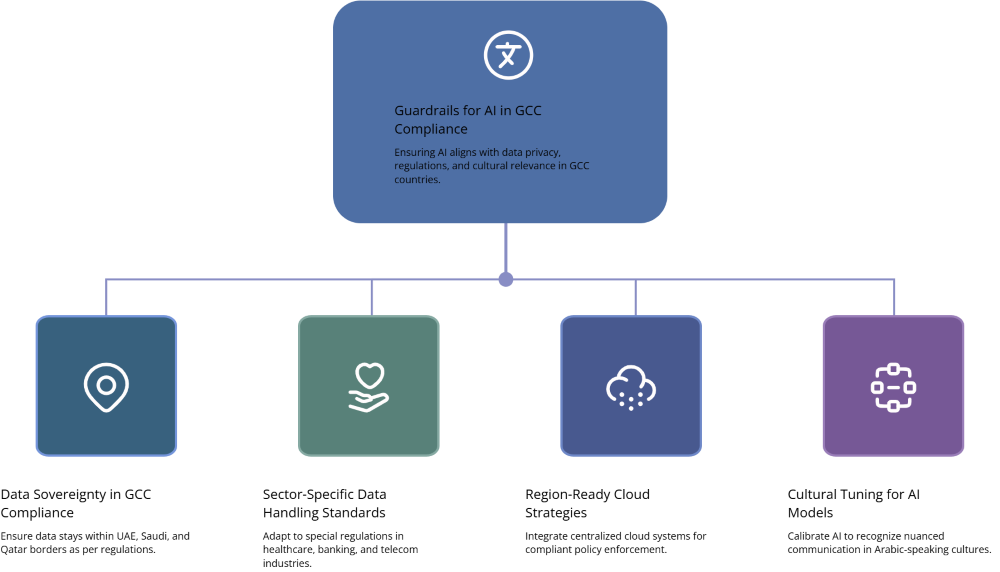
7. Guardrails: Privacy, Regulation, and Cultural Nuance
UAE, Saudi, and Qatar each have their own data and privacy regulations, plus sector-specific rules (especially in banking, telecom, and healthcare). Your AI analytics strategy has to respect where recordings live, who can access transcripts, and how long data is retained. That’s where using region-ready cloud foundations – similar to those described in compliance-focused cloud call center deployments – pays off, because you can enforce policies centrally instead of handling them via ad-hoc scripts.
Cultural context matters just as much as legal text. Arabic has polite forms, indirect ways of expressing dissatisfaction, and phrases that sound neutral but signal deep frustration. AI models need to be tuned with local input so they don’t treat every raised voice as a crisis or every quiet customer as “satisfied.” Pair your data science efforts with local QA and CX leads, and use lessons from GCC-specific setup guides like UAE call center compliance playbooks and Saudi Arabia call center frameworks to understand practical risk boundaries.
8. 90-Day Rollout Plan for AI Call Analytics in UAE, KSA, and Qatar
Days 1–30: Baseline and architecture. Inventory your queues, languages, and existing recording stack. Confirm where audio is stored, how long, and who owns it. In parallel, check if your telephony and routing stack can support an AI layer without major rework; if not, explore moving to modern foundations similar to remote-ready cloud call center platforms. Choose 2–3 queues in one market (e.g., UAE banking + e-commerce) as your pilot scope.
Days 31–60: Pilot and calibration. Deploy speech-to-text and topic detection for those pilot queues. Spend this phase tuning dialect handling, sentiment thresholds, and category labels instead of chasing flashy dashboards. Bring in local supervisors and QA leads to validate outputs. At the same time, connect analytics to your reporting and workforce stack via integrations, using patterns similar to high-value integration playbooks. Start surfacing a small number of insights every week and acting on them.
Days 61–90: Scale and operationalize. Expand analytics across more queues and at least one additional market (e.g., KSA). Turn on AI-assisted QA and targeted coaching, especially for new Arabic-speaking agents. Launch a monthly “Insights to Actions” forum where CX, product, and operations teams review AI findings and commit to changes. Embed AI metrics into leadership reviews, alongside traditional KPIs, just like you would embed AI-driven cost metrics in Salesforce-integrated call center designs. By day 90, AI analytics should be an everyday tool, not a lab project.
9. FAQ — AI Call Analytics for Arabic-Speaking Markets (UAE, KSA, Qatar)
Arabic-aware AI call analytics is no longer a “nice to have” for GCC operations. It’s the difference between guessing why customers call – and knowing, at scale, what they say, feel, and need in every market you serve. When you combine the right speech models, GCC-tuned intent libraries, and a modern cloud voice stack, you get a call center that doesn’t just speak Arabic and English – it actually understands them.