
For years, “accelerated manual dialing” was what every aggressive outbound team bragged about. You stacked reps, loaded click-to-dial lists, pushed them to hit 150–250 attempts a day, and hoped that volume would hide every process flaw under the surface. But in 2025, that model is collapsing. Labor is expensive, regulators are watching, and buyers do not tolerate random call blasts. AI dialers, predictive engines, and real-time coaching have quietly turned manual power dialing into the fax machine of outbound. This guide breaks down why that shift is happening, ranks the AI replacements that are actually working in the field, and shows you how to move from “faster fingers” to a ruthlessly efficient, AI-assisted outbound engine.
1. What “Accelerated Manual Dialing” Really Looked Like
Accelerated manual dialing was never truly “manual” – it was a patchwork of speed hacks. Reps used click-to-call inside CRM, hotkeys in softphones, and lead lists exported every morning by ops. The promise was simple: more attempts, more connects, more pipeline. In reality, you burned hours on low-intent leads, duplicate records, and bad numbers while supervisors watched dashboards that looked busy but didn’t prove revenue impact. Outbound engines were built on motion, not on the kind of ROI-driven feature thinking you see in modern call center capability rankings.
It also forced your best people to do their worst work. High-caliber reps spent half their day clicking, waiting through rings, and manually logging outcomes. Managers tried to compensate with ever more aggressive “power hour” rituals, floor contests, and spreadsheets. Meanwhile, competitors began swapping in dialers designed like revenue engines rather than click machines, quietly compounding gains with better targeting, cleaner data, and more intelligent pacing.
2. Why Accelerated Manual Dialing Is Dying in 2025-2026
Three forces are killing accelerated manual dialing at the same time. First, labor economics: every outbound seat now competes with AI. If a machine can handle pre-qualification, list cleaning, and basic nurture touches, you can’t justify paying humans to do the equivalent of copy-paste and ring-wait cycles. That’s why the most effective shops are re-allocating spend into voice AI tools that reduce manual hours instead of adding more entry-level dialers.
Second, regulators are closing the “move fast and call everyone” loophole. TCPA, privacy laws, and regional consent requirements make unsupervised click-to-call dangerous. Teams that still rely on ungoverned manual acceleration risk the same penalties as sloppy robodialers, a shift already mapped in modern outbound compliance frameworks. Third, buyers themselves have changed. The average prospect has already seen your ads, visited your site, and chatted with a bot before you call. Cold brute force is being replaced by precise, context-rich outreach orchestrated by AI-aware systems.
3. AI Replacements for Manual Dialing — Ranked for 2026
Not all “AI dialers” are equal. Some are still glorified pacing algorithms with a chatbot bolted on; others genuinely rewire how outbound is planned, executed, and coached. Below is a ranking of the main AI replacements teams are adopting, based on impact on pipeline, labor, and risk. Think of it as a menu, not a checklist — you don’t need all of them on day one.
4. How AI Dialers Change the Economics of Outbound
AI-driven dialers don’t just make calls faster; they rewire the math. Traditional power dialing assumed every rep needed hundreds of attempts to hit quota. AI flips that by maximizing productive minutes: fewer dials, more qualified connects, and higher conversion per conversation. The best teams treat their dialer like the systems described in modern U.S. outbound engines — data-driven, TCPA-aware, and tuned weekly based on results.
This has a direct impact on headcount planning. Instead of adding three more manual dialers to attack a new list, you use AI to refine that list, pick the right windows, and keep existing seats fully utilized. That’s why revenue leaders increasingly pair AI dialing with use cases ranked by pipeline impact, killing “more reps for more calls” thinking and replacing it with “more intelligence for better calls.”
5. Compliance, Risk, and Reputation in an AI Dialer World
One of the biggest myths is that manual dialing is “safer” than automated dialing. In 2025, the opposite is often true. Humans make mistakes under pressure: they skip consent checks, call numbers too frequently, or ignore local quiet hours. AI dialers with embedded rules, like those modeled in modern sales acceleration stacks, can systematically avoid those errors while still producing high connect rates.
Reputation risk matters just as much. Buyers don’t distinguish between manual and automated calls; they only experience interruption. AI helps you narrow outreach to people who have shown real interest or fit clear ICP criteria, instead of mass bombing entire lists. When combined with guidance from best-practice predictive dialing strategies, you can enforce caps on attempts, control cadence across channels, and exit leads gracefully when they’re clearly not a fit.
6. Designing Your Migration Off Accelerated Manual Dialing
You don’t have to jump straight from spreadsheets to a fully autonomous AI dialer. The most successful teams run a staged migration. Phase one is about visibility: instrument your outbound like a proper contact center. Track connect rates, handle times, outcomes, and revenue per call using KPI sets similar to modern efficiency dashboards. This baseline will help you prove the impact of AI later.
Phase two is about orchestration. Replace raw click-to-dial with a platform that can own pacing, queueing, and routing across global numbers, modeled on the kind of cloud architectures seen in zero-downtime call systems. Start with a subset of teams, lean into one or two AI capabilities (for example, predictive dialing and live agent assist), and tune them weekly before scaling across the floor.
Phase three is where you refactor playbooks, not just tooling. Rewrite cadences, list strategies, and call objectives around AI strengths: better targeting, richer context, and instant coaching. This is where mature organizations pull in lessons from large-scale dialer evaluations and vertical use cases, then hard-code them into routing, scripts, and reporting.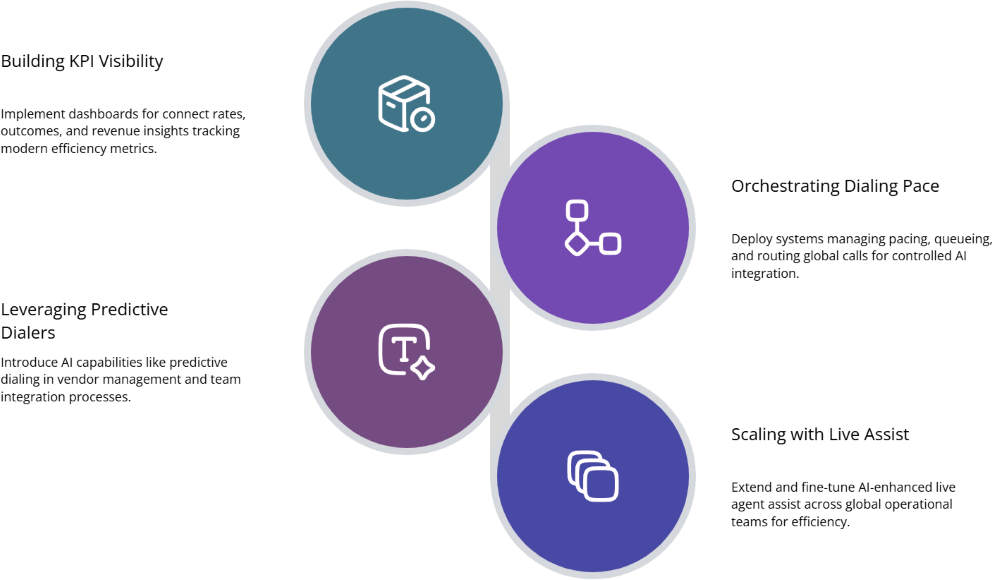
7. Data, Analytics, and Coaching You Unlock When Manual Dies
When every call is initiated, routed, and recorded through an AI-aware platform, you suddenly see what manual dialing was hiding. You can correlate talk time with pipeline, map which opening lines perform best by segment, and understand exactly how often your reps mention critical value props. That’s the jump teams make when they move closer to AI-first QA and monitoring models instead of one-off spot checks.
Coaching also shifts from anecdotal to surgical. Rather than waiting for quarterly reviews, leaders get daily or weekly scorecards that highlight specific skills: discovery depth, competitive positioning, pricing confidence, and more. Paired with live assist similar to real-time coaching engines, you can correct behaviors during active pipelines, not after deals are lost. Over time, your dialer becomes less of a “phone system” and more of a revenue performance lab.
Finally, data from AI-driven outbound feeds back into your wider CX and telephony strategy. You can see which markets respond best by phone versus digital, which integration gaps cost the most time, and where your telephony estate needs modernization. Many organizations use these insights to plan broader upgrades, drawing on patterns from SIP-to-AI cloud telephony transformations rather than treating outbound as a silo.
8. FAQ: Replacing Accelerated Manual Dialing With AI in 2025
Accelerated manual dialing had its moment. It belonged to an era when lists were cheap, regulations were softer, and buyers picked up unknown numbers more often. That era is gone. In 2025, the teams that win outbound are not the ones with the fastest fingers. They are the ones who design dialing as an AI-assisted, data-rich system — where every call is intentional, every rep is supported, and every campaign improves the engine for the next one.