Most teams do not lose money on cloud telephony because of one big outage. They lose it in a slow leak of bad decisions: no real inventory, rushed cutovers, ignored edge cases, and “we’ll fix it later” integrations that never get fixed. By the time anyone notices, customer experience has dipped, support queues are noisy, and finance is asking why the “cheaper” cloud platform costs more than your old PBX. This guide walks through the top twenty five migration mistakes teams make and shows you how to avoid each one before it shows up as churn, NPS drops, or lost revenue.
1. Why Cloud Telephony Migrations Go Wrong Quietly
Voice migrations usually fail in slow motion. Calls still connect, but the experience degrades: more transfers, longer handle times, and no reliable data to explain what changed. The root problem is treating telephony like a simple tool swap instead of a core part of your customer retention engine, the same engine covered in modern customer loss prevention playbooks. If you move trunks and numbers without rethinking routing, reporting, and AI, you simply re-skin old problems on a new platform.
Another quiet failure mode is underestimating how much of your business depends on “just working” calls. Sales, support, collections, field ops, and even facilities lean on your phone system. When you migrate without interviewing those teams, you break flows you did not even know existed. That is why any serious cloud telephony project starts with discovery, not procurement.
2. Quick View: 25 Migration Mistakes (And Their Fixes)
Use this table as your pre flight checklist. If any of these issues feel uncomfortably familiar, you already know where to focus design and governance before you schedule a single cutover.
3. Strategy and Discovery Mistakes
The first cluster of mistakes happens before any new platform is selected. The biggest is skipping structured discovery. Teams assume “everyone just uses phones” and never ask how sales, support, collections, and field ops really work. In reality, each group has custom call flows, forwarding rules, and reporting needs. Patterns from modern PBX migration case studies show that the best programs spend real time mapping what exists before designing anything new.
Another strategic error is treating cloud telephony as a narrow IT cost optimization. The business case becomes “save on maintenance,” not “improve customer experience, unlock AI, and support new markets.” When that happens, budgets get squeezed and the project is framed as risk, not opportunity. Strong programs define target state outcomes: lower abandonment, faster handle times, better NPS, and cleaner data for AI, using the same thinking you see in end to end contact center transformations.
4. Architecture and Integration Mistakes
Once a target platform is chosen, architecture mistakes start to creep in. A common one is lifting a messy on prem dial plan directly into the cloud. Old extension ranges, ad hoc hunt groups, and half documented forwarding chains all survive the move. Instead, cloud designs should reflect the kind of clean, resilient layouts used in zero downtime call fabrics. That means clear entry points, consistent numbering, and routing that follows real journeys, not historical accidents.
Integration is another major failure vector. Voice rarely lives alone. It must connect cleanly to CRM, ticketing, payment systems, and analytics. When teams treat CTI as a “phase two,” agents end up copying call notes between systems, and managers lose visibility. The difference between a clumsy stack and a high velocity one is often exactly the sort of joins described in integration heavy cloud contact center examples. Plan integration as a first class workstream, not an afterthought.
5. People, Training, and Change Management Mistakes
Even the cleanest architecture fails if people are not ready. A major mistake is showing users the new softphone or agent desktop for the first time on go live day. That guarantees low confidence, slow calls, and higher error rates. Instead, treat change like the teams behind remote friendly VoIP rollouts: hands on sandboxes, scenario based training, and a network of early adopters who become go to experts.
Leadership messaging is just as critical. If the narrative is “IT chose a cheaper system,” adoption will lag. If the narrative is “we are giving you tools that reduce clicks, support remote work, and unlock AI coaching,” teams lean in. That story becomes real when agents experience features like the real time prompts and guidance shown in AI assisted contact centers. Tie change communications to visible benefits, not just deadlines.
6. Cutover, Testing, and Reliability Mistakes
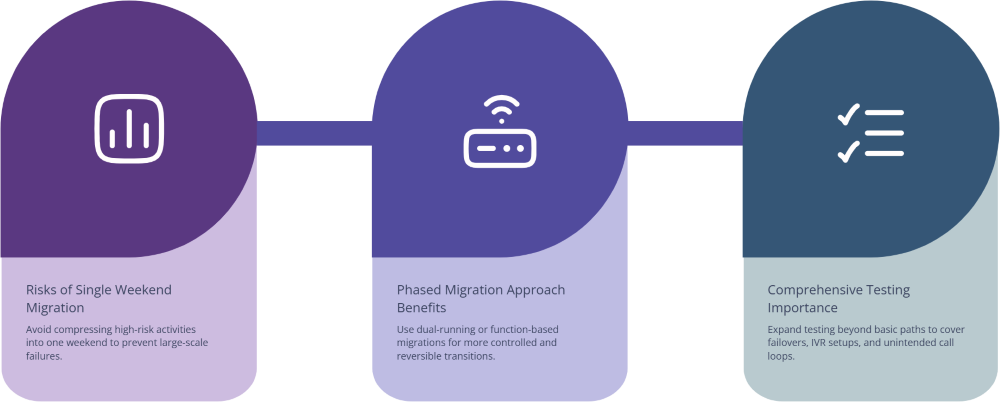
Most visible pain happens here. One classic mistake is trying to migrate everything in a single weekend: all numbers, all queues, all regions. This compresses risk into one window. If anything goes wrong with porting, routing, or authentication, the blast radius is huge. The more resilient pattern is the phased approach used in downtime resistant migrations: dual running, site by site or function by function, with clear rollback options.
Testing is another weak spot. Many teams run only happy path checks: make a call, receive a call, confirm audio. That misses forwarding loops, failover behavior, and complex IVR paths. Build test plans like you would for production call centers handling healthcare or banking workloads, informed by the vertical scenarios in industry specific cloud call center use cases. Include cold transfers, warm transfers, conference calls, voicemail, and external failover routing.
Network design underpins all of this. If you simply point users at the cloud over whatever broadband they have, quality will vary widely. Strong programs treat network and QoS as part of telephony, leveraging patterns from global PBX and VoIP reference architectures. That means testing from branch offices and home networks, not just from a single HQ lab.
7. Post Migration, AI, and Governance Mistakes
Once the PBX is decommissioned, many teams quietly disband the project. That is a mistake. The real value of cloud telephony appears after stability, when you start layering AI, analytics, and automation. If you stop at “phones work,” you miss the labor savings and quality uplifts outlined in AI cost cutting playbooks. Plan at least two to four quarters of post migration sprints focused purely on optimization.
Governance is the other long tail risk. Without clear ownership, your new platform slowly drifts into the same chaotic state as the old PBX: unused numbers, unreviewed IVRs, and inconsistent policies by region. Treat voice and contact center as a product with a backlog. Use ROI thinking similar to feature ROI frameworks to prioritize work. Decide which improvements ship each quarter and which experiments you will run with AI, routing, and analytics.
Finally, keep your compliance lens sharp. Cloud telephony makes it easier to record, store, and analyze calls, but it also raises the stakes for data privacy. Use patterns proven in GDPR ready voice environments: consistent retention rules, clear access controls, and audited exports. Your goal is not only to avoid fines, but to be able to answer tough questions from enterprise customers and regulators with confidence.
8. FAQ: Avoiding Cloud Telephony Migration Pitfalls
If you treat cloud telephony migration as a single event, the best outcome you can hope for is “the phones still work.” When you treat it as a structured, multi wave program that touches strategy, architecture, people, and AI, the outcome is different: lower risk, better CX, cleaner data, and a platform that can actually keep up with where your business wants to go next.