

Most PBX migrations don’t fail because of technology; they fail because leadership underestimates how many moving parts touch “just the phones.” Finance wants lower costs, IT wants fewer outages, operations want better routing and analytics, and suddenly you’re changing every extension, IVR, and SIP trunk at once. PBX Migration 2025 is about doing this without chaos: turning a fragile, hardware-heavy setup into a cloud or hybrid voice layer that supports remote teams, AI, and global clients with almost no downtime. This blueprint walks you through costs, timeline, downtime playbooks, and architecture so your next cutover feels like an upgrade, not a gamble.
1. PBX Migration 2025-2026: What You’re Actually Changing
On paper, a PBX migration looks simple: move from legacy hardware to a new platform. In reality, you’re rewiring how every customer, partner, and internal team member reaches you. You’re touching numbers, trunks, IVRs, routing rules, integrations, and reporting. The smartest teams treat migration as a business transformation, using it to modernize routing, analytics, and remote work—not just swap boxes. That’s the logic behind many modern PBX transformation stories: you don’t just port lines, you redesign how voice supports revenue.
In 2025, the target state for most organizations is either cloud PBX or a lean hybrid model. The PBX becomes a software layer, not a physical “thing” in the closet. Calls flow through a global, carrier-agnostic backbone; features arrive as configuration, not hardware upgrades; and AI overlays voice with coaching, summarization, and quality scoring, as you’d expect from a forward-looking telephony roadmap. Migrating is about crossing that gap with clear steps, not heroics.
2. Cost Anatomy: Where PBX Migrations Spend (and Save) Money
Finance leaders often ask, “Why are we spending so much to save money?” The answer is timing. PBX migration introduces short-term project costs to unlock recurring savings: decommissioned hardware, simpler licensing, and reduced outage risk. To keep everyone aligned, break the budget into clear buckets and document where savings show up quarter by quarter, using patterns similar to the PBX cost-optimization playbooks you’d show a CFO.
Use a cost matrix like this to structure internal conversations and vendor proposals.
Once you see costs structured this way, it’s easier to make trade-offs. Maybe you spend more on experienced implementation partners so your internal team can stay focused on core systems. Maybe you invest in better observability to avoid headline-grabbing outages, as you’d see prioritized in high-availability voice deployments. The goal is not just a cheaper bill—it’s a more predictable, resilient voice layer.
3. Timeline Blueprint: 90–180 Days from Audit to Cutover
A realistic PBX migration is rarely “30 days and done.” The winning teams plan for a 3–6 month journey, with clear milestones and overlapping workstreams. That doesn’t mean you wait six months to see value; it means you stage risk and deliver improvements incrementally, similar to the phased playbooks used in global phone system rollouts.
Phase 1: Discovery and target design (Weeks 1–4). Inventory every number, queue, IVR, integration, and device. Map who owns each flow and what “good” looks like—answer times, transfer patterns, SLAs. Use this to design your target architecture: cloud-only, hybrid, or region-specific combinations inspired by multi-office VoIP designs. Document all of this before you sign contracts.
Phase 2: Build and pilot (Weeks 4–10). Stand up the new PBX environment, configure dial plans, IVRs, and integrations, and create a lab with real test numbers. Move a low-risk group (e.g., an internal helpdesk or small sales pod) first. Run them in the new platform while everyone else remains on legacy. This is where you validate call quality, routing behavior, and analytics—before touching high-stakes lines.
Phase 3: Dual running and gradual cutover (Weeks 10–18). Run both systems in parallel. Port numbers in waves, starting with internal and low-volume lines, then moving to core customer channels. Use progressive routing (e.g., percentage-based or queue-specific) to move traffic gradually. This “two-lane” design is the same approach used in near-zero-downtime architectures.
Phase 4: Decommissioning and optimization (Weeks 18–26). Once stable, retire legacy trunks and hardware, clean up unused numbers, and simplify routing. Introduce AI for QA and agent-assist, borrowing ideas from real-time coaching platforms and automated quality programs. Move from “it works” to “it performs.”
4. Downtime Strategy: How to Migrate Without Going Dark
The nightmare scenario is simple: numbers port over, something misroutes, and customers hit dead air. You avoid that by treating downtime as a design problem, not a surprise. Start by defining your acceptable impact: can you tolerate a few short maintenance windows at low-traffic hours, or do you need continuous availability like the teams behind downtime-resistant call platforms?
Build your downtime playbook around four pillars. First, dual systems: legacy and new PBX running together with clear rollback steps. Second, over-provisioned capacity: extra SIP channels and trunk paths during migration so testing and real traffic don’t compete. Third, progressive cutovers: move one region, department, or number block at a time, verifying live traffic before proceeding. Finally, communication: internal alerts, status pages, and customer-safe messaging in case something doesn’t work as expected.
Number porting deserves special care. Use temporary ranges, hunt groups, or call forwarding to keep lines reachable during port windows. Keep a human “war room” on standby during the first days after major cutovers, mirroring the incident readiness you’d see in serious data-safe telephony projects. The more you rehearse this upfront, the less you need to improvise under pressure.
5. Architecture: From Single Box to Global Voice Platform
A legacy PBX usually thinks in buildings and extensions. A modern voice stack thinks in services, regions, and APIs. Your migration is the chance to move from “that box in the server room” to a software-first architecture that looks more like a cloud contact center than a simple phone system, similar to the way modern voice foundations are built for growth.
Start by defining the core layers. At the base: carriers, SIP trunks, and numbers. Above that: the PBX or cloud voice platform handling routing, registrations, and basic queues. On top: integrations—CRM, helpdesk, workforce tools—and specialized components like contact centers or AI engines. This layered approach is the same pattern you see in scalable call architectures, where each layer can evolve without breaking the others.
If you operate across countries, design globally from day one. Your new PBX should be able to host numbers and users in multiple regions, much like the setups described in multi-country VoIP deployments. That means location-aware routing, region-specific failover, and compliance-aware recording—so expanding into a new market is a configuration change, not a new project every time.
Finally, treat contact center overlays as part of the blueprint, not an afterthought. Even if you’re not replacing your call center yet, your PBX architecture should comfortably integrate with cloud contact center platforms or native capabilities like those used in customer-retention-focused environments. Otherwise, you’ll end up boxed in when CX teams push for new features later.
6. Integrations, AI, and Operations: Making the New PBX Actually Worth It
A PBX migration that doesn’t improve daily work for agents, supervisors, and IT is a missed opportunity. The biggest operational wins come from integrations and automation: fewer screens, fewer manual notes, and smarter decisions. That’s why integration-heavy setups like high-impact call center stacks invest so much effort in CTI and data flows—not just dial tone.
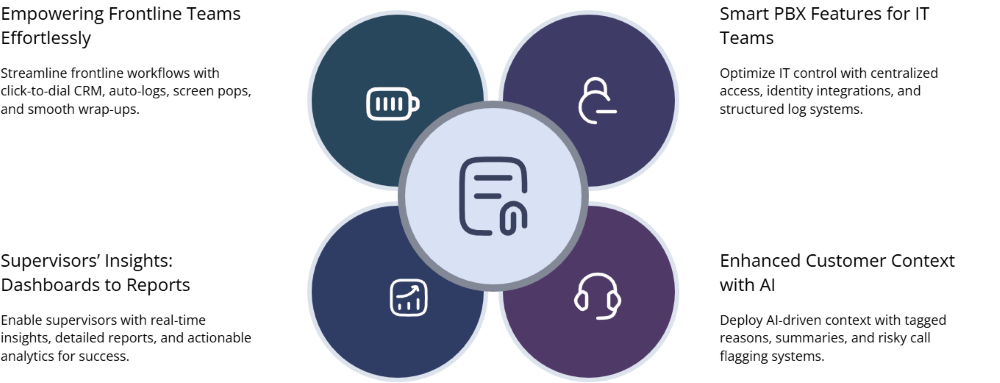
For frontline teams, the must-haves are simple: click-to-dial from CRM or helpdesk, screen pops with customer context, automatic logging, and clear wrap-up workflows. For supervisors, it’s real-time dashboards, wallboards, and historical reports that match or beat what they had before. For IT, it’s identity integration, centralized access control, and structured logs. Make all of this part of the migration scope, not “phase two.”
AI is where PBX migrations in 2025 start to look different from previous generations. Voice analytics can summarize calls, tag reasons, and flag risky moments without manual QA, following the same philosophy as AI-driven labor savings. Real-time assist can whisper suggestions and next steps to agents, modeled on live coaching engines. Start with one or two high-impact use cases, measure results, and expand from there.
Operationally, treat migration as a continuous improvement program. Run weekly “voice health” reviews where you examine routing behavior, call outcomes, and agent feedback. Borrow the structured thinking from industry-specific cloud call use cases to identify new automation opportunities as you go. The new PBX should feel easier to evolve every month—not frozen the day it goes live.
7. PBX Migration 2025: FAQ
How long should a PBX migration really take in 2025?
Most serious PBX migrations take 3–6 months from initial discovery to full cutover, depending on how many sites, numbers, and integrations you have. Anything faster than 60–90 days usually means you’re either small and simple or you’re cutting corners on testing and change management. Use a phased roadmap like the ones behind modern PBX upgrade projects: discovery, build and pilot, dual running, then decommissioning. Each phase has its own checkpoints so you can pause if issues surface.
What’s the single biggest cause of downtime during PBX migration?
The most common cause is poor planning around numbers: missing inventory, misconfigured call flows, or rushed porting windows. When no one owns a complete list of numbers, ranges, and their purpose, it’s easy to drop something critical on cutover night. You can reduce this risk by doing a thorough inventory, using temporary ranges, and dual-running systems like resilient telephony designs do. That way, if something breaks, you have a quick rollback path.
How do we estimate the true cost of PBX migration?
Start with three categories: project costs (implementation, training, overlap), recurring costs (licenses, trunks, usage), and avoided costs (legacy maintenance, outage risk, manual work). Use references like the PBX savings blueprints to sanity-check vendor promises. Then model scenarios over 3–5 years: conservative, expected, and aggressive. The more you tie numbers to specific improvements—fewer outages, less hardware, better agent productivity—the easier it is to get buy-in.
Is it safer to migrate PBX and contact center together or separately?
In most environments, it’s safer to sequence them, not move both at once. PBX migration already touches numbers, trunks, and routing; contact center migrations add queues, skills, and much deeper reporting complexity. Many teams follow the same pattern as the stepwise call center build-outs: stabilize core voice first, then layer or replace contact center tooling once routing and integration foundations are solid.
What should we demand from PBX vendors before signing?
Ask for more than a demo. You want architecture diagrams, reference designs for your size and industry, and a realistic migration plan with responsibilities clearly assigned. Look for real-world examples similar to global PBX deployments: multi-site, remote agents, and integration-heavy stacks. Insist on a pilot or proof of concept with real traffic before committing to full rollout.
Where does AI genuinely help in a PBX migration?
AI helps in two main phases. During design and testing, voice analytics can highlight routing failures, long handle times, and repeated transfers, pointing you to flows that need redesign. After go-live, AI QA and agent-assist, like those described in AI-led QA programs, turn every call into structured data and coaching material without manual tagging. The key is to start small, measure impact, and then expand into more advanced use cases.
How do we know if our PBX migration was successful?
Success isn’t just “nothing broke.” You should see fewer outages, faster change cycles, and better insight into performance. Measure key indicators before and after: uptime, time-to-change for IVR and routing tweaks, average handle time, abandoned calls, and tickets related to “phones not working.” Compare them against benchmarks from ROI-focused feature sets. If you can show that your new PBX is both cheaper to run and easier to evolve, the migration did what it was supposed to.
PBX Migration 2025 is your chance to turn voice from a brittle utility into a strategic platform. Plan costs, timeline, downtime, and architecture with the same rigor you’d apply to any core system—and the phones stop being “the scary thing we never touch” and become an asset you can actually improve every quarter.