
For years, NICE and Five9 were the “safe” choices: proven cloud contact center stacks, global reach, and enough features to keep most operations afloat. But 2025 is exposing a gap. AI is no longer a bolt-on, and leaders are asking different questions: “Which platform actually cuts labor costs, compresses handle time, and lets my supervisors rewire workflows without a six-month project?” This guide breaks down what modern AI-first alternatives look like, how they differ from legacy CCaaS, and where they outperform NICE and Five9 in the only metrics that matter: revenue per agent, cost per resolved conversation, and time-to-change when the business shifts.
1. Why Leaders Are Actively Looking Beyond NICE & Five9 in 2025/2026
NICE and Five9 still run massive global operations. But many teams now feel boxed in by their speed of change, fragmented AI add-ons, and pricing that scales linearly with seats instead of value. You can run solid inbound service, yet struggle to experiment with AI routing, QA automation, and proactive outreach without multi-quarter projects. Meanwhile, leaner stacks built around AI-driven labor cost reductions are proving they can deliver the same reliability with far more automation and supervisor control, especially in mid-market and fast-scaling BPO environments.
The shift isn’t about ripping out “legacy” for the sake of it. It’s about recognizing that many older platforms were built for control rooms, not for AI-native, API-first, experiment-heavy operations. When every tiny change—new queue, new scoring rule, new bot handoff—requires a vendor ticket or SOW, your contact center becomes a bottleneck instead of a growth engine. That’s the pressure pushing teams toward AI-first alternatives.
2. What Counts as an “AI-Powered Alternative” in 2025 (And What Doesn’t)
Throwing “AI” into the marketing page isn’t enough. A real AI-powered alternative has three non-negotiables: AI deeply embedded into routing and queue logic; AI in QA and compliance, scoring 100% of conversations; and AI in coaching, helping agents in real time, not just sending post-call dashboards. That’s the bar you see in platforms inspired by AI-first QA blueprints, not in bolt-on transcription widgets that sit unused.
Second, the AI has to be integrated with your telephony, CRM, and helpdesk—not floating as yet another disconnected tool. Teams that win in 2025 are wiring AI into their call flows, auto-tagging, and ticket creation using integration patterns similar to those in large integration catalogs. If it can’t read your context or write back to your systems, it won’t move the metrics that matter.
3. Architecture: From Monolithic CCaaS to AI-First, Integration-Centric Stacks
The biggest difference between legacy platforms and AI-first alternatives is architectural. Instead of “big monolith with AI bolt-ons,” next-gen stacks are built around three pillars: a robust global telephony core, an event-driven orchestration layer, and deeply integrated AI services. That looks a lot like the architectures described in zero-lag, always-on call systems, where uptime and latency are solved at the foundation level, not as an afterthought.
On top of that backbone, AI-first platforms treat CRM, helpdesk, and back-office tools as equal citizens. Every call, message, and agent action generates events that AI can analyze and act on. That’s how they deliver real-time coaching, adaptive routing, and automated escalation that feels intelligent instead of rule-bound. In practice, you get fewer integration dead-ends and more room to swap components—exactly what you want if you’re modernizing after years on NICE or Five9.
4. How AI Alternatives Actually Cut Handle Time and Labor Costs
Vendors love promising “30% productivity gains.” The question is how. The best AI-powered alternatives focus on specific levers: cutting wrap-up through auto-summarization; shrinking dead air with real-time scripting; reducing transfers via predictive routing; and lowering recontact rates with better resolution on the first touch. Those levers are the same ones you see highlighted in ROI-ranked cloud features, not vague “AI optimization.”
Over a year, those micro-gains stack. If AI trims 20–40 seconds of average handle time on a high-volume line, or reduces repeat contacts by a few percentage points, you can absorb more contacts with the same headcount. That’s exactly the math behind the savings outlined in AI cost-reduction playbooks. The alternatives that win aren’t the ones with the most AI buzzwords; they’re the ones that consistently move these underlying metrics.
5. Regional and Vertical Readiness: Where AI Alternatives Shine
AI-powered alternatives aren’t just about features; they’re also about fit. Many are tuned to specific geographies and regulatory climates. For example, stacks optimized for GCC and MENA prioritize Arabic IVR, regional routing, and data handling patterns similar to those in UAE-focused reviews. Others specialize in BPO-heavy regions like Manila or Cebu, where they mirror the ultra-tight SLA and volume expectations described in Philippines-ready architectures.
Vertically, some alternatives are built from the ground up for healthcare, banking, or e-commerce, bringing pre-built flows, compliance presets, and reporting packs. Those designs echo vertical playbooks like industry-specific use-case collections. When you’re comparing against NICE or Five9, it’s worth asking not just “What features exist?” but “Which of these features were clearly designed for my region and industry?”
6. Migration Strategy: Moving Off NICE / Five9 Without Breaking Your Operation
Executives often fear migration more than ongoing pain. That’s why smart teams treat the move like a PBX modernization project, phasing it in gradually, just as in stepwise PBX-to-cloud guides. You don’t flip a switch; you start with one business unit, region, or channel, port a subset of numbers, and run both platforms in parallel until you trust the new stack’s uptime, reporting, and AI behavior.
Successful migrations usually follow a pattern: inventory queues, flows, and integrations; replicate only what’s still working; redesign the bad parts using AI-native routing models; and lean on mature telephony cores similar to downtime-resistant cloud platforms. You retire NICE or Five9 workloads gradually as you prove that agents, supervisors, and customers are getting a better experience on the new system.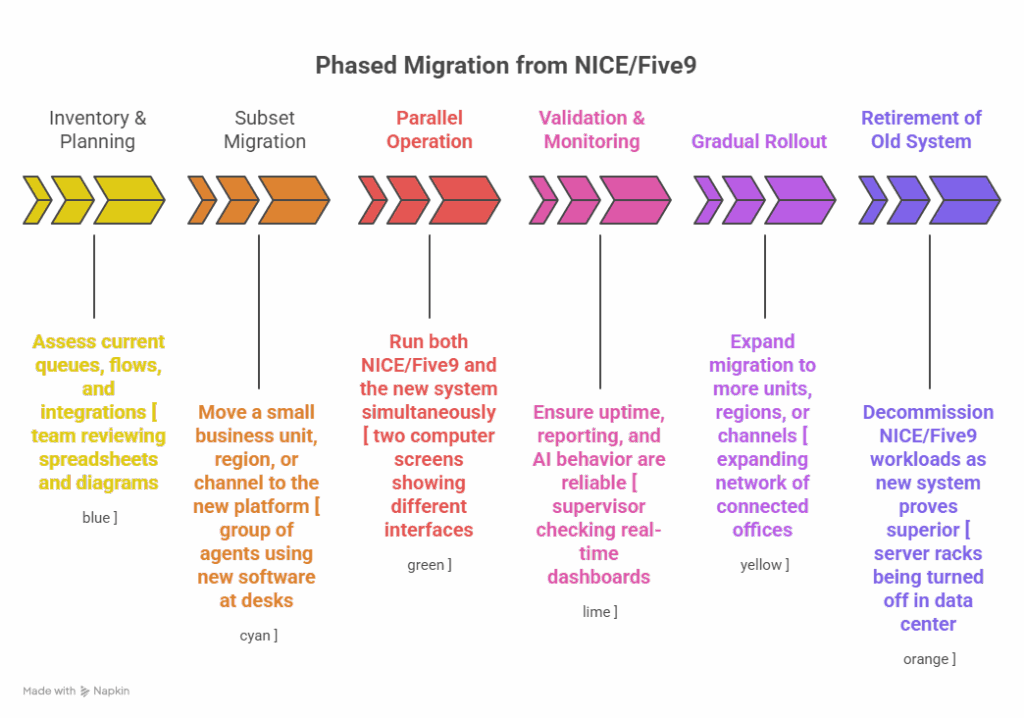
7. FAQs: Choosing AI-Powered Alternatives to NICE / Five9 (2025 Edition)
Do AI-first alternatives really beat NICE / Five9 on reliability?
Reliability used to be the main argument for sticking with large incumbents. In 2025, that’s no longer true by default. Many AI-first platforms are built on hardened VoIP backbones, redundant carriers, and architectures similar to zero-downtime call systems. The difference typically isn’t “Will it stay up?” but “How quickly can we change things without breaking it?” If a newer platform can match uptime and give you faster iteration, it’s a net upgrade.
Where do NICE and Five9 still win against newer AI alternatives?
NICE and Five9 remain strong in very large, complex enterprises with deep legacy integrations and long-standing relationships. Their ecosystems, partner networks, and compliance track records are proven. If your operation spans tens of thousands of seats and relies on highly customized workflows built over many years, incumbents may still be the safest choice. Even then, some teams run hybrid stacks, bringing in more agile platforms for new lines of business while maintaining core workloads on the existing systems, similar to the way PBX migrations are staged in cost-cutting telephony setups.
How should we measure whether an AI alternative is delivering real value?
Ignore generic “AI usage” stats and focus on fundamentals: average handle time, first-contact resolution, transfers per contact, QA coverage, and revenue or retention per agent hour. These are the same metrics emphasized in efficiency benchmark frameworks. If those numbers don’t improve materially within 6–12 months, the platform is not earning its keep—regardless of how slick the AI demos look.
What role does CRM integration play when replacing NICE / Five9?
CRM integration is non-negotiable. Your AI, routing, and analytics only become truly powerful when they can see customer history, open tickets, and deal stages in real time. Look for alternatives that offer deep, native integrations into your core systems, similar to patterns used in Salesforce-native call center solutions. If a platform treats CRM integration as a basic connector rather than a first-class design constraint, it will hit the same walls you already know.
Is it realistic to expect AI to reduce headcount, or just avoid future hiring?
Most realistic teams use AI to avoid future hiring, not to slash current headcount overnight. By trimming handle time, improving QA coverage, and boosting first-contact resolution, you grow volume without growing seats at the same rate. Over 18–24 months, this compounds into meaningful savings that look a lot like the projections in labor cost optimization models. If a vendor promises immediate headcount cuts, be skeptical—sustainable gains usually show up as “doing more with the same team,” then hiring slower as the business scales.
The takeaway: you don’t need to be “angry” at NICE or Five9 to explore alternatives. But if your roadmap is full of change requests that never quite ship, if your QA team is drowning in audio, and if supervisors are begging for more control, an AI-first, integration-heavy, telephony-strong alternative isn’t a luxury anymore—it’s how you keep your contact center from becoming the slowest part of your business.