

Saudi Arabia is full of people who wake up thinking, “How do I build something big enough to ride Vision 2030, but lean enough to start this year?” A call center sits in that zone: recurring revenue, contracts with banks, airlines, and e-commerce players, and a workforce that already speaks Arabic, English, Urdu, Hindi, and Filipino. Where most founders get stuck is not the idea—it’s turning “let’s launch a center in Riyadh or Jeddah” into a licensed, data-safe, always-on operation that can pass vendor due diligence from day one. This guide walks you through designing, licensing, staffing, and wiring a Saudi call center that feels enterprise-grade from the first live call, without overcomplicating your stack or blowing your margins.
1. Decide What “Saudi Call Center” Actually Means For You
“Call center in Saudi Arabia” can mean very different things: a 10-seat outbound sales squad in Riyadh selling SaaS to the GCC, a 60-seat Arabic CX hub in Jeddah handling banks and insurers, or a fully remote team spread across Riyadh, Dammam, and smaller cities. Before you talk to regulators or telcos, write a one-page model. Are you building a BPO that sells seats to clients, or an in-house support center for your own product? Are calls mostly inbound service, outbound prospecting, collections, or blended? Your answers decide whether your cloud contact center stack should be optimised for first-contact resolution, conversion rate, or hard compliance.
Then define geography and hours. A Saudi call center that promises 24/7 coverage for US and EU clients needs shift design, leadership coverage, and routing that look nothing like a 9–6 Gulf-only shop. Decide whether you’ll lean into KSA’s time zone to serve Europe, North Africa, and Asia on the same day, or specialise in night-shift US coverage. These choices drive hiring pools, salary bands, and how aggressively you will lean on automation and AI to protect SLAs.
2. Choose Your Saudi Market Segment and Value Proposition
Saudi buyers don’t hire “a call center”; they hire a very specific operating capability. Broadly, you’re choosing between three lanes: (1) local enterprises with Arabic-first customers (banks, telcos, airlines, government-linked entities), (2) international brands expanding into KSA and the GCC, and (3) regional or global BPOs that need a Saudi footprint. If you’re targeting regulated local giants, your pitch leans on Arabic IVR, call recording controls, and reliability similar to what’s expected in high-compliance markets. If you’re courting global SaaS and e-commerce, you emphasise multilingual coverage, fast pilots, and deep integrations—not just “cheap seats.”
Turn positioning into 2–3 concrete offers, not a vague rate card. For example: a 12-seat Arabic/English inbound CX pod for Saudi fintech, a 25-seat blended sales and success team for B2B SaaS, and a flexible shared-services pod for startups. Each package defines languages, channels, coverage hours, and SLAs. Price against measurable business outcomes instead of treating yourself like commodity capacity, similar to how mature operations wrap their technology and routing into ROI-focused feature bundles.
3. Licensing, Regulation, and Data Residency
In Saudi, your legal and regulatory foundations are not a box-ticking exercise—they determine which clients you can even pitch. Decide your legal form and where you’ll base operations: a Riyadh headquarters with possible satellite sites in Jeddah or Dammam is common. Align your licensed activities with what you actually do: customer support, telesales, collections, technical helpdesk. If invoices, contracts, and regulatory filings describe different realities, your vendor risk questionnaires will become painful.
Data residency is now a front-page topic in every enterprise RFP. Map exactly what personal data you touch: phone numbers, emails, addresses, transaction IDs, notes, and call recordings. Decide which data must stay in-Kingdom versus what can live in regional clouds. Build your technology choices around that map so you can show clients an architecture closer to data-safe deployments than to legacy black boxes. Document retention and deletion rules by campaign—consumer finance recordings should not be managed like e-commerce returns calls.
4. Sites, Telephony, and Network Architecture for KSA
Saudi gives you three levers: major hubs (Riyadh, Jeddah, Dammam), emerging cities with lower costs, and remote talent across the Kingdom. Decide where leadership, training, and complex programs will sit, versus simpler or seasonal work. Many operators centralise complex, regulated campaigns in a primary city while running simpler tasks from distributed agents, using a multi-site model similar to how multi-office VoIP environments are built globally. Whatever you choose, design one operating model—not three conflicting ones.
On telephony, avoid stitching together a legacy PBX, random SIP trunks, and local numbers per client. Start with a carrier-agnostic cloud platform that can host Saudi and international numbers, support elastic channels, and fail over between providers when Internet routes wobble. Prioritise latency, jitter, and packet loss monitoring so voice quality stays consistent during peaks, borrowing from the principles behind zero-downtime architectures. Design IVRs with Arabic-first menus, English options, and clear paths for VIP, complaints, and high-risk calls.
5. Platform, Integrations, and AI for Saudi Operations
By the time your first enterprise prospect sends over a due diligence questionnaire, they’ll expect more than “we have phones and a CRM.” You need an operating spine: a cloud contact center platform, CRM, ticketing, WFM, and analytics all working together. Map your systems—Salesforce, Dynamics, HubSpot, custom CRMs, payment gateways—and choose a platform that offers deep native integrations or robust APIs, similar to the integration-heavy setups documented in high-value integration guides. The aim is to kill “swivel chair” work where agents retype information across tools.
Once the basics are wired, bring in AI with discipline. Start with real-time agent assist that suggests answers, surfaces policies, and flags next-best actions on complex Arabic and English calls, echoing the design of live coaching engines. Add post-call summaries and automatic tagging so every conversation feeds your reporting. For QA, use AI to score and prioritise calls so human analysts focus on high-risk and high-value interactions, mirroring AI-led quality programs. Document clearly where AI is used, how data is handled, and how humans override it—Saudi enterprises will ask.
6. Workforce, Culture, and Language Design
Saudi’s strength is its multilingual, multicultural talent—Saudi nationals and expatriates who already understand GCC customer expectations. Use that deliberately. Build specific hiring pipelines for Arabic/English bilinguals, technical support agents, collectors, and sales closers. Make role expectations explicit: who handles VIP calls, who works night shifts, who deals with escalations. Senior agents and subject-matter experts should earn more but also take the calls that carry revenue or regulatory risk, similar to how revenue-focused teams structure high-yield dialer pods.
Culture matters as much as skills. Saudi campaigns often include sensitive conversations—financial hardship, complaints about public services, family travel issues. Train agents not just on scripts but on empathy, de-escalation, and culturally appropriate language. Use anonymised call recordings to build libraries of “golden” and “red flag” conversations for each account. Back this with side-by-side coaching, whisper, and barge capabilities so supervisors can intervene in real time, augmented by cost-focused AI tools like labor-saving coaching assistants.
7. Economics, Pricing, and Margin Protection in KSA
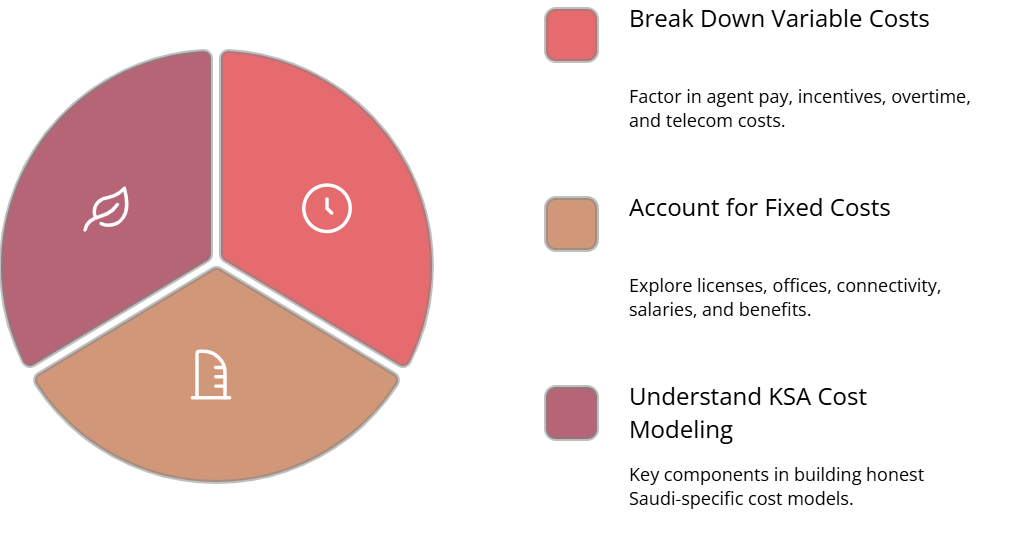
A Saudi call center can look impressive—new office, screens everywhere—and still lose money on every seat. Start with a brutally honest cost model: licenses, office (if not remote), connectivity, platform fees, leadership salaries, and benefits. Add variable costs: agent pay, incentives, overtime, and telecom. Model occupancy at 70–80%, shrinkage at 10–15%, and real attrition. Sanity-check your model against how cost-conscious operations design lean voice architectures so you don’t underestimate infrastructure.
On pricing, combine predictability and performance. Your base per-seat or per-hour rate should comfortably cover costs and a healthy margin; performance components (conversion bonuses, retention fees, collections recovery) should sit on top, not replace it. Resist the temptation to undercut offshore competitors purely on price—Saudi’s value lies in Arabic coverage, proximity, regulatory comfort, and ability to host sensitive workloads, similar to how vertical-focused operations justify premium positioning. Protect margins by avoiding one-off, highly bespoke demands from tiny clients that force you to change your whole stack.
8. 90-Day Execution Roadmap for a Saudi Call Center
Days 1–30: Design and Foundations. Finalise your target segments, campaigns, and locations. Incorporate the company and align commercial activities with what you’ll actually deliver. Build your data map and draft privacy and security policies. Shortlist cloud telephony and contact center platforms that can support Saudi numbers, in-country or regional hosting, and robust SLAs, similar to the reliability expectations in downtime-resistant deployments. Sketch your initial routing design on paper before touching a console.
Days 31–60: Stack, Flows, and First Hires. Sign with your chosen platform and carriers. Configure IVRs, queues, skills, recording rules, and standard reports. Integrate your telephony with CRM and ticketing so agents work from one surface, taking cues from Salesforce-integrated voice environments. Hire your first team lead and small pilot cohort. Run intense bootcamps that blend product knowledge, system navigation, and real Saudi customer scenarios. Internally test routing, QA workflows, and AI assist before you go live.
Days 61–90: Pilot, Prove, and Optimise. Launch a controlled pilot with one client or one internal line of business. Track service level, AHT, abandonment, FCR, CSAT, and revenue per contact daily. Introduce bounded AI features—summaries, tagging, limited agent assist—with clear documentation. Use predictive-style thinking from advanced dialing playbooks to optimise outbound workloads, even if you’re not yet running full auto dialers. Stress-test incident runbooks for outages, data queries, and complaint escalations. By day 90, you should have real numbers, real recordings, and a credible scale-up story.
9. Risk Management and Common Failure Patterns in Saudi
Most Saudi call centers don’t fail because of technology; they fail because of misalignment and weak governance. Common patterns: signing every client that knocks, then running wildly different programs in one generic queue; promising 24/7 coverage without workforce management; or wiring auto dialers and WhatsApp campaigns without compliance guardrails. Learn from how mature operations frame modern dialer compliance even in strict markets—those principles apply to outbound voice and messaging into the Kingdom and beyond.
Another failure mode is thin reporting. If your QBR deck is just SLA and AHT charts, you’re easy to replace. Saudi enterprises expect a narrative: how routing changes improved complaint resolution, how AI-assisted coaching lifted first-call resolution, how your stack now resembles future-ready SIP-to-AI telephony models rather than legacy on-prem PBX. Internally, build a culture where agents, WFM, and QA can escalate issues early—and where leadership is willing to say “no” to misaligned work that would break your operation.
10. FAQs — Saudi Call Center Setup 2025–2026
Designed this way, a Saudi call center stops being “just another vendor” and becomes a strategic operating system for customer conversations—rooted in local strengths, wired with modern cloud and AI, and ready to grow alongside the Kingdom’s broader transformation through 2025–2026 and beyond.