

The Philippines is full of people who wake up thinking, “If BPOs built this economy, why not build one of my own?” A call center is still the fastest way to plug into global demand: US, UK, ANZ, and Asian brands already understand Philippine talent, accent profile, and time zone. Where most founders fail is not the dream—it’s translating “let’s start a BPO” into a licensed, SLA-hitting, data-safe operation that feels enterprise-grade from day one. This guide walks you through designing, licensing, staffing, and wiring a Philippines call center that can win serious campaigns, not just leftover overflow, without overcomplicating your stack or burning your margins.
1. Define Your BPO Model: What “Philippines Call Center” Really Means
“Call center in the Philippines” can mean a five-seat founder-led team in Davao doing outbound demos, a 200-seat CX hub in Manila handling tier-1 support, or a fully remote squad spread across Cebu, Iloilo, and Pampanga. Before you touch landlords or telcos, write a one-page model. Are you building a classic voice BPO, a CX specialist shop, a sales engine, or an internal support center for your own product? Are you optimising for volume, complex troubleshooting, or high-value sales? The answers decide how you architect your cloud contact center stack, which KPIs matter, and what kind of clients you should chase.
Next, decide your campaign mix and channel strategy. Will you stay voice-only, or add email, chat, and messaging from day one? Will you run pure inbound, outbound, or blended? A US healthcare support line demands different hiring, training, and QA from a UK e-commerce returns desk. Many successful BPOs start with one clear hero use case, then expand once they’ve proven they can hit SLAs and keep auditors happy—similar to how specialised teams first nail one Philippines-optimised SLA pattern before adding more complexity.
2. Positioning: Competing Beyond “Cheap Seats”
The era of “we’re cheaper than everyone else” is over. You’re competing with established Philippine BPOs and growing talent pools in India, Vietnam, and Eastern Europe. To win serious programs, you need a position sharper than “good English.” You might lean on vertical focus (e-commerce, SaaS, healthcare, fintech), channel expertise (voice + chat + social), or operational maturity (deep reporting, strong QA, AI-assisted coaching). Buyers are increasingly looking for partners whose operating playbooks look like modern ROI-ranked feature sets, not just basic telephony.
Turn that positioning into three concrete offers, not a generic rate card. For example: (1) a 15-seat “launch pod” for SaaS onboarding and support, (2) a 40-seat dedicated e-commerce CX squad with multilingual capabilities, and (3) a blended revenue team that does renewals, win-backs, and soft collections. Each offer should define languages, channels, hours, SLAs, and which outcomes you will be judged on. When your packages are that clear, you can confidently plug them into modern churn-prevention playbooks clients already use internally.
3. Legal, Regulatory, and Data-Privacy Foundations
Incorporation is the easy part. What separates amateur BPOs from serious players is how early they treat compliance as a design constraint, not a post-launch patch. Decide whether you’ll pursue incentives and infrastructure in special zones or operate in the wider market. Either way, align your business purpose, contracts, and invoices—customer support, helpdesk, inside sales, collections—so regulators, banks, and clients all see the same story. When larger firms compare you with providers in heavily regulated markets, consistency becomes an asset.
Data privacy is non-negotiable. Map what personal data you handle: phone numbers, emails, addresses, payment tokens, notes, and recordings. Define retention periods and destruction rules by campaign type. Implement role-based access so only authorised roles can download recordings or export data. Make sure your contracts specify who is the data controller and who is the processor. When you later add AI, you’ll be grateful you designed a data map that looks compatible with AI-first QA and analytics, not something you have to rip apart.
4. Locations, Telephony, and Network Design
The Philippines gives you three main levers: Metro Manila’s depth of talent and infrastructure, Cebu’s growing BPO ecosystem, and secondary cities with lower wages and less saturation. Decide where leadership, training, and complex programs will sit versus simpler or lower-cost work. Many operators centralise high-skill work in Manila and run simpler voice tasks from satellite teams, similar to how global companies design multi-office VoIP environments. Whatever mix you choose, design a single operating model—not three disconnected mini-call centers.
On telephony, avoid building a Frankenstein of legacy PBXs and one-off SIP trunks. Start from a cloud platform that can host US, UK, ANZ, and local numbers, support elastic channels, and maintain quality even when internet routes fluctuate. Prioritise latency, jitter monitoring, and automatic failover between carriers or regions, mirroring the design principles behind zero-downtime architectures. Configure IVRs in American English, neutral English, and any client-required languages, with clear queues by campaign and skill.
5. Platform, Integrations, and AI: Your Operating Spine
A Philippines call center is ultimately an integration challenge. Agents need one surface that brings together CRM records, order history, ticket status, and call controls. Start by mapping your core systems: Salesforce, HubSpot, Zendesk, custom CRMs, billing, and your telephony stack. Choose a platform that offers deep native integrations or robust APIs, the way sophisticated teams plug dozens of tools into integration-heavy contact center setups. The goal is to eliminate “swivel chair” work—copying notes between systems after every call—because that’s where AHT, error rates, and burnout quietly climb.
Once the basics are wired, layer AI thoughtfully. Start with real-time agent assist that suggests answers, surfaces knowledge, and highlights next-best actions for complex calls, drawing on the same philosophy as live coaching engines. Add post-call summaries and automatic tagging so every conversation enriches your data. For QA, use AI to score and flag calls so human analysts focus on the highest-risk or highest-value interactions, similar to AI-centric QA programs. Define guardrails: which calls AI can label, who can override, and how you handle edge cases.
6. Workforce, Training, and Operational Cadence
The Philippines’ advantage is not just accent; it’s cultural compatibility with Western customers plus deep BPO experience. Use that intentionally. Build hiring funnels for voice specialists, chat-savvy agents, and high-empathy retention roles. Make language and complexity expectations clear per campaign. Senior agents, subject-matter experts, and high performers should earn more—but they should also handle the calls that drive revenue or risk, similar to how revenue-focused teams structure dialer-driven sales pods.
Training should be designed like a product, not a quick classroom. Combine systems navigation, communication frameworks, and client-specific scenarios. Use anonymised recordings to create libraries of “golden calls” and “red flag calls” for each account. Layer in side-by-side coaching, whisper, and barge capabilities so supervisors can intervene in real time, echoing the workflows used in AI-augmented coaching stacks. Lock this into an operational cadence: daily huddles, weekly one-on-ones, monthly calibration, and quarterly program reviews.
Workforce management is where many new BPOs quietly bleed money. Build a basic but real WFM discipline: shrinkage tracking, forecast vs. actual, and schedule adherence. For outbound, coordinate dialer pacing, list management, and agent availability the way advanced teams orchestrate predictive dialing strategies. For inbound, plan for peaks around holidays, marketing campaigns, and product launches, not just average days.
7. Economics, Pricing, and Margin Protection
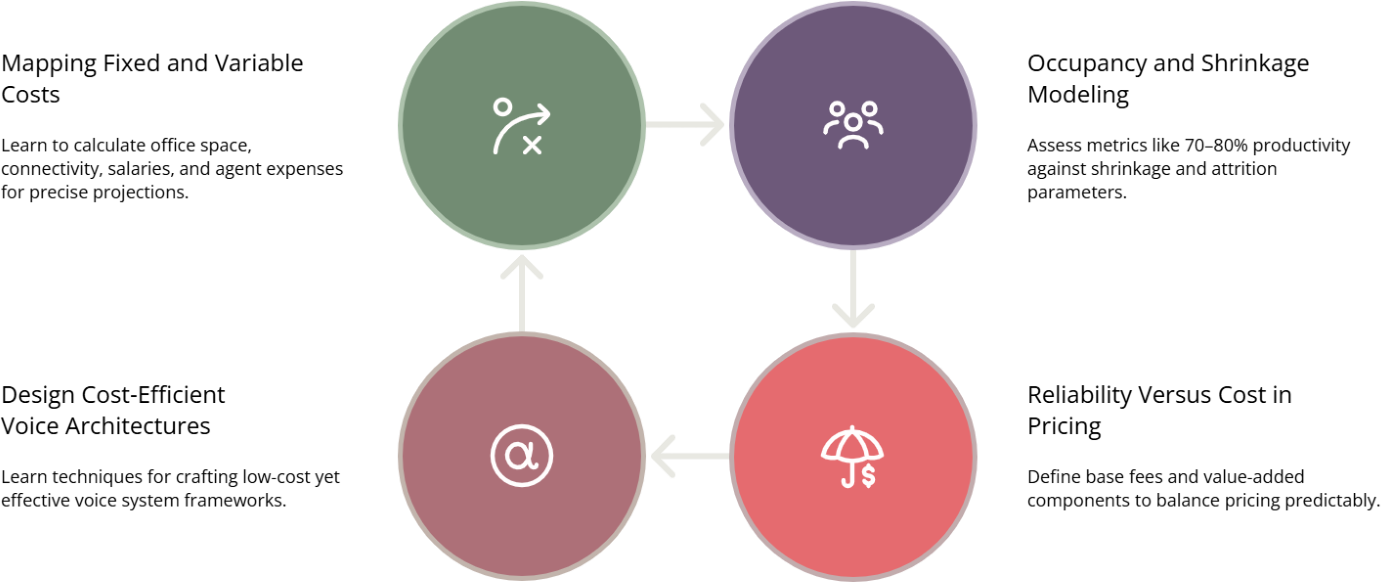
A Philippines call center can look busy and still lose money on every seat if your assumptions are wrong. Start by mapping fixed costs—office or co-working space (if on-site), connectivity, platform licenses, leadership salaries—then layer variable costs: agent pay, benefits, performance incentives, and telecom. Model occupancy at 70–80%, shrinkage at 10–15%, and attrition realistically. Cross-check your model against how efficiency-focused teams design cost-cutting voice architectures so you’re not guessing.
On pricing, mix predictability and performance. A base per-seat or per-hour rate should comfortably cover your costs and target margin. On top, add outcome-based fees for conversions, retention saves, collections recovery, or upsells where you truly move the needle. Avoid racing to the bottom against the cheapest global vendors; instead, position yourselves as the partner who can handle complex programs, integrate deeply, and deliver reliable outcomes—closer to enterprise-ready US stacks than a generic voice shop.
Protect margins with discipline: don’t sign bespoke deals that require entirely new tools for a single small client; watch scope creep; revisit seat plans quarterly. Use your dashboards not just to prove value to clients but to spot where your own economics are drifting, leaning on granular views similar to multi-country telephony analytics.
8. 90-Day BPO-Ready Execution Plan
Days 1–30: Model and Foundations. Finalise your target verticals, regions, and campaign types. Incorporate the company and align activity descriptions with what you actually sell. Design your data map and draft privacy and security policies. Shortlist platforms with strong routing, reporting, and integration options, similar to what you’d expect in downtime-resistant deployments. Sketch your telephony architecture: which countries you’ll support, which carriers you’ll use, and how you’ll fail over.
Days 31–60: Stack, Flows, and First Hires. Sign with your chosen telephony and platform partners. Configure IVRs, queues, skills, recording rules, and basic reports. Integrate CRM and helpdesk so agents can work from one surface, mirroring patterns in Salesforce-integrated call center designs. Hire your first team lead and a small pilot cohort. Run intensive bootcamps that combine product knowledge, systems practice, and scenario drills. Internally test routing, reporting, AI assist, and QA workflows before touching a single customer.
Days 61–90: Pilot and Optimise. Launch a controlled pilot with one client or one internal process. Track SLAs, AHT, abandonment, CSAT, schedule adherence, and revenue metrics daily. Introduce bounded AI features—summaries, tagging, limited agent assist—using governance similar to the frameworks behind revenue-ranked automation playbooks. Run structured incident simulations (outages, data questions, angry clients) to test your runbooks. At day 90, you should be able to show prospects a functioning operation, credible numbers, and an expansion plan.
9. Risk Management and Common Failure Patterns
Most new Philippine call centers don’t die from technology; they die from misaligned programs and weak governance. Common patterns: signing clients with wildly different needs and trying to serve them from one generic queue; promising 24/7 without a workforce plan; or turning on an auto dialer without compliance guardrails. Learn from how mature teams design modern dialer compliance regimes even when calling into strict markets—those principles apply to voice, chat, and messaging too.
Another failure mode: shallow reporting and weak communication. If your QBRs are just “here’s your SLA chart,” you’re replaceable. Build narratives that connect operational changes to business outcomes, drawing inspiration from vertical-specific use-case libraries. Internally, create a culture where issues surface early—agents can flag broken flows, WFM can call out unrealistic promises, and QA can say “this script fails customers” without fear.
Finally, treat AI as a lever, not a magic trick. Tools that compress handle time, automate QA, and triage conversations can protect margins and uplift quality if they’re tied to clear use cases, similar to the way AI-powered sales engines reframe outbound dialing. Unbounded experimentation, on the other hand, can spook clients and confuse agents.
10. FAQs — BPO-Ready Call Centers in the Philippines
Built with this level of intent, a Philippines call center stops being “just another BPO” and becomes a durable operating system for global customer conversations—one that can scale, adapt, and keep winning quality work well beyond 2025–2026.