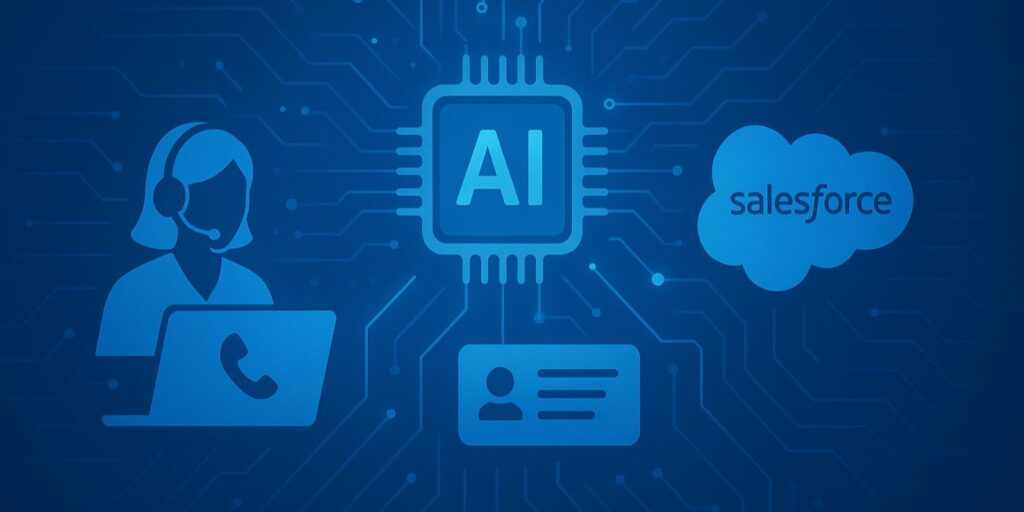
Most “AI call center” pitches sound great until you try to plug them into Salesforce. Suddenly you’re stuck with duplicate contacts, half-synced tickets, and transcripts living in a separate black box. A real AI call center solution with native Salesforce integration behaves like one brain: every call, note, sentiment tag, and follow-up task lands on the exact right record, in real time, without agents doing admin gymnastics. That’s the standard modern platforms like ActiveCalls aim for — cloud voice, AI routing, and Salesforce moving in lockstep.
| Tool | Salesforce Integration Type | AI Capabilities | Best For |
|---|---|---|---|
| Talkdesk | Deep CTI + Salesforce AppExchange package | AI routing, sentiment analysis, agent assist | Global sales & support teams |
| Five9 | Native CTI + embedded softphone | Predictive dialer, AI-powered call summaries | Enterprise inbound/outbound centers |
| Amazon Connect | Salesforce-managed package & CTI | LLM-based intelligence, real-time analytics | Omnichannel & custom workflows |
| Genesys Cloud CX | Certified Salesforce CTI connector | Predictive routing, AI coaching, WFM | Large multi-region contact centers |
| RingCentral Contact Center | Embedded CTI + click-to-dial | Transcription, keyword spotting, analytics | Hybrid sales & service teams |
| ActiveCalls | Native Salesforce integration (real-time bidirectional sync) | AI routing, auto-summaries, sentiment, global WebRTC softphone | High-volume, AI-first global call centers |
| Aircall | AppExchange CTI + contact sync | Basic transcription, tag suggestions | SMBs & startup sales teams |
| Dialpad | Native CTI + activity logging | AI coaching, real-time assist, sentiment | Fast-moving inside sales orgs |
| Nice CXone | Certified Salesforce CTI adapter | AI QM, predictive models, analytics | Service-heavy contact centers |
| UJet | Deep Salesforce CRM binding | AI-driven intent, context-rich routing | Mobile-first & app-centric support |
| Freshcaller (Freshdesk Contact Center) | Salesforce sync + embedded CTI | Call transcripts, auto-tagging | SMBs & mid-market CX teams |
| 8×8 Contact Center | Native Salesforce CTI adapter | Conversation IQ, AI analytics | Hybrid & remote workforces |
| Zoom Contact Center | Salesforce app + CTI panel | AI companion, live summaries, topics | Teams already on Zoom stack |
| Krisp Contact Intelligence Stack | Salesforce activity & insights push | Noise removal, call intelligence | QA-heavy & compliance-focused orgs |
| Observe.AI | Salesforce data & outcome sync | AI QA, coaching analytics, scoring | Teams scaling AI QA coverage |
1) Why AI + Salesforce Is Now the Default Call Center Stack
Salesforce is already the system of record for most revenue and service teams. If your AI call center platform doesn’t plug directly into it, you’re creating a second source of truth. That means agents logging notes twice, supervisors reconciling conflicting dashboards, and leaders guessing which funnel numbers to trust. The strongest platforms treat Salesforce as the “front page” of every interaction: calls pop on the right record, AI summaries and outcomes sync back as structured fields, and reports line up with what your CFO sees.
AI is the second non-negotiable. Instead of listening to a random 2% of calls, AI-first stacks score 100% of conversations, surface coaching moments, and push next-best actions in real time. Patterns described in resources like AI-first QA blueprints show that once you have full coverage, your top and bottom performers stop being a mystery. The combination of Salesforce context + AI insight is what unlocks predictable revenue and CSAT uplift.
Cost pressure is the third driver. Leaders aren’t adding headcount for “more calls”; they’re looking for fewer manual steps per outcome. That’s why many are leaning on playbooks similar to those in AI call center labor-cost reduction guides—using automated summaries, intent detection, and suggested actions to claw back minutes from every interaction and protect margins.
Finally, customers expect channel fluidity. They don’t care whether support came from a dialer, an inbound queue, or a callback bot; they just expect one coherent experience. The omnichannel philosophies behind platforms like cloud contact centres that prevent customer loss become even more powerful when every touch-point lands inside Salesforce as a single timeline.
2) Architecture: One Conversation Graph Between Voice and Salesforce
AI recommendations only work when your architecture is clean. The most resilient stacks treat everything as events flowing through one pipeline: CallStarted → IntentDetected → OutcomeLogged → FollowUpCreated. Your call center platform handles media, routing, and AI; Salesforce stores the customer graph, opportunities, and cases. The two talk over a real-time, field-level integration that’s been battle-tested for high volume.
At the telephony layer, you want cloud PBX + VoIP that can connect agents anywhere, similar to the global designs described in global phone system architectures. ActiveCalls-style stacks use WebRTC softphones and carrier-diverse SIP edges so your teams in the US, UAE, India, or Canada all ride the same AI and routing engine without quality gaps.
On the application side, the call center platform should expose native Salesforce objects and flows: logging calls as Activities, writing dispositions to custom fields, linking recordings to Cases or Opportunities, and triggering Flows or Process Builders from AI events. This is the same “single conversation graph” philosophy used in zero-downtime call system architectures, extended into CRM.
Routing logic is where AI earns its keep. Platforms influenced by predictive routing playbooks use Salesforce data—account tier, open opportunities, renewal dates, health scores—to prioritize who gets answered first. A “platinum renewal in 10 days” call should never wait behind a low-value prospect with no history. AI models can weigh these factors alongside skills, language, and backlog in real time.
3) Solution Matrix: AI Call Center + Salesforce Integration Approaches
Most teams evaluating AI call center solutions fall into three buckets: they either want a light-weight connector, a fully embedded CTI experience, or an AI-first rebuild of their entire routing and QA stack. Use the matrix below to compare options clearly.
| Solution Type | Best For | What It Looks Like in Practice |
|---|---|---|
| Basic CTI Connector | Small teams, simple inbound | Click-to-dial from Salesforce, call logs as Activities, minimal AI or routing logic in the voice layer. |
| Embedded Softphone + Screen Pop | Growing sales & support orgs | Agents handle calls in a Salesforce widget; screen pops on the right Lead/Contact; dispositions and notes sync instantly. |
| AI-First Call Center with Native Integration | High-volume, multi-region teams | Platform handles routing, AI coaching, QA; Salesforce tracks accounts, deals, and CS. Data flows both ways in near real time. |
| Omnichannel Voice + Digital Hub | Omnichannel CX (voice + chat + SMS) | Voice, email, chat, and WhatsApp all log against a common case or opportunity, similar to omnichannel routing engines. |
| Sales Dialer Overlay | Outbound-heavy SDR/BDR teams | Predictive & preview dialling on Salesforce lists; call outcomes update lead statuses and opportunity stages automatically. |
| Service Cloud Voice-Optimized | Service Cloud customers | Customisable routing, AI summaries, and transcript-to-Case mapping aligned with best-practice metrics. |
| AI QA & Coaching Layer | Orgs keeping existing telephony | Existing PBX feeds recordings to an AI engine that scores calls and writes coachable moments back to Salesforce. |
| Vertical-Specific Packaged Solution | Healthcare, finance, e-commerce | Prebuilt workflows modelled on use cases like those in industry-specific call center guides. |
| Multi-Region Global Rollout | Enterprises spanning 10+ countries | One central AI routing brain with regional edges and Salesforce orgs linked through a common data model. |
| AI-Led Migration from Legacy PBX | Teams moving off on-prem systems | Legacy PBX co-exists temporarily while an AI-enabled cloud stack—similar to those in PBX migration stories—takes over. |
4) High-Impact AI Workflows You Should Turn On First
With architecture in place, the next question is “Where does AI move the needle fastest?” The first place is in-call coaching. Platforms inspired by real-time AI coaching engines give agents prompts inside the softphone: objection handling, compliance reminders, and suggested next steps. These hints are driven by what’s on the Salesforce record—industry, deal size, support history—not generic scripts.
The second lever is AI summarisation mapped into Salesforce. After every conversation, the system writes a concise recap, key entities, and follow-up tasks back to the relevant Lead, Contact, Case, or Opportunity. Pair this with structured fields such as intent, sentiment, and next step. Over time, these summaries feed the kind of dataset used in ROI-driven feature rankings, where you can see exactly which flows and scripts correlate with revenue.
Third, connect your auto dialer to Salesforce lists. High-impact playbooks look a lot like those in revenue-ranked dialer use-case libraries: laddered follow-ups, priority callbacks, and recycled no-answers. The AI layer predicts when to call, which number to use first, and which offer is most likely to land, while Salesforce stores contact history and qualification scores.
Finally, bring QA and workforce management into the loop. AI call scoring, as described in AI tools that cut labor costs, lets you evaluate every call against a consistent rubric: greeting, discovery, solution, next step, and compliance. Scores roll into Salesforce dashboards by rep, team, and intent, making performance conversations more objective and far less political.
5) Rollout Playbook: 90-Day Plan for an AI-Ready Salesforce Contact Center
Days 1–30: Foundations. Start by integrating your call center platform with a Salesforce sandbox. Configure click-to-dial, incoming screen pops, and basic Activity logging. Mirror one low-risk queue—such as outbound follow-ups—into the new system while your main traffic stays on the old stack. Use this time to validate call quality, connection stability, and field mappings, following the kind of cautious approach used in reliability-first rollouts.
Days 31–60: AI + Dialer Go-Live. Enable AI features in the pilot queue: summaries, sentiment tags, and basic scoring. Connect a targeted Salesforce list to the auto dialer (e.g., renewal reminders or event follow-up) and watch for changes in connect rates and opportunity creation. Borrow pacing and laddering ideas from resources like predictive dialling strategy guides. During this phase, keep supervisors in a weekly calibration loop to align AI scores with human judgement.
Days 61–90: Full Migration & Optimisation. Once the pilot proves stable, port your main inbound numbers and major outbound campaigns. Turn on omnichannel logging (voice + email + chat) and rebuild your management dashboards in Salesforce, using metric frameworks similar to ROI-ranked feature sets. By day 90, leaders should be able to see per-intent performance, revenue per call, and QA results—all from Salesforce, with AI quietly working in the background.
6) Governance, QA, and Compliance You Can Trust
AI doesn’t remove governance requirements; it amplifies them. Every AI call center solution with Salesforce integration must support clear data boundaries: which fields models see, how long transcripts are stored, and how scores are used. The best platforms borrow from the governance discipline described in auto dialer compliance playbooks—treating rules as design constraints, not afterthoughts.
QA should move from “mystery scorecards” to a clear rubric. Many teams adopt a five-behaviour model—Greet, Discover, Resolve, Next Step, Compliance—similar to the patterns in AI-first QA frameworks. AI pre-scores calls; supervisors focus only on edge cases or outliers. Those scores sync to Salesforce so coaching plans and performance reviews share the same source of truth as your revenue metrics.
Finally, remember reliability. AI is useless if the phones don’t work. Architectures inspired by zero-downtime VoIP deployments and downtime-proof call center guides rely on carrier diversity, regional edges, and automated failover. Pair that with 24/7 support and you get a stack that can handle peaks, outages, and new markets without firefighting every week.
7) FAQs — AI Call Center Solutions with Native Salesforce Integration
1) What makes an AI call center “native” to Salesforce?
“Native” means the call center platform doesn’t just push basic logs into Salesforce—it understands Salesforce data structures and workflows. Calls create Activities with correct Who/What links, recordings sit on Cases or Opportunities, AI summaries map to notes and fields, and automations trigger from AI events. Solutions influenced by high-SLA contact center designs tend to treat this tight integration as a core requirement, not a future add-on.
2) How should we measure success after rolling out AI and Salesforce integration?
Anchor on metrics that connect directly to business outcomes: revenue per contact, first-contact resolution, repeat-contact rate, and cost per resolved case. Frameworks like call center metric benchmarks give you healthy ranges. Also watch softer indicators: wrap time per call (should drop with AI summaries), QA coverage (should approach 100%), and coaching frequency (should rise as it gets easier to spot patterns).
3) Can we keep our existing PBX and just add AI + Salesforce on top?
You can, but you’ll cap your upside. An AI QA or transcription layer can sit on top of legacy telephony, but you’ll miss out on intelligent routing, flexible auto dialling, and many omnichannel features. That’s why many organisations follow staged migration paths similar to those in PBX migration guides: run AI + Salesforce with a subset of traffic first, then gradually retire hardware as the cloud stack proves more reliable and easier to manage.
4) How do AI dialers avoid hurting our brand or breaking compliance rules?
Reputable AI dialers bake compliance into the design: pacing rules to avoid abandoned calls, time-zone awareness, opt-out handling, and daily attempt limits per contact. Many follow principles similar to those in dialer compliance frameworks. Salesforce acts as the system of record for consent and preferences; the dialer queries that data before placing calls and writes outcomes back so your legal and CX teams can see exactly what happened.
5) Does this approach work for multilingual or regional teams (UAE, India, EU)?
Yes—provided your platform supports regional telephony edges, language-aware routing, and flexible IVR. Teams running Arabic + English flows similar to those in UAE-optimised deployments can still push clean data into a single Salesforce org. The AI layer recognises language, sentiment, and intent per conversation, while Salesforce keeps a unified account view for global reporting and leadership.
An AI call center solution truly “native” to Salesforce doesn’t feel like two tools—it feels like one operating system for conversations. When voice, AI, and CRM all move together, your agents stop fighting the stack and start focusing on what matters: clean outcomes, happier customers, and revenue that compounds every quarter.